

[BizHanKook] “Each organoid represents an individual patient.”
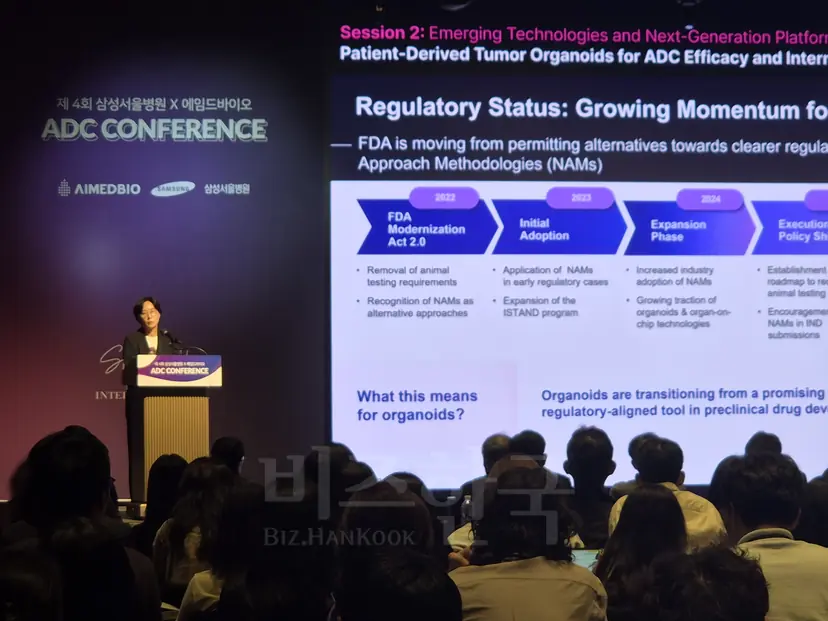
Kim Se-hee, Head of the Organoid Technology Research Group at Samsung Biologics, made this statement at the ‘AimedBio ADC Conference’ held on August 27. She explained that their technology goes beyond simply culturing cancer cells in 3D; it allows for the analysis of a patient’s treatment history alongside their drug responses. This is the core competitive advantage of Samsung Biologics’ organoid business. By combining patient-derived tissues and clinical data obtained from Samsung Medical Center with their proprietary drug evaluation technology, they aim to collaborate with client companies from the very early stages of new drug development.
Samsung Biologics is now looking to expand its business beyond mere candidate screening to include non-clinical pharmacology data services for Investigational New Drug (IND) applications.
A Samsung Biologics official stated, “We are building a service to provide non-clinical pharmacology data for IND submissions to pharmaceutical companies through the standardization and validation of organoid efficacy evaluation methods for anti-cancer drugs,” adding, “Our goal is to reach a level where we can partially replace or omit animal efficacy tests.”
Secured over 350 organoids for lung cancer, colorectal cancer, and more
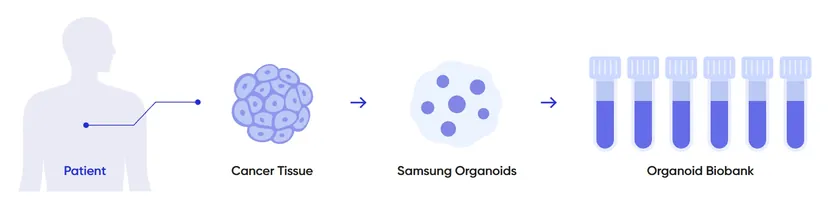
In June of last year, Samsung Biologics launched ‘Samsung Organoid,’ a patient-derived organoid-based drug screening service. Organoids are models that simulate the characteristics of real human tissues by culturing patient tissues in a 3D environment.
In cooperation with Samsung Medical Center, Samsung Biologics has been building a library of patient-derived tumor organoids. According to Kim, as of August, they have secured over 350 organoids across more than 10 types of cancer, with models for lung and colorectal cancer being the most abundant.
The essence of this collaboration lies not just in the scale of the organoids, but in the clinical information linked to them. The process involves analyzing the genomic variations and gene expression levels of each organoid while utilizing the corresponding patient's chemotherapy history, actual treatment response, and information regarding primary vs. metastatic cancer. This enables the analysis of why drug responses to certain candidates vary between patients and can be used to discover biomarkers that predict treatment efficacy.
At the American Association for Cancer Research (AACR) conference this year, Samsung Biologics presented analysis results linking 24 organoids created from the tumor tissues of colorectal cancer patients at Samsung Medical Center with their clinical records. A separately released conference poster showed that the concordance between the organoids’ drug responses and actual clinical treatment outcomes was 82.6%. However, as this result targeted a specific patient group, it does not imply that the same predictive power has been achieved for all types of cancer.
Regarding the point of differentiation from global competitors, a Samsung Biologics official explained, “Our differentiation point is providing an efficacy evaluation service using organoids whose correlation with clinical responses has been verified.”
As the process utilizes patient-derived tissue and clinical data, the management of personal information and specimens is critical. A Samsung Biologics official stated, “We use specimens collected with patient consent, and pseudonymized specimens that have passed IRB and DRB approval, along with minimal clinical and genetic data, are stored in a space isolated from the internet.” However, specific collaboration terms such as research and development, profit sharing, and data rights with Samsung Medical Center were not disclosed, citing confidentiality.
From ADC evaluation to IND documentation… Connecting with existing CDMO business
Samsung Biologics is also applying its technology for analyzing patient-specific drug responses to the evaluation of ADCs (Antibody-Drug Conjugates). An ADC is a therapeutic agent that links a cytotoxic drug to an antibody that binds to a specific antigen on the surface of cancer cells.
Kim explained, “Out of the 9 types of organoids tested, 7 showed no drug response, while significant drug reactivity was observed in only 2 models,” adding, “Analysis of the reactive models revealed that the killing effect was stronger in models with relatively higher target protein expression.”
Integrating patient clinical data with efficacy evaluation technology in this manner also connects with Samsung Biologics’ existing CDMO (Contract Development and Manufacturing Organization) business. This is linked to an ‘early lock-in’ strategy aimed at securing clients from the initial drug candidate evaluation stage and maintaining the partnership through to CDO (Contract Development) and the production of clinical and commercial drugs.
At the conference, Kim also explained that the business portfolio, which started with CMO (Contract Manufacturing), has been expanded to include CDO and, now, the initial efficacy evaluation sector.
In particular, if the company provides non-clinical pharmacology data for IND submissions, the contact point with the client extends from candidate screening to the clinical entry preparation stage. This can be a competitive advantage, reducing the burden on clients who would otherwise have to select separate agencies for each development stage. However, it has not been confirmed if any organoid clients have subsequently signed follow-up development or production contracts.
FDA also expanding non-animal testing… Verification of test methods is key
Another strength Samsung Biologics aims to leverage in the organoid business is the manufacturing and quality management experience accumulated through its existing CDMO operations. Based on its experience in GMP (Good Manufacturing Practice) operations, the company is strengthening its specimen handling and data management capabilities and is also building an organoid testing system that considers GxP standards.
The global regulatory environment is also shifting. The U.S. Food and Drug Administration (FDA) announced a roadmap to reduce animal testing last April, and this September, it released a direct final rule changing the terminology related to animal testing in its regulations to the more comprehensive ‘non-clinical testing.’ Although it is scheduled to go into effect on February 4 of next year, it could be withdrawn if significant adverse comments are received by December 7.
While the FDA’s recent policy focuses primarily on non-clinical testing to evaluate the safety and toxicity of drugs, Samsung Biologics is primarily aiming to replace animal efficacy tests. Although the evaluation purposes differ, they are aligned in their direction of reducing reliance on animal testing and increasing the accuracy of new drug development by utilizing testing models that mimic the human body.
If organoids linked with Samsung Medical Center’s clinical data can be used to predict actual patient drug responses, they could serve as a means to supplement the limitations of existing animal models. However, including organoid data in an IND submission and having regulatory agencies recognize it as a basis to replace existing animal efficacy tests are two different things.
Ultimately, Samsung Biologics’ organoid business is significant in that it is an attempt to expand into the early stages of new drug development by combining patient clinical data from Samsung Medical Center with its own drug evaluation and quality management capabilities. The company’s competitive edge will likely be measured by its ability to prove the reliability of these test methods and connect them to actual IND submissions and follow-up development and production contracts.