

[BizHanKook] S-OIL has officially announced the completion of the "Shaheen Project," a mega-scale petrochemical complex that required a total investment of 9.258 trillion won. Experts suggest that the company’s bold move to shift its business structure from oil refining to petrochemicals has reached a critical milestone. However, at the same time, concerns are being raised within the domestic petrochemical industry—which is fighting for survival by cutting excess capacity ahead of the year-end deadline—that this could turn into a "supply bomb" that dilutes the effectiveness of restructuring efforts.
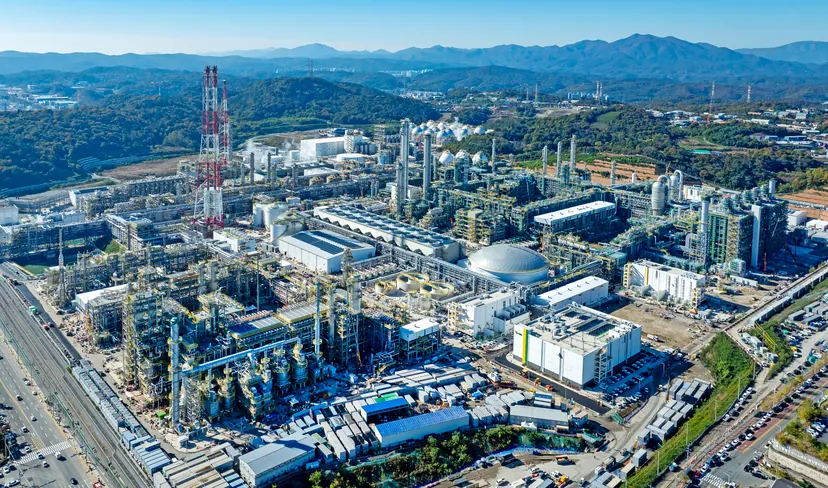
On November 25, S-OIL held a ceremony to commemorate the completion of the Shaheen Project at the Shilla Hotel in Jung-gu, Seoul, in conjunction with its 50th anniversary. The event was attended by approximately 500 government and industry figures from both South Korea and Saudi Arabia, including Minister of Trade, Industry and Energy Kim Jung-kwan and Amin Nasser, President and CEO of Aramco. Located on an approximately 880,000-square-meter site within the Onsan National Industrial Complex in Ulsan, the facility is scheduled to begin commercial operations sequentially starting with the polyethylene (PE) plant next January, followed by the steam cracker (with an annual production capacity of 1.8 million tons of ethylene).
S-OIL Stakes Success on Cost Competitiveness Powered by New TC2C Technology
Through the Shaheen Project, S-OIL plans to significantly expand its profit structure, which has been centered on oil refining, toward petrochemicals. The company aims to more than double the proportion of petrochemicals in its total production from the current 12% to 25%, following over 14 trillion won in cumulative investments over the past decade in Residue Upgrading and Olefin Downstream Complex (RUC/ODC) facilities.
The core weapon touted by the company is the "Thermal Crude to Chemicals (TC2C)" process technology, which is being commercialized for the first time in the world. Unlike conventional Naphtha Cracking Centers (NCC), the company explains that it has achieved cost competitiveness and energy efficiency by shortening the refining stages and directly converting crude oil into petrochemical feedstocks such as naphtha and liquefied petroleum gas (LPG). Anwar Al-Hejazi, CEO of S-OIL, stated, "The Shaheen Project is a long-term investment that we have pursued for years in line with the government's direction for high-tech, high-efficiency facility investment," adding, "We will enhance global competitiveness by strengthening synergies between our oil refining, petrochemical, and lube base oil businesses."
The company also emphasizes the synergy within the supply chain in the Ulsan petrochemical complex. The Shaheen Project will produce 1.8 million tons of ethylene, 770,000 tons of propylene, 200,000 tons of butadiene, and 280,000 tons of benzene annually, along with 1.32 million tons of polyethylene (880,000 tons of LLDPE and 440,000 tons of HDPE). By supplying basic feedstocks directly to downstream raw material companies via an integrated pipeline network within the Ulsan industrial complex, the company expects to reduce import dependency and logistics costs, generating an import substitution effect of approximately $770 million per year.
Offsets 72% of Capacity Reductions in Daesan and Yeosu… Ulsan’s Three-Company Restructuring Negotiations Remain "In the Fog"
However, many point out that behind S-OIL’s rosy blueprint lies a strategy that directly contradicts the "facility reduction and business reorganization" trend that the domestic petrochemical industry is currently struggling to implement. Since signing a voluntary agreement in August 2025, the government and the industry have been accelerating the reduction of excess capacity by approving plans such as "Daesan No. 1" (integration of Lotte Chemical and HD Hyundai Chemical and suspension of operations) and "Yeosu No. 1" (integration of Yeochun NCC and Lotte Chemical, shutdown of two NCC units, and a 1.3-million-ton capacity reduction).
The problem is that once the Shaheen Project becomes operational, it will immediately offset approximately 72% of the capacity reductions (about 2.49 million tons) made in the Daesan and Yeosu industrial complexes. Ethylene production capacity in Ulsan is also expected to surge from the current 1.74 million tons to 3.54 million tons (or 2.88 million tons even if SK Geo Centric closes its 660,000-ton facility), deepening the oversupply. In particular, the PE (1.32 million tons) to be poured out by Shaheen is about 38 times the net increase in domestic PE exports over the past five years (35,000 tons per year), and is seen as a trigger that could pull down domestic PE utilization rates, which have already fallen to the 59% level.
This controversy over equity is directly linked to the delay in business restructuring within the Ulsan industrial complex. Unlike the Daesan and Yeosu complexes, which have launched integrated entities and begun facility shutdowns, negotiations among the three Ulsan-based companies (Daelim Industrial, SK Geo Centric, and S-OIL) are facing difficulties regarding whether to account for the Shaheen expansion. There is significant frustration that if only Shaheen—which is highly likely to run at 100% capacity due to initial economic viability—remains an exception while existing companies give up immediate cash flow to participate in production cuts, it will amount to a "free ride" on restructuring.
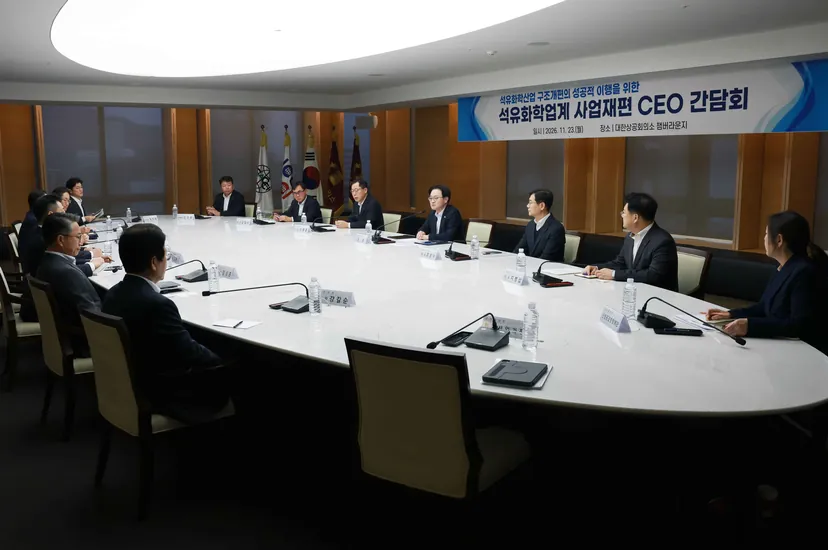
The government is also pressuring for the completion of business restructuring within the year. At a CEO roundtable held at the Korea Chamber of Commerce and Industry in Seoul on November 23—two days before the completion ceremony—Minister Kim Jung-kwan addressed the companies that had not yet presented final plans: "I am well aware that these are complex interests and by no means easy decisions, but all companies must share the responsibility for the future of the entire industry rather than focusing on immediate gains and losses." He urged, "Please finalize the business restructuring discussions within this year so that we do not miss the golden time."
Inside and outside the industry, experts say the Shaheen Project, backed by Aramco’s capital and new process technology, is on trial to see whether it will be a "catalyst" that transforms the nature of the domestic petrochemical market or a "supply bomb" that hinders restructuring. This is because the export market for general-purpose products has already hit a limit due to large-scale capacity expansion in China and the Middle East, along with stricter regulations on single-use plastics in major countries such as the EU.
While the National Assembly passed the "Special Act on Strengthening Competitiveness and Support for the Petrochemical Industry" late last year to encourage a transition to high-value-added specialty products and eco-friendly circular products, critics point out that the operation of large-scale general-purpose facilities could collide with these policy directions.
Jeong Seok-hwan, head of the petrochemical team at Solutions for Our Climate, noted, "Many companies are participating in restructuring by giving up immediate cash flow and exiting competition in general-purpose products. If someone tries to only take the benefits of that adjustment, trust will inevitably be broken." He pointed out, "Even if the TC2C process can lower costs, it does not create demand where there is none. If a large amount of low-cost virgin plastic (new plastic without recycled materials) is released into the market, the industrial transition toward low-carbon, circular products and high-value-added specialty items—which carry price premiums—will lose its footing."