

[BizHanKook] The Air Force has decided on its acquisition strategy for Collaborative Combat Aircraft (CCA), the next-generation autonomous combat drones that will fly alongside manned fighter jets, with specific requirements to be determined starting next year. The acquisition plan follows an "import first, domestic later" principle: the Air Force intends to prioritize procuring U.S.-made CCAs for existing U.S.-made military aircraft, and only after operating these imported CCAs will it establish a methodology to integrate and operate domestic CCAs with domestic fighter jets.
This plan is similar to the past next-generation fighter program, which prioritized the introduction of imported FX-3 fighters over the domestic KF-X project. While it offers the advantage of risk reduction, there are concerns regarding uncertain export potential, weakened competitiveness for domestic fighters, and reduced budgets for domestic CCA procurement, necessitating a more precise strategic direction.
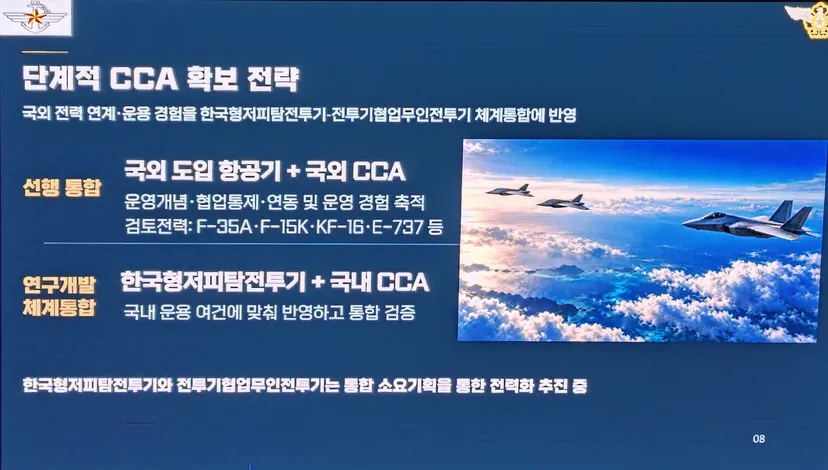
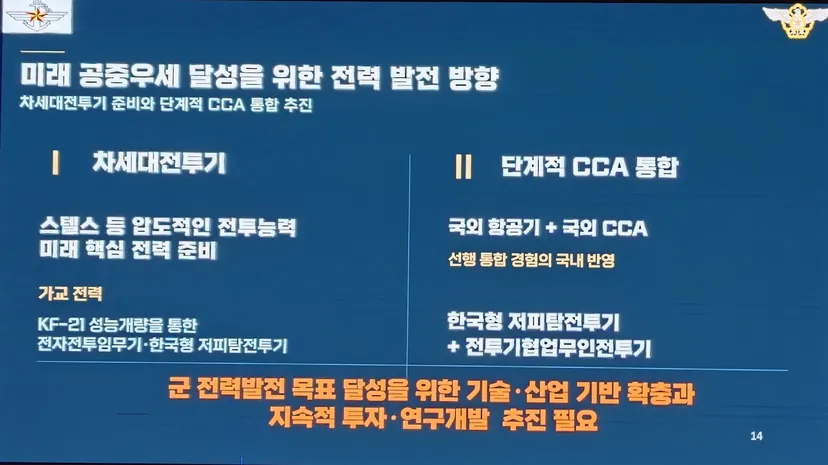
The Air Force unveiled this plan for the first time on the 13th at a special symposium held during the Korea Institute of Military Science and Technology's fall conference. The presenter was the Air Force Headquarters' Manned-Unmanned Teaming Power Division, and the theme was "Development Direction for Korean Next-Generation Fighters and Phased CCA Integration Strategy." According to the presentation materials obtained by this reporter, the logic is to first field CCAs on imported aircraft, establish operational concepts through their use, and then begin the development of domestic CCAs.
The framework for the first phase, where imports come first, is as follows: integrate foreign CCAs into existing assets such as the F-35A, F-15K, KF-16, and E-737 to gain experience in operational concepts and collaborative control. The inclusion of the E-737 is notable. The plan to use an Airborne Early Warning and Control (AEW&C) aircraft as a control node likely considers Boeing Australia's MQ-28 Ghost Bat, which is also seemingly the target for the F-15K. For the KF-16 and F-35, the candidates appear to be focused on the Vectis, currently under development by Lockheed Martin.
In other words, the Air Force's CCA introduction plan is estimated to include not only General Atomics’ FQ-42A Dark Merlin and Anduril’s FQ-44A Fury—which have been confirmed for procurement by the U.S. Air Force—but also other platforms not yet officially adopted by the U.S. military.
After importing CCAs, the second phase involves transitioning to domestic CCAs and acquiring a Korean low-observable fighter. The KF-21EX, which enhances stealth performance through an internal weapons bay, is a potential candidate. The Air Force revealed a plan to integrate this aircraft and domestic CCAs into a single system from the research and development stage through to operational deployment. The same improvement line is also expected to produce electronic warfare mission aircraft that can fly alongside strike packages to jam enemy radar.
The background for "imports first" is understandable. Reports suggest that China has begun operational deployment of the GJ-11 stealth combat drone, in addition to the J-36 and J-50 stealth fighters. In particular, the GJ-11's stealth performance exceeds that of the CCAs currently being produced by the U.S., posing a tangible threat.
The Air Force also plans to share know-how regarding CCA operations with the U.S. On the 22nd of last month, the Air Force Chiefs of Staff of South Korea and the U.S. signed a Letter of Intent (LOI) for cooperation on an Autonomous Collaborative Platform (ACP). The announcement disclosed eight areas of cooperation, including operational concepts, autonomy, AI-based air combat support, combat experimentation, and Government Reference Architecture (GRA). If this cooperation allows South Korea to acquire U.S. operational know-how, "imports first" appears to be a choice that minimizes risk, given that the U.S. has already paid the costs of trial and error.
The problem lies in what follows. First, it is unclear how much CCA information the U.S. government will actually share. The ACP LOI is not legally binding and does not guarantee the sale of specific models or technology transfers. While Anduril, which is working on the U.S. Air Force's CCA program, claims that the U.S. is already preparing for CCA exports, there is a high probability that we will be granted limited information and authority regarding maintenance and data communication during operations.
Second, the competitiveness of domestic fighters could be weakened. The KF-21 received a "combat-suitable" judgment for Block-I in May this year, and the first mass-produced unit was delivered in September, but it still requires significant performance improvements. Specifically, the export competitiveness of the KF-21EX series depends not on the airframe alone, but on the manned-unmanned package bundled with domestic CCAs. If operational standards and datalinks become solidified around U.S. CCAs, domestic fighters will be relegated to being "platforms that carry U.S. CCAs," effectively losing the leadership of the package.
Third, the budget and volume for domestic CCAs are prone to being reduced. Proven imports targeting less than $30 million (approximately 42 billion KRW) per unit will arrive first. The priority for domestic CCAs, which require heavy R&D spending, will inevitably be pushed back. Even in the next-generation fighter program, the domestic KF-X project entered system development in 2015 only after the import of foreign fighters was confirmed, and it took 11 years to complete. If the same sequence is repeated for drones, domestic CCA development could languish at the prototype stage.
"Imports first, domestic later" should be a means, not a strategy. The urgency of the "time battle" to fill the gap in the 2030s is acknowledged. However, the assumption that domestic R&D will always be slower than foreign imports does not align with practical interests. Furthermore, it is more cost-effective for overall Air Force capability enhancement to grant CCA capabilities to the KF-21—which will be operated for more than 20 years longer than the KF-21 or F-15K—first, or at least at the same time.
The current CCA market is considered one of the most lucrative "gold mines" among new weapon systems, and countries worldwide are racing to secure market share. In particular, Turkey's KAAN fighter, a competitor to our KF-21, could potentially achieve manned-unmanned teaming ahead of us, necessitating rapid R&D and investment.
Fortunately, KAI has already successfully conducted the first flight of the AAP-150, a small drone capable of electronic warfare and suicide attacks, and the Low-Observable Unmanned System (LOWUS), jointly developed by Korean Air and the Agency for Defense Development (ADD), is expected to perform its first flight later this year with size and performance similar to the U.S. Air Force's FQ-42. South Korea is no longer a country that barely managed to build the T-50 and could not dream of an F-35-class fighter. The technological gap between South Korea and the U.S. in CCAs has narrowed significantly compared to that of manned fighters, currently at a level where "while the U.S. is firing missiles with CCAs, we are preparing for CCA flight."
Ignoring these facts, we must pursue domestic CCA R&D and foreign aircraft introduction at least simultaneously, or consider the introduction of imported CCAs for imported fighter jets while establishing operational strategies for manned combat using domestically developed CCAs.