

[비즈한국] The government has pledged to increase renewable energy capacity to 100GW by 2030. However, solar power developers have filed a constitutional appeal against the government, claiming they are suffering massive investment losses because the most fundamental "power grid (system) information" required to build power plants is not being transparently disclosed. They argue that although the National Assembly amended the law seven years ago to mandate the disclosure of power grid information, the responsible ministry failed to establish implementing rules containing detailed criteria, thereby infringing upon their basic constitutional rights.
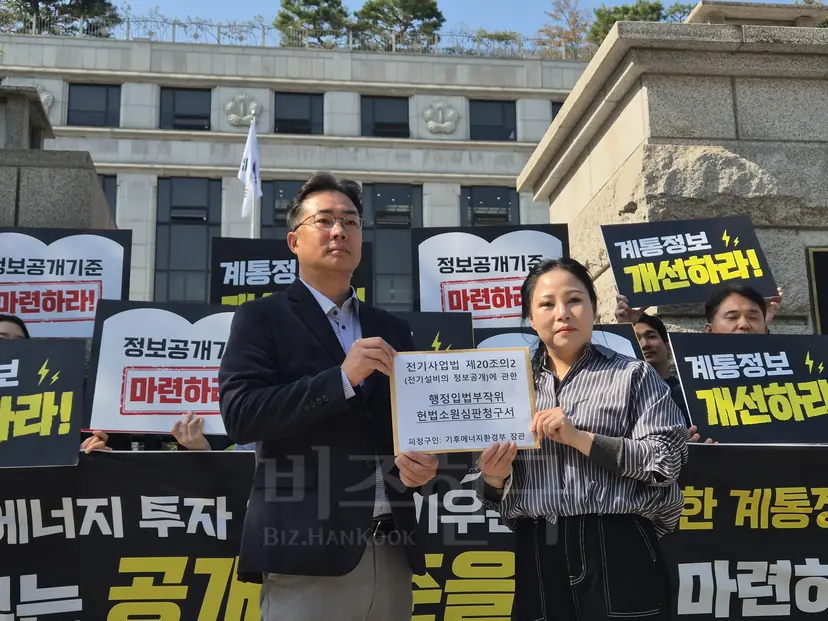
The National Solar Power Association and the organization Solutions for Our Climate held a joint press conference at the Constitutional Court on October 15, announcing that they have filed a constitutional appeal against the Minister of Climate, Energy, and Environment for "legislative omission"—the failure to establish standards for the disclosure of system information. Administrative legislative omission refers to a failure where, despite a higher-level law imposing a specific duty on an administrative agency to create subordinate regulations, the agency leaves the matter unaddressed without justifiable cause.
Law Enacted 7 Years Ago… But Subordinate Rules Are "Non-Existent"
On April 23, 2019, the National Assembly added Article 20-2 to the Electric Utility Act, mandating that transmission and distribution operators disclose the capacity and utilization status of electrical facilities to assist other power generation businesses in using the power grid. This provision went into full effect on October 24 of the same year.
However, while the law delegated the authority to define the specific scope, criteria, and methods of disclosure to a ministerial ordinance (implementing rule), the Ministry of Climate, Energy, and Environment has failed to establish these detailed standards even after seven years. With only the legal text existing but no practical criteria for operation, there is effectively no basis to hold KEPCO, the monopoly transmission and distribution operator, legally accountable or force the disclosure of key grid information, even if it manages that data restrictively.
Ha Jung-min, an attorney at Solutions for Our Climate, stated at the press conference, "This constitutional appeal challenges the administrative legislative omission of the Ministry of Climate, Energy, and Environment in failing to establish the information disclosure standards required under Article 20-2 of the Electric Utility Act." She added, "By forcing business failure through the absence of information, the ministry is infringing upon the freedom of business and severely damaging the right to know and the right to equality by failing to provide information mandated by law."
Permits Secured, Only to Be Denied "Connection"
To build a renewable energy plant, it is essential to secure "available grid capacity" to transmit electricity produced by the facility into the national power grid. However, in the field, there are recurring cases where developers buy land and spend hundreds of millions of won to complete all licensing processes, only to be notified afterward that grid connection is impossible.
In fact, one of the claimants in this constitutional appeal confirmed the available capacity of distribution lines through KEPCO in April 2026 and proceeded with land purchase and licensing for two solar power plants. However, after completing the complex licensing process with local governments and related agencies, the response received from KEPCO was a denial: "Unable to connect to the power grid due to a lack of transformer capacity." This occurred because other developers had preempted the connection capacity during the months it took to process the permits.
Developers unanimously agree that the information KEPCO currently provides via its website (KEPCO ON) is merely superficial data on distribution lines, transformers, and substations. They argue that critical technical information—such as the size of the connection queue and the actual physical spare capacity of the grid—remains hidden.
Choi Jin, Vice Chairman of the National Solar Power Association, lamented, "Developers are pouring in massive upfront investments, ranging from tens of millions to hundreds of millions or even billions of won, but after obtaining all permits, all they get is a single, irresponsible line from KEPCO saying 'grid connection impossible'." He added, "Since developers have no way of knowing during the months or years it takes to get permits that capacity has been exhausted, they are being pushed to the brink of bankruptcy."
"Predictability" Needed to Achieve 100GW of Renewable Energy
On September 29, the government released power grid innovation measures, promising to lift the designation of grid-managed substations in the Honam region and expand flexible connections. These are measures intended to achieve the national greenhouse gas reduction goal (NDC) by increasing renewable energy capacity from the current level of less than 40GW to 100GW by 2030.
However, the power generation industry points out that lowering the physical barrier to entry for the power grid and creating an environment where investors can reasonably judge project feasibility are completely different issues. Even if grid connection is permitted, if it is impossible to know in advance how long the connection wait time will be or how often the generator must be stopped due to output curtailment after connection, project investment becomes difficult.
Ju Da-yoon, a researcher on the power grid market team at Solutions for Our Climate, emphasized during the reading of the press conference statement, "Information disclosure is not a favor to businesses, but a path to increasing renewable energy faster and more efficiently. If a business cannot know when and under what conditions they can connect, it is difficult for the government's renewable energy goals to translate into actual investment."