

[비즈한국] The government has unveiled the detailed framework for an "Industrial Regional Electricity Rate System," which differentiates electricity prices based on the distance from power plants and transmission congestion conditions. The core of the policy is to effectively maintain current rates in the southern part of the capital region—where power consumption is concentrated—while significantly reducing industrial electricity rates by up to 10% in non-capital regions, such as the southern power-dense belt.
Industrial sectors and local political figures, who have long complained about cost burdens due to cumulative electricity rate hikes, have collectively welcomed the announcement. However, concerns are simultaneously being raised that by implementing only discounts for non-capital regions without surcharges for power-overcrowded areas, the original intent of "local power production for local consumption" is being distorted, and that this could negatively affect the Korea Electric Power Corporation (KEPCO), which carries over 210 trillion won in debt.
Subdivided into 11 Regions Nationwide… Up to 18 Won/kWh Reduction in the Southern Region
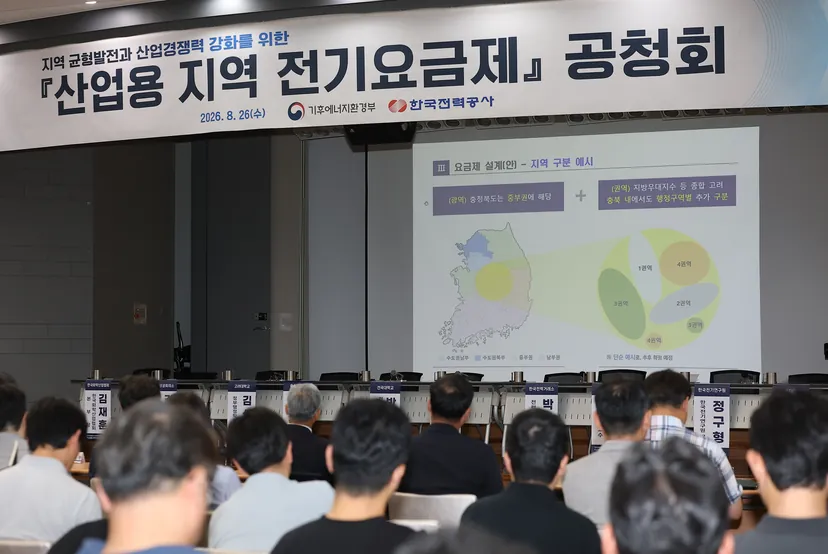
The Ministry of Climate, Energy, and Environment and KEPCO held a public hearing at the Namsouthern Headquarters in Yeongdeungpo-gu, Seoul, on the 26th to announce the "Industrial Regional Electricity Rate System Design." This comes two years and two months after the "Special Act on the Promotion of Distributed Energy" was enacted in June 2024. The government plans to introduce the system within this year after gathering feedback from the public hearing and revising relevant notices and electricity service terms.
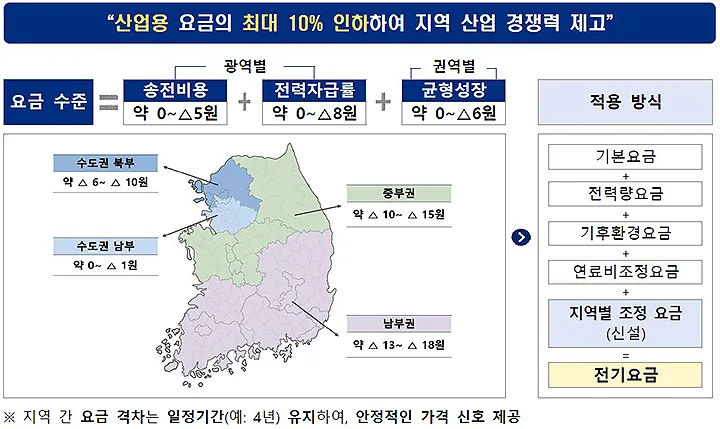
The reform is designed to introduce a "region-specific adjustment rate" on top of the existing structure of basic rates, power usage rates, climate and environmental rates, and fuel cost adjustment rates. The target of the policy is "industrial electricity," which accounts for 51% of the nation's total power usage (280,202 GWh as of 2025). Residential electricity and power for Jeju Island, which is an island region, are excluded from this application.
The regional classification is subdivided into a total of 11 areas by cross-referencing "four metropolitan regions," which reflect power grid conditions, with "four districts" that consider balanced regional growth. Based on transmission congestion and power flow, the country is divided into △Southern Capital Region, △Northern Capital Region, △Central Region, and △Southern Region, then further cross-referenced with the Ministry of the Interior and Safety’s regional preference indices (distance from Seoul, population, economic/social conditions, etc.) and designated industrial crisis area status.
Three major factors are comprehensively reflected in the rate calculation: "power self-sufficiency rate" (0–8 won reduction), which indicates power supply capacity; "balanced growth indicators" (0–6 won reduction); and "transmission costs" based on grid usage by region (0–5 won reduction).
As a result, the Southern Capital Region, where power demand is dense, will see no rate changes or only a slight adjustment of around 1 won, effectively freezing the rates. In contrast, the Northern Capital Region, including Incheon, will see a reduction of up to 10 won; the Central Region, including Gangwon and Chungcheong, up to 15 won; and the Southern Region, home to dense nuclear and renewable power plants, will see rates drop by up to 18 won—approximately 10% of the 2025 average industrial sales price (181.9 won per kWh). The government expects this to reduce the annual electricity cost burden for the industrial sector by approximately 2.8 trillion won.
Industrial Sector Welcomes "Export Competitiveness Recovery"
Twenty-one major economic and industrial organizations, including the Korea Chamber of Commerce and Industry, the Federation of Korean Industries, and the Korea Federation of SMEs, issued a joint statement on the day, declaring, "We actively welcome the introduction of the Industrial Regional Electricity Rate System and the overall trend of rate reductions."
The industrial sector responded that it would alleviate the management burden accumulated from sharp rate hikes over the past several years. Industrial rates were raised seven times between 2022 and 2025. The economic sector expects this reduction to ease production cost burdens for core manufacturing sectors like steel, petrochemicals, semiconductors, and batteries, providing an opportunity to secure export competitiveness against low-price offensives from countries like China.
Political figures representing districts with local industrial complexes also voiced their welcome. Kim Eui-kyeom, a member of the Democratic Party of Korea, stated on his Facebook page, "It is welcome and grateful news that the long-standing imbalance, where regions bearing the burden of power plants and transmission lines paid the same rates as the capital region, has been corrected." He emphasized, "If the Southern Region receives a rate reduction of up to 18 won, it could serve as a stepping stone for the revival of existing industrial complexes, such as Gunsan, by providing them with breathing room and new vitality."
Minister of Climate, Energy, and Environment Kim Sung-hwan also stated, "By attracting investments from power-hungry industries to non-capital regions, we will fundamentally reduce the burden of nationwide transmission network construction and promote balanced national development."
Risk of "Vicious Cycle" as Businesses Flock to Cheap Non-Capital Regions
However, energy policy experts and civil society groups have criticized the proposal, arguing that it drifts significantly from the original purpose of promoting distributed energy. They analyze that without a "surcharge" mechanism to impose higher costs on power-overcrowded areas to suppress demand in the capital region, a simple discount in non-capital regions will be ineffective in truly dispersing demand.
Lee Heon-seok, a policy committee member of Energy Justice Actions, commented, "The original regional electricity rate differential system was proposed by environmental groups to bridge the gap in power self-sufficiency between the capital and non-capital regions and to promote distributed energy. By opting for a discount policy that only lowers non-capital rates while leaving capital rates untouched, the government is simply satisfying the long-standing demands of large corporations and the industrial sector for lower industrial rates, rather than reducing consumption or mitigating inequality through surcharges on high-consumption areas like the capital."
If power-hungry companies flock to areas with power plants in search of cheaper rates, it could trigger a vicious cycle where local power consumption surges, leading to the need to build additional power generation facilities in those regions to meet the increased demand. Critics argue that a policy intended to alleviate regional inequality is creating a contradiction that cements the environmental and social burdens on areas already dense with power plants.
For a standard differential system to function, higher rates should be imposed on the capital region—which consumes excessive power—and the funds secured from such surcharges should be reinvested into expanding distributed power facilities within the capital or addressing regional inequalities. However, critics point out that by excluding surcharges out of fear of political and social backlash from the capital region, the funding mechanism itself has disappeared.
There is also concern that lowering rates only in areas surrounding nuclear plants in Yeongnam or coal-fired plants in Chungcheong and Gangwon may cement the current power structure centered on large-scale nuclear and fossil fuels, thereby delaying the transition to renewable energy.
The massive annual electricity discount of 2.8 trillion won is also expected to further deteriorate KEPCO's financial structure.
Kim Byung-kwon, director of the Reform Climate Institute, stated, "At a time when KEPCO’s debt still exceeds 210 trillion won and massive investment in energy transition—such as expanding transmission grids—is necessary, this is a misguided decision that caves to the demands of the industrial sector for rate cuts." He added, "By abusing the concept of a regional differential system, which should have meant higher rates for the capital and lower rates for the supply-surplus non-capital regions, the government has backtracked into offering cheaper rates for industry, losing sight of the goal of higher energy efficiency."
The government plans to introduce a "Locational Marginal Pricing (LMP)" system to differentiate wholesale power prices between the capital and non-capital regions, allowing KEPCO to purchase electricity more cheaply from plants while potentially using government financial support to minimize losses. The strategy is to reduce KEPCO's power purchasing costs by lowering wholesale prices in non-capital regions.
However, experts point out that wholesale market reforms alone are insufficient to fully offset the loss in revenue. Policy committee member Lee Heon-seok noted, "There is already talk that there is not enough money to invest in power infrastructure and transmission grids due to KEPCO's existing debt. While the government mentions splitting the wholesale market or fiscal support, there are clear limits to how much this can prevent the financial hit to KEPCO resulting from retail rate cuts."