

[BizHankook] This week, the expansion of trading volume in decentralized finance (DeFi) projects, token demand structures, and the incorporation of digital assets into corporate treasuries drove the top performers. While Bitcoin remained unsettled by macroeconomic uncertainties following its early September highs, capital flowed into mid-cap altcoins and privacy assets. The market was characterized more by a rotation of individual catalysts and high-volatility assets rather than a uniform, market-wide bullish trend.
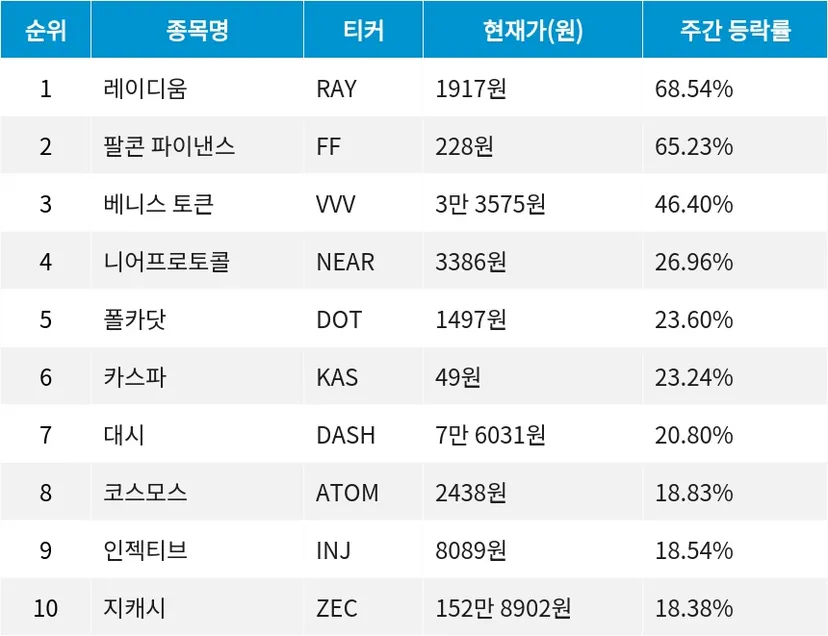
According to CoinMarketCap, a global cryptocurrency market data provider, Raydium ranked first in weekly gains with a 68.54% increase from 6:00 on September 4 to 6:00 on September 11. Raydium's current price is 1,917 KRW, and it maintained strong upward momentum with a 12.23% gain over the last 24 hours.
Falcon Finance took second place with a weekly gain of 65.23%. Its current price is 228 KRW, having risen 12.94% in the last 24 hours. Venice Token placed third, rising 46.40% over the week. It is currently trading at 33,575 KRW, with a 24-hour fluctuation of +0.82%.
NEAR Protocol ranked fourth, rising 26.96% for the week. Its current price is 3,386 KRW, up 0.55% in the last 24 hours. Polkadot secured the fifth spot with a 23.60% weekly gain. It is currently priced at 1,497 KRW, though it saw a 0.33% decline over the past 24 hours.
The 6th-ranked Kaspa rose 23.24% for the week to trade at 49 KRW. 7th-ranked Dash recorded a 20.80% increase to 76,031 KRW. 8th-ranked Cosmos rose 18.83% to 2,438 KRW, and 9th-ranked Injective traded at 8,089 KRW, up 18.54%. 10th-ranked Zcash rose 18.38% over the week to 1,528,902 KRW.
Venice Token Rises on Buyback/Burn and Corporate Treasury Inclusion
Raydium, ranked 1st, is a decentralized exchange on the Solana ecosystem that supports token swaps and liquidity provision. When users deposit assets into liquidity pools, they receive a portion of trading fees, and RAY tokens are utilized for ecosystem incentives and staking. Raydium allocates 12% of trading fees generated from concentrated liquidity pools and standard automated market maker pools toward market buybacks of RAY. This structure allows the protocol's buyback volume to grow alongside trading activity.
During this reporting period, price growth was accompanied by a rapid expansion in trading volume. Based on public market data, Raydium's daily trading volume surged around the price spike on September 6 compared to the previous trading day, maintaining high levels thereafter. No specific major business announcements were identified to explain the weekly rally. It is interpreted that as the existing fee-based buyback structure gained attention, short-term capital flocked to Solana ecosystem assets, amplifying price elasticity. Even in the final 24 hours of the period, the token recorded double-digit growth, suggesting that buying pressure continued rather than immediate profit-taking following the surge.
Falcon Finance, ranked 2nd, is a DeFi protocol that issues USDf, pegged to the value of the US dollar, collateralized by Bitcoin, Ethereum, stablecoins, and tokenized real-world assets (RWA). Depositing USDf allows users to receive the yield-bearing asset sUSDf, while FF is used for governance and staking rewards.
Falcon Finance previously launched an RWA tokenization pipeline starting with GPU financing, utilizing El Salvador’s regulatory framework. However, as this announcement was made just before the reporting period, it is difficult to cite it as the sole direct cause for the entire week's gain. During this period, price breakouts accompanied by volume were more prominent than new core business announcements. Specifically, as the price jumped significantly on September 8, trading volume spiked compared to the previous day. Since a significant portion of the weekly gain formed in a short period, it can be viewed that momentum trading amplified the gains alongside a revaluation of business value.
Venice Token, ranked 3rd, is used in Venice, a generative AI service that does not store user requests or chat data on a central server for long periods. Staking VVV allows users to issue DIEM, a digital resource used for AI model calls, and a portion of paid service revenue is linked to VVV buybacks and burns.
Venice introduced a policy where 5 dollars out of every 100 dollars spent on API credit purchases are used for VVV buybacks and burns, and is gradually increasing its DIEM supply target from 38,000 to 40,000 by September 14. Additionally, it was revealed on September 10 that TenX Protocols, a Canadian-listed company, had purchased approximately 7,710 VVV tokens between August 31 and September 4, incorporating them into their digital asset treasury portfolio. While the purchase volume itself was not large enough to move the entire market, the simultaneous confirmation of a burn structure linked to actual service usage and corporate demand contributed to the rise.
Rotation Spreads Beyond Individual Catalysts to Layer 1, Interoperability, and Privacy
NEAR Protocol, ranked 4th, is a Layer 1 blockchain that increases scalability through sharding, which divides processing space based on network usage. Its "chain abstraction" feature, which helps users access assets and services across multiple chains with a single account, is also a key function. NEAR recently unveiled a technology roadmap for signature techniques to defend against quantum computer attacks, and major exchanges adjusted their deposit/withdrawal support schedules during the network upgrade in early September. However, it is difficult to attribute the weekly gains solely to the upgrade. It is more reasonable to view the trend as a result of the combination of the technical roadmap release and the rotation of Layer 1 assets.
Polkadot, ranked 5th, is a network designed for multiple blockchains to share security and data based on a central Relay Chain. DOT is used for staking, governance, and network resource allocation. Polkadot previously reduced the staking unbonding period for general delegators from about 28 days to two days and modified its system so that delegators do not bear losses resulting from validator sanctions. On September 9, updates to its product development network were released, improving chat encryption and application functionality. However, after the weekly surge, the price fell 0.33% in the last 24 hours, indicating a slowdown in upward momentum. This suggests that short-term profit-taking occurred after the period of concentrated trading volume.
The composition of the top 6 to 10 performers shows that the upward trend was not limited to a specific industrial sector. Kaspa is a Proof-of-Work network that processes multiple blocks in parallel, and Dash is a cryptocurrency focused on payment and remittance functions. Cosmos is an interoperability ecosystem connecting different chains, and Injective is a Layer 1 specialized in financial services like derivatives and spot trading. Zcash is a privacy asset providing transaction information protection. The inclusion of trading infrastructure, payments, multi-chain, DeFi, and privacy assets in the top ranks signifies that buying targets have broadened to encompass a wider range of altcoins with high price elasticity, rather than being confined to a single technology theme.
Among the top 10 tokens this week, there was a distinction between assets where new announcements triggered price increases and those that rose based on trading volume and market rotation without clear new catalysts. Venice Token saw confirmed changes in demand through buybacks/burns and corporate treasury inclusion, while NEAR Protocol and Polkadot were supported by upgrades and improvements to their staking structures. In contrast, Raydium and Falcon Finance saw their gains amplified by a surge in short-term trading volume on top of their existing business structures.
Bitcoin and Ethereum showed volatility during the same period due to concerns over potential US interest rate hikes and rising oil prices. Therefore, it is too early to conclude that the high growth rates of the top performers signal a market-wide trend reversal. However, the fact that the buying spree which started in DeFi spread to Layer 1, interoperability, and privacy assets indicates that investors are seeking short-term profit opportunities in altcoins that have higher volatility and greater potential for price swings than large-cap coins.
※ This article was written with the help of generative AI from BizHankook and MetaVX.