

[비즈한국] It has been confirmed that a domestic natural language processing company accessed the ‘Korean Spell Checker,’ developed by researchers at Pusan National University and provided for free for over 20 years, approximately 2 million times. The surge in traffic over a short period caused a service outage. The company responsible for the mass access is known to have a history of conducting government-funded projects over several years.
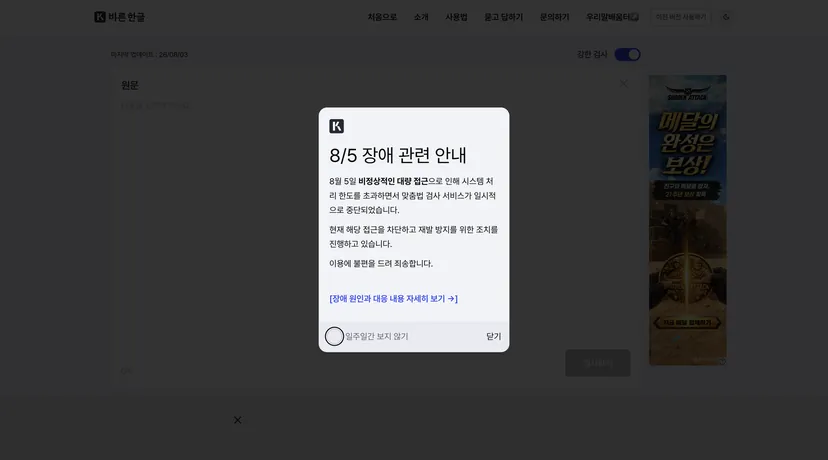
According to Bizhankook’s reporting on the 12th, it was confirmed that on the afternoon of the 5th, a domestic company accessed Barun Hangeul, known as the ‘Pusan National University Korean Spell Checker,’ approximately 2 million times. The service, which typically processes about 250,000 documents a day, was hit by a massive volume of requests in a short time, leading to a service disruption.
At the time, it was estimated that 800,000 to 850,000 documents had undergone spell checking through this mass access—a volume more than three times the usual daily capacity. To prevent a spike in AWS usage costs due to excessive requests, Barun Hangeul has a system in place that automatically shuts down if access exceeds a certain threshold. This safeguard was triggered on the 5th, causing the service to stop.
Barun Hangeul believes the access was not from typical users but was performed using automated ‘crawling.’ It is virtually impossible for a human to input hundreds of thousands of documents manually, and the requests were concentrated from a specific server in a very short period. Notably, the company accessed the site using a legacy interface that had been left active for older users. It was confirmed that the same company attempted access again the day after the system was shut down. Consequently, Barun Hangeul does not consider this a simple mistake or a one-time incident and is currently investigating the specific circumstances.
On the 10th, Barun Hangeul sent a formal letter to the company in question, demanding an explanation for the motive and circumstances behind the mass access. As of the 12th, there has been no response from the company. The firm is involved in spell-checking and language processing businesses and is not considered a small-scale operation. They also have a history of performing government-funded projects related to spelling and AI training data.
Barun Hangeul suspects that this mass access may have been used for ‘Knowledge Distillation,’ a process where output from a high-performance system is used to train a smaller model. In the field of AI, this method is used to improve model performance by utilizing results generated by other systems as training data.
This is not the first time that such abnormal, high-volume access to the Korean spell checker has occurred. In 2023, a case was identified where over 5 million requests were made via an IP address suspected to be from an apartment complex in the southern Gyeonggi region over the course of a month. At that time, it was also determined that the checker was being repeatedly called for the purpose of deep learning or similar objectives.
Barun Hangeul stated, “We are currently investigating the specific circumstances, including the exact motive,” adding, “We are being cautious because disclosing details before hearing the company’s side could lead to the spread of incorrect information.”