

[비즈한국] As the number of schools closing or relocating due to a decline in the school-age population caused by low birth rates increases, interest in how to utilize closed schools, former school sites, and long-vacant school land is growing. While there are ongoing success stories of transforming closed schools and idle school sites into spaces needed by the community, such as educational, cultural, welfare, and sports facilities, plans to supply public housing on these sites are also being actively pursued. However, as the scope of utilization widens, voices are calling for standards that take into account both local needs and future demand for schools.
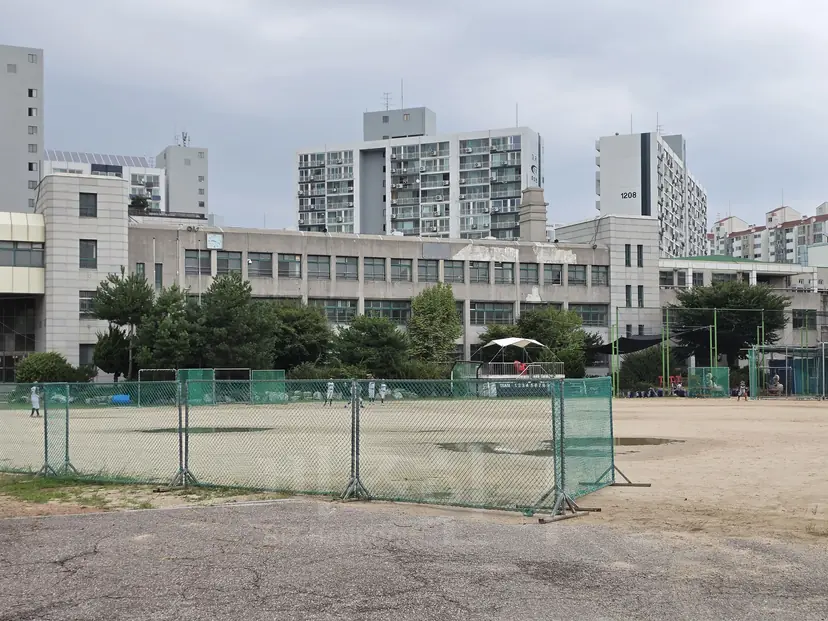
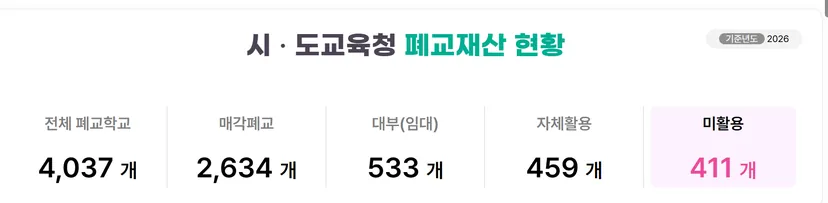
Currently, the school-age population nationwide is on a downward trend. According to future population projections by the National Data Agency, the school-age population aged 6 to 21 is 6.785 million this year, a decrease of 193,000 from last year. Along with the decline in the number of students, the number of schools closing is also rising. According to the Ministry of Education’s "Closed School Information Service," as of 2026, there are 4,037 closed schools nationwide, an increase of 29 from last year. Of these, 2,634 have been sold, and 1,403 are held by metropolitan and provincial offices of education.
As the number of closed schools grows, how to utilize these spaces that have lost their original function is emerging as a major task. Currently, closed schools held by metropolitan and provincial offices of education are either used directly by the offices or leased to local governments and other entities to serve as educational, cultural, welfare, and sports facilities, or as community spaces for residents.
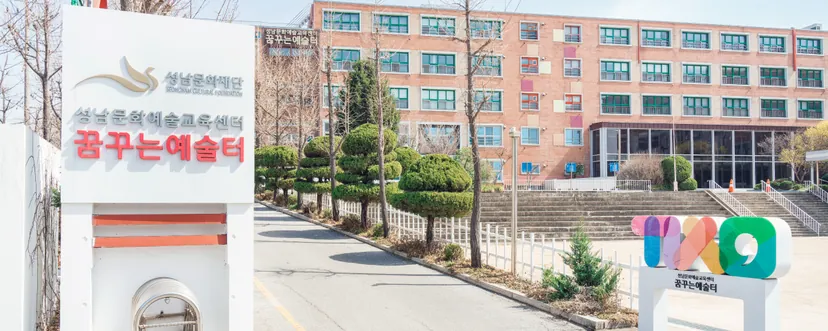
The former Yeongseong Girls' Middle School in Seongnam, Gyeonggi-do, is a representative example of closed school utilization. The school building, which closed in 2019, was remodeled and reopened the following year as the Seongnam Culture and Arts Education Center, "Dreaming Art Center." It currently runs culture and arts education programs for students and citizens.
The government has also begun refining regulations to allow for more diverse uses of closed schools. For instance, rental fees can be reduced or waived when closed school property is used for certain public interest purposes. Recently, relevant laws were amended to expand the scope of use, such as including community resident facilities and integrated support facilities in the list of eligible projects for special exemptions.
The Seoul Metropolitan Office of Education is pursuing the utilization of closed schools and former school sites as a mid-to-long-term policy. In March of this year, the Office of Education announced a five-year strategy, investing approximately 273.2 billion KRW from 2026 to 2030, to convert former school sites and closed schools into future educational facilities and local complex spaces.
Recently, moves to utilize closed schools and idle school sites for residential purposes have also begun in earnest. In the housing supply measures announced on August 13, the government unveiled plans to use closed schools and long-vacant school land for the supply of public housing. According to the plan, 1,438 households will be supplied across four locations in Seoul and Gyeonggi-do as a first step. The former Gonghang High School site in Gangseo-gu, Seoul, will be developed into 270 housing units specialized for youth along with an indoor gym for students, and public housing will also be supplied on unused school sites in places like Suwon and Yongin in Gyeonggi-do where schools were never built.
The scope of utilizing closed schools and idle school sites is expanding to include housing. However, their use cannot be changed as freely as general land. Under relevant laws, closed school property is subject to certain restrictions regarding the purpose of use, leasing, and sale. Even when developing unused school land for other purposes, relevant consultations and administrative procedures must be followed based on the site’s designated status and the project method. While institutional improvements are being made to expand the scope of use, how to reduce the procedures and constraints required during the actual project process remains a challenge.
As the threshold for utilization lowers, decisions on which sites to use and how to use them are becoming increasingly important. Experts point out that it is necessary to consider not only the immediate need for utilization but also facilities needed by the community, future student numbers and school demand, and public interest.
Experts suggest that rather than uniformly utilizing closed schools and idle school sites for a specific purpose, it is necessary to pursue complex utilization that reflects local conditions and needs. Shin Bo-yeon, a professor at Sejong University's Department of Real Estate AI Convergence, said, "It is desirable to expand living infrastructure for local residents by combining residential, childcare, cultural, and welfare functions," adding, "Integrated utilization is particularly necessary rather than single-purpose use, especially in areas on the outskirts of Seoul."