

[비즈한국] The Russian large-scale discount chain Svetofor is preparing to enter the Korean market. SovRK, known to be its local operating entity, plans to open test stores starting in Hwaseong, Gyeonggi-do, followed by Yongin and Asan, under the warehouse-style discount banner ‘PriceFit.’ Reports suggest a long-term goal of expanding to 200 stores nationwide. However, Korea is a market that has seen the successive exits of global retail giants like Walmart, Carrefour, and Tesco. Attention is focused on whether a Russian-style ultra-low-cost store can resonate with domestic consumers.
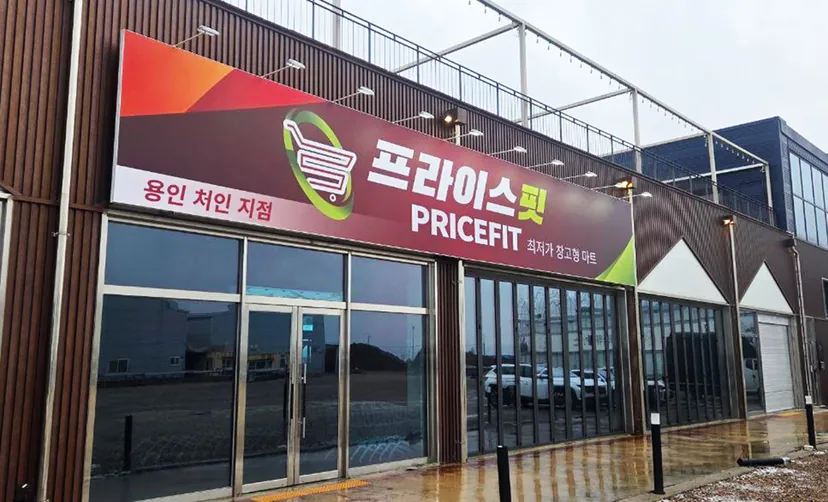
Preparing the First Hwaseong Location, Signs of Hiring in Yongin and Asan
According to the retail industry, Svetofor is preparing to launch the warehouse-style discount mart ‘PriceFit’ in Korea via its local subsidiary, SovRK. The first store is reportedly planned to open in Hwaseong, Gyeonggi-do, as early as the Chuseok holiday in September, or by the end of the year at the latest. The stores are expected to operate as warehouse-style discount marts sized between 250 and 300 pyeong (approx. 825–990 square meters).
Corporate records show that SovRK was established as a limited company on February 19, 2024. Its current address is registered at the Signature Gwanggyo Knowledge Industry Center in Suji-gu, Yongin-si, Gyeonggi-do. Job postings also confirm preparations for the launch. SovRK previously posted a job opening for a manager at the upcoming Hwaseong store and has since posted openings for new stores in Asan, South Chungcheong Province, and Yongin, Gyeonggi Province. The Yongin job posting lists the workplace as ‘PriceFit Yongin Cheoin Branch.’ This suggests that the plan to open test stores in Yongin and Asan following the first Hwaseong location is largely concrete.
Svetofor, a Hard Discounter Known as ‘Mere’ in Europe
Svetofor is a hard-discount chain that started in Krasnoyarsk, Russia, in 2009. It is known as ‘Svetofor’ in Russia and primarily as ‘Mere’ or ‘MyPrice’ in Europe. Its model involves displaying goods on pallets or in boxes within warehouse-style stores, minimizing interior costs, labor expenses, and logistics costs to lower product prices.
International retail experts describe Svetofor’s model as a ‘no-frills’ strategy. This approach reduces store decor and display services, utilizes peripheral locations with low rent, and minimizes operating costs through limited staffing. Rather than carrying a wide range of products like large hypermarkets, they often focus on food and household goods where price competitiveness can be secured.
This strategy can be attractive to consumers during an economic downturn. In a climate of high inflation and financial pressure, positioning itself as the ‘cheapest shopping channel’ can draw in highly price-sensitive consumers. In Korea, low-cost and value-driven channels such as food ingredient marts, No Brand, Daiso, and warehouse-style discount stores have been growing steadily.
However, it is difficult to view PriceFit as a direct competitor to Costco or E-mart Traders. While Costco and Traders emphasize large-scale stores, bulk purchasing, membership, or a warehouse shopping experience, the stores PriceFit is preparing are known to be around 250–300 pyeong in size. They can be seen more as localized, ultra-low-cost food and household goods stores rather than large-scale warehouse discount marts.
The ‘Graveyard’ of Foreign Retailers: Localization is Key in Korea
The Korean market has not been easy for foreign large-scale retailers. Walmart and Carrefour pulled out of the Korean market in 2006, and the British retailer Tesco effectively exited in 2015 by selling Homeplus to MBK Partners. High barriers to entry for foreign retailers include Korean consumers' preference for fresh food, a dense network of urban stores, rapid delivery and intense e-commerce competition, and government regulations on hypermarket operations.
Svetofor has not met with success in every overseas market either. While it entered several countries in Europe under the Mere brand, it faced store closures and delayed expansion in some Western European nations. Since the war in Ukraine, the image of being a Russian company has become a burden, and the company has reportedly faced difficulties in matching local supply chains and consumer tastes.
The challenges in Korea are clear. First, securing a stable product supply chain is crucial. The ultra-low-cost retail model relies on direct transactions with suppliers, simple logistics, and low operating costs. However, the domestic food and household goods market already features intense price competition among hypermarkets, convenience stores, e-commerce, and food ingredient marts. Simply introducing a Russian-style low-cost model will not be enough to differentiate itself.
Fresh food competitiveness is also a variable. Korean consumers place high importance on the quality and accessibility of fresh foods such as vegetables, fruits, meat, and seafood. It is uncertain how acceptable the store configuration—focused on limited product ranges and box displays like those of overseas hard discounters—will be to local consumers. Basic retail services including quality, hygiene, accessibility, ease of payment, and return policies must be supported alongside low prices.
Eye on Low-Cost Retail Experiments Amid Homeplus Vacuums
The emergence of PriceFit coincides with a period of reorganization in the Korean offline retail market. With Homeplus undergoing a rehabilitation process and facing turmoil in store operations and relationships with partners, the hypermarket industry as a whole is facing stagnant growth. Conversely, consumers are seeking cheaper shopping channels amid high inflation. Foreign ultra-low-cost retailers are essentially trying to tap into this niche.
It is also noteworthy that SovRK has chosen the southern capital region and the Chungcheong region—Hwaseong, Yongin, and Asan—as its test sites. Hwaseong and Yongin are areas that combine residential demand with industrial complexes, and Asan also has a sufficient local population and industrial demand. This is interpreted as a strategy to target value-conscious consumers in locations where rent burdens are lower than in core urban commercial districts.
Industry insiders believe the performance of the first store will determine the speed of future expansion. For the goal of 200 stores to become reality, the initial test stores must prove inventory turnover and profitability. Whether they can attract customers based on price competitiveness alone, whether they can trade stably with domestic suppliers, and how the perception of being a Russian-affiliated retailer will affect consumers remain key variables.
A retail industry official noted, "While Korean consumers are sensitive to prices, they also attach great importance to freshness, convenience, and brand trust," adding, "The success or failure will depend on whether PriceFit can offer a product lineup that draws repeat visits, rather than remaining just a ‘cheap store’ in the eyes of consumers."