

[BizHanKook] As 'AI glasses,' which combine artificial intelligence (AI) with ultra-small cameras, emerge as tools for academic cheating, discussions on countermeasures have begun in earnest. On the 23rd, two consecutive forums were held at the National Assembly to address this issue. On-site discussions covered technical solutions such as device identification markers and component-level security. Experts pointed out that because it is difficult to plug every loophole solely through monitoring at test sites, preventive measures must be implemented across the manufacturing, distribution, and service stages. Additionally, discussions were held on how to manage the AI glasses market, which has only just begun to emerge as a new industry.
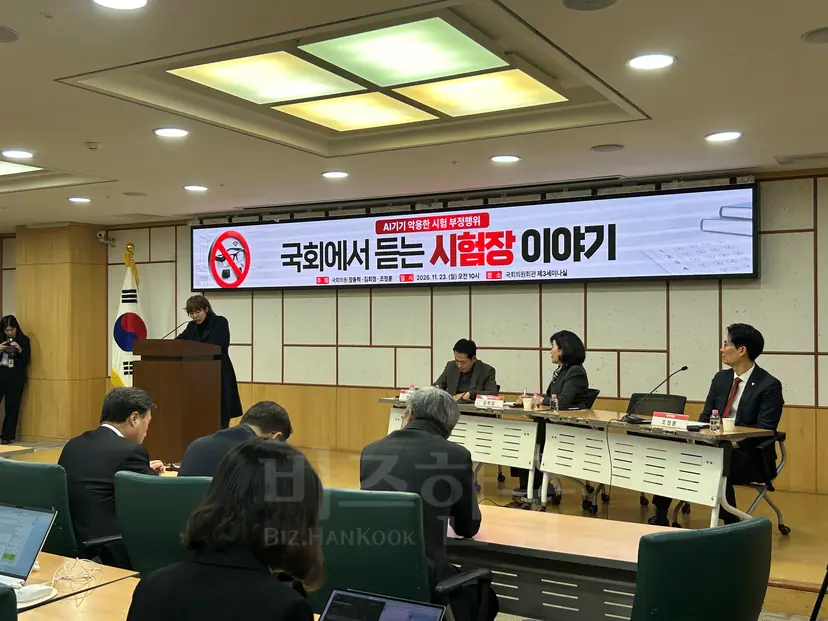
At the 'Stories from the Exam Site, Heard at the National Assembly' forum held in the morning, students, parents, and education officials attended to voice their grievances from the field. One teacher, who has participated in the preparation and review of the Korean language section of the College Scholastic Ability Test (CSAT) for eight years, remarked, "Warnings about new types of cheating involving ultra-small wearable devices or AI have been appearing for months," and pointed out that "the core issue is the delayed response." Park Seung-min (24) noted that "on-device AI cannot be detected by radio wave sensors. This is AI that can be used without Wi-Fi or internet," indicating that blocking network connectivity alone is insufficient to prevent cheating.
From encrypting exam papers to 'component security'… "Hard to block at a single point"
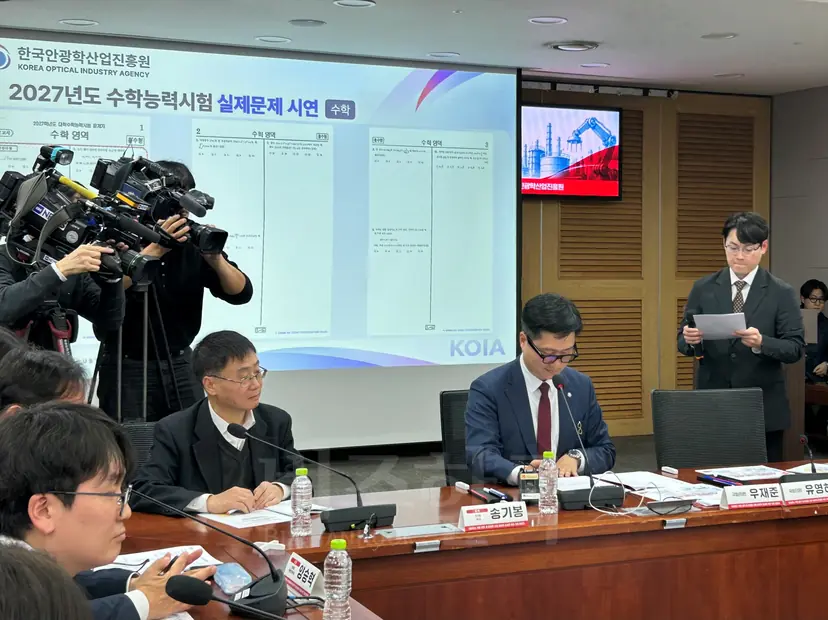
In the afternoon forum, 'Preventing the Misuse of AI Glasses and Creating a Fair Industrial Ecosystem,' preventive measures for product identification and the recording-transmission process were discussed. Song Ki-bong, a researcher at the Electronics and Telecommunications Research Institute (ETRI), stated, "We could consider attaching special markers to smart glasses or using NFC (Near Field Communication) to distinguish them from regular glasses," adding, "We could also examine designs that make it difficult to remove identification markers so they can be verified at test sites."
The proposal to embed security features in the connection phase between components like cameras, microphones, and speakers was also raised. The concept involves incorporating such standards into the 'MIPI Alliance,' an international private consultative body that sets component connection standards, to control the recording and transmission processes themselves. Researcher Song also mentioned, "Adding security features could lead to data processing delays or increased power consumption."
The fact that semiconductor suppliers are limited to a few global companies is another hurdle. Song explained, "There are realistic limitations and challenges in bargaining power when it comes to demanding that specific security features be installed independently in Korea."
Response at the AI service level was also identified as a challenge. At the morning forum, Kim Hee-jung, Chair of the National Assembly Education Committee, suggested features such as "playing a sound when an exam paper is being transmitted" and ways to prevent AI services from interpreting exam papers during test hours. A unique idea was also proposed: encrypting the exam papers themselves so that text is visible only when wearing designated glasses capable of decryption, while remaining unreadable otherwise.
Regarding the issue of managing 500,000 units, Researcher Song said, "If we divide it by region, it is technically feasible to implement," but added, "Rather than trying to block all problems at a single point, it is more desirable to distribute response elements across various stages including manufacturing, distribution, usage, and service."
Kim Myung-seop, CEO of 'Lounz,' an online and offline glasses platform, pointed out, "We must pay attention to the fact that this cheating was enabled by the combination of an ultra-small camera and AI, rather than the AI glasses themselves." While approximately 11,000 optical shops nationwide could serve as outlets to provide guidance on recording functions and exam site entry regulations, he added, "The responsibility of manufacturers and service companies must also be clear."
"A growing market… Concerns over excessive regulation"
Within the industry, there are also concerns that discussions on preventing misuse might lean solely toward regulation. The global shipment of AI glasses in the first half of this year is estimated at about 4.2 million units, with projections reaching 45 million by 2030. Do Ki-tae, a division head at the Korea Optic Industry Promotion Agency, said, "We must prepare for AI glasses as a market that is approaching soon, not a distant future."

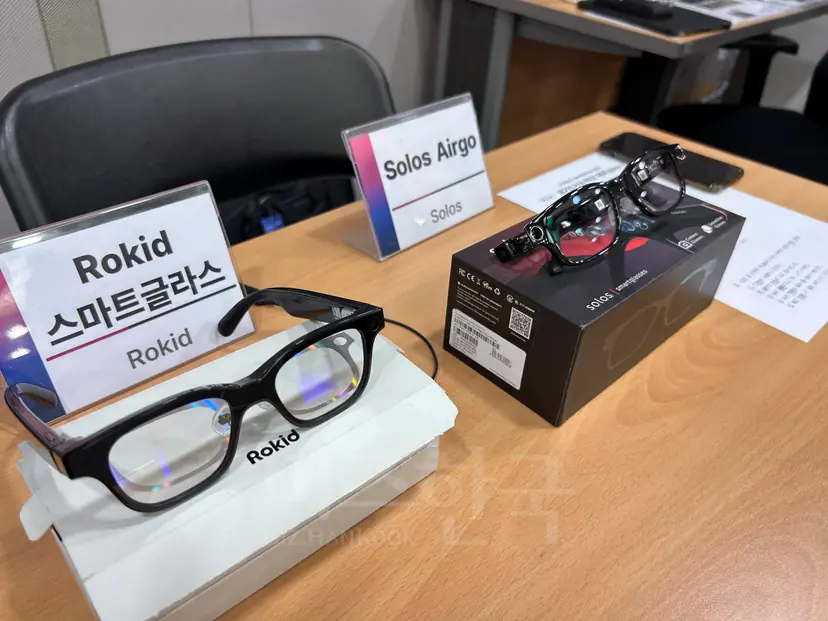
On the other hand, the domestic industrial base is weak. Major components, such as displays small enough to fit into glasses, are highly dependent on overseas supply chains, and the domestic companies' standing in the finished goods market is not significant. The hosts could not even find a domestic product for the demonstration.
China is currently pursuing 'Smart Glasses Safety Technical Specifications' as a national standard this month. Director Do emphasized, "If regulations precede industrial promotion, it could hinder market formation," but added, "We need to establish a verification, testing, and analysis system that can respond to international standards."
Caution was advised regarding the scope of management standards. Lee Yoon-seop, head of the Display and Home Appliance Team at the Ministry of Trade, Industry and Energy, said, "If we classify products that are existing electronic devices with attached cameras as AI glasses, it could leave a negative image on the market." He added, "As there are diverse application areas, it is difficult to apply uniform standards."
Representative Woo Jae-jun of the People Power Party stated, "We can only build a system to manage and control side effects if we understand the technology well," adding, "We must prepare countermeasures starting now, looking five to ten years into the future."