

[비즈한국] As the government accelerates discussions on fostering ‘Physical AI’ as a next-generation national strategic industry, experts suggest that the next five years will be the golden time that determines global leadership. They emphasize the need for an all-out effort to build an industrial ecosystem that goes beyond performance competition of AI models to connect data from manufacturing sites, robotics, and AI semiconductors.
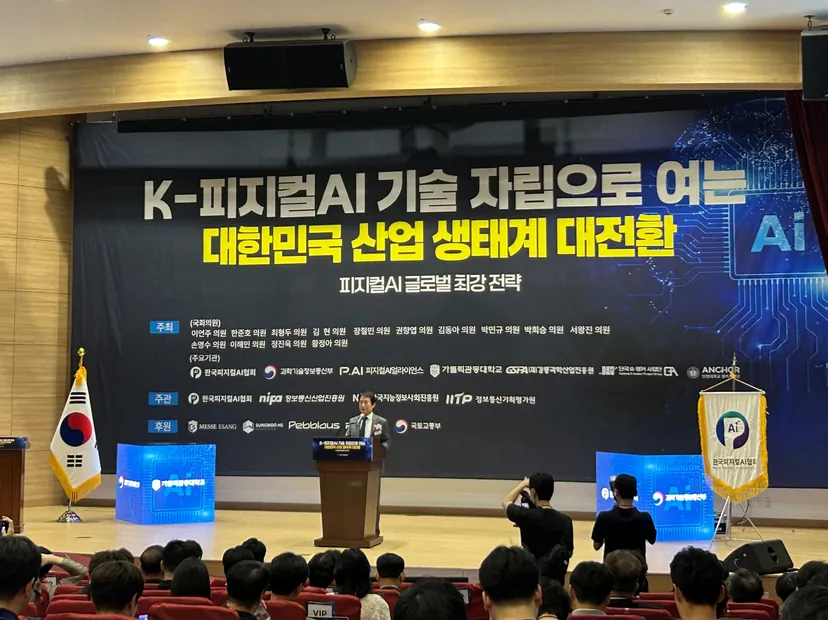
Full-stack capabilities encompassing models, data, and manufacturing required
Bae Choong-sik, the new president of the Korea Advanced Institute of Science and Technology (KAIST), stated at the ‘Great Transformation of Korea’s Industrial Ecosystem Opened by K-Physical AI Technology Self-Reliance’ seminar held at the National Assembly in Yeouido on the afternoon of the 25th, “The next five years are extremely critical. This is a time that has not yet materialized and where productivity improvements have not yet surfaced—literally, a time without an owner.”
Physical AI refers to technology where AI does not remain within the virtual space on a screen but perceives and judges the real world through robots, autonomous vehicles, and production facilities before taking direct action. This involves a cyclical structure: ‘perception’ to sense surroundings, ‘judgment and planning’ to decide actions, robot hardware and control technology to implement actual movements, and data learning to refine these processes.
President Bae projected, “Mechanical tasks that have been performed by simplified commands until now will need to respond to non-routine and unpredictable unexpected situations in the future. Technology hegemony is already in an era of ‘winner-takes-all,’ and this phenomenon could become much more severe in the AI era.”
The prevailing view is that for South Korea to secure an edge in Physical AI, it needs ‘full-stack’ capabilities that include not just AI models, but also manufacturing, simulation tools, and data. President Bae noted, “You must have the models, you must have the manufacturing sector, and you must have simulation tools and data. Currently, only a few big tech companies possess these capabilities, but we must leverage South Korea’s strength as a manufacturing powerhouse to seize the number one spot in Physical AI.”
He also identified the shift in regulatory approaches as a task. President Bae explained, “There is no way to resolve issues under positive regulations. The solution is to resolve problems first through regulatory sandboxes and, in the long term, transition to negative regulations.”
From world models to robots… the task of implementing ‘On-site AI’
The fact that the technical structure of Physical AI is still in its early stages is considered both an opportunity and a challenge for domestic companies. While Large Language Models (LLMs) follow the so-called ‘scaling law,’ where performance improves as model size, data, and computing resources increase, this method does not apply to Physical AI due to the complexity of the real world. There is a lack of data for robots to learn in actual environments, and the optimal model structure has not yet been established.
Choi Hong-seop, Head of Technology at Mind AI, proposed the ‘World Action Model (WAM)’ as a solution. A World Action Model is an AI model that goes beyond merely recognizing the current situation to predicting future changes and generating the necessary actions. Choi said, “The world models developed by global big tech companies still have many shortcomings, such as inaccurate movements. We judged that the world model is an area where we can jump in right now.”
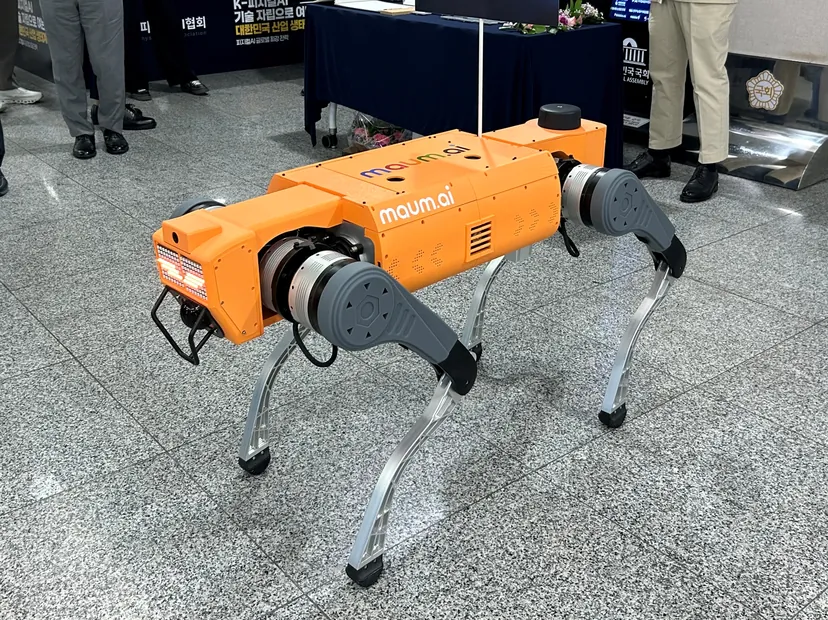
He explained that unlike daily life data, manufacturing site data can be secured more quickly by utilizing South Korea’s industrial base. Choi stated, “South Korea can collect manufacturing site data better. Through this government-supported project, we intend to develop a World Action Model that imagines what will happen next and generates actions accordingly.”
To apply this model to actual industrial sites, semiconductors responsible for AI calculations and robot technology to move them are also needed. Jung Young-beom, an executive at FuriosaAI, said, “We plan to run the world model on our own NPU servers to verify performance at the server level, and supply AI semiconductors for edge computing required for future manufacturing sites and robots.” NPUs are semiconductors specialized for AI calculation and are considered key components for running AI on devices with strict power and heat constraints, such as robots.
Park Jong-hoon, CEO of Neuromeka, pointed out that it is difficult to secure the task accuracy required in industrial sites solely through competition in AI models. Park emphasized, “The precision of robots implementing Physical AI also plays a role in significantly reducing the amount of necessary training data. We must advance not only the AI models but also the robot hardware and control technology that implement them into actual movements.”
The government also plans to support data acquisition and large-scale research and development. Song Chang-jong, team leader of the Device AX Innovation Team at the Ministry of Science and ICT, said, “Big tech companies accumulate experience through failures by attempting various things based on their capital power, but it is not easy for individual domestic companies to handle this. We will move toward an R&D system that distributes the risk of failure at the ecosystem level and supports diverse attempts.”
The government plans to build an inter-ministerial data acquisition and management system and supplement data on failures and recovery processes—which are difficult to obtain in the field—with synthetic data using world models. Team Leader Song revealed, “We plan to support as many diverse attempts as possible through large-scale R&D support starting next year.”
Park Tae-wan, Director of Information and Communications Industry Policy at the Ministry of Science and ICT, urged, “Physical AI will spread not only in manufacturing but also in various fields such as care, agriculture, and defense. As various ministries including the Ministry of Economy and Finance, the Ministry of Trade, Industry and Energy, and the Ministry of SMEs and Startups are reflecting Physical AI-related policies this year, I hope this becomes an opportunity for each company to enhance its capabilities.”