

[비즈한국] Is solving the problem of "forever chemicals" possible merely by purifying industrial wastewater before discharging it into rivers? As 17 types of per- and polyfluoroalkyl substances (PFAS) were detected in the effluent of the Godeok Industrial Complex in Pyeongtaek, Gyeonggi-do, voices are growing louder demanding the establishment of emission standards and the implementation of advanced treatment technologies.
The government has announced plans to expand water quality monitoring, and Samsung Electronics has stated it will introduce reduction technologies. However, there are calls for moving beyond the reactive approach of filtering pollutants before discharge to developing plans that reduce the volume of effluent itself by increasing water reuse within industrial processes.
Civic groups participating in this investigation urged not only the establishment of PFAS management standards for industrial wastewater but also a phased reduction in discharge volumes. The intent is that management should not stop at controlling water quality at the discharge outlet but should extend to changing how water is used and wastewater is discharged in production processes.
Kim Hyun-jung, Secretary General of the Gyeonggi Federation for Environmental Movement, emphasized, "While purification technology to lower concentrations in wastewater is necessary, the risk continues as long as the discharge pattern itself remains unchanged. The government and companies must provide a concrete policy roadmap to phase out discharge volumes and ultimately transition to a 'Zero Liquid Discharge (ZLD) system.'"
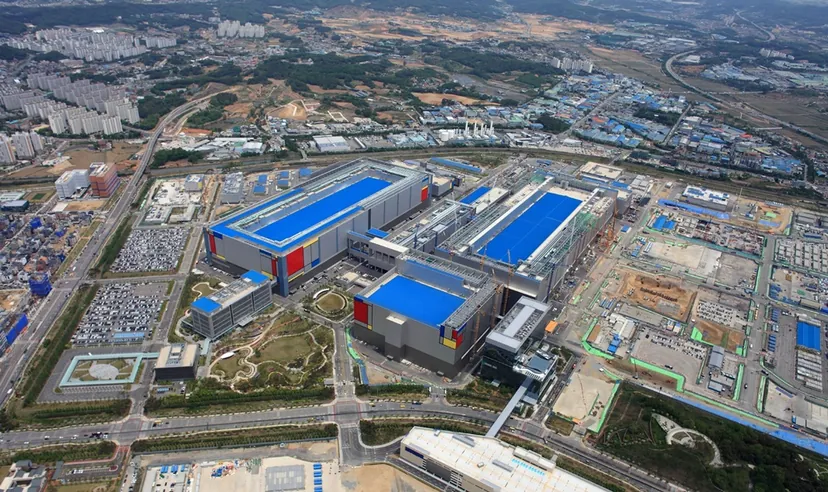
Detected concentration alone does not indicate actual emission scale
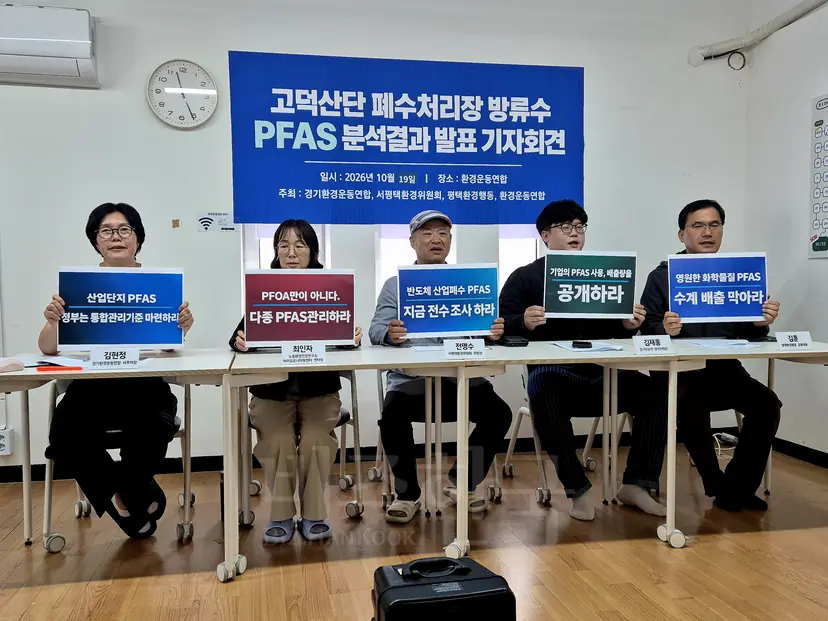
This controversy stems from the analysis results of final effluent from the Godeok Industrial Complex, released on October 19 by four organizations: the Gyeonggi Federation for Environmental Movement, the West Pyeongtaek Environmental Committee, Pyeongtaek Environmental Action, and the Korean Federation for Environmental Movement. Samples were collected on September 17 from the terminal discharge outlet of the Godeok Industrial Complex, where the Samsung Electronics Pyeongtaek Campus is located, and analyzed by the Research Institute for Environment and Energy at Pusan National University's Industry-Academic Cooperation Foundation. The samples were taken at a point immediately before the effluent enters the Seojeong Stream.
The analysis revealed the presence of 17 types of PFAS, with a simple sum of quantified concentrations totaling 9007.66 ng/L. Four short-chain perfluorocarboxylic acids (PFCAs)—PFBA (4240 ng/L), PFPeA (1830 ng/L), PFHxA (1200 ng/L), and PFHpA (695 ng/L)—accounted for 88.4% of the total concentration. Long-chain compounds such as PFOA (339 ng/L) and PFNA (239 ng/L) were also identified.
PFAS are a group of man-made synthetic chemicals resistant to heat, oil, and water, used extensively in everything from household goods to semiconductor manufacturing processes. Due to their characteristic of not breaking down easily in nature, it is crucial to determine the amount continuously released into the environment.
However, the concentration confirmed in this survey alone does not reveal how much PFAS flows from the Godeok Industrial Complex into the river per day. The total emission of pollutants can only be calculated by verifying both the concentration and the volume of discharge. Even if concentration is lowered through treatment technology, a rise in discharge volume could reduce the effect of total pollutant reduction. Conversely, even if less water is discharged, if the concentration increases, it is difficult to conclude that pollutant emissions have decreased accordingly.
Environmental groups have demanded that influent and effluent be compared and actual discharge volumes be disclosed to verify the current situation. They argue that it is necessary to track which PFAS enter from where, how they pass through treatment facilities, and how much is eventually discharged, as well as to conduct repetitive surveys linking the effluent to the river water system.
Choi In-ja, Director of the Bio Center at the Occupational & Environmental Health Institute, explained, "Perfluorinated compounds are substances that do not naturally degrade and have a half-life of decades, causing them to accumulate continuously. In particular, the short-chain compounds that made up over 88% of this effluent are highly water-soluble and mobile, which could lead to the rapid spread of pollutants across national water systems." Director Choi pointed out, "PFOA is a proven human carcinogen, and even at low concentrations, it causes concerns regarding kidney cancer, testicular cancer, birth defects, liver and thyroid dysfunction, and endocrine disruption."
Government to expand monitoring; Samsung to push for reduction technology by 2027
The Ministry of Climate, Energy and Environment stated in an explanatory note on the 19th that it has been conducting a survey since 2025 to identify emission characteristics by industrial sector for 34 types of PFAS. Precise monitoring is being carried out at eight points on the main stream of the Nakdong River via the Waegwan and Maeri Water Quality Measurement Centers, with results made public through the Mulmoa (Water Collection) system.
This monitoring system is planned to expand nationwide by the second half of 2027. Construction of the Yeongsangang and Geumgang Water Quality Measurement Centers has been completed, and construction of the Hangang Water Quality Measurement Center is scheduled to begin in November. Regarding effluent management standards, the ministry's position is to review monitoring results and overseas regulatory trends to prepare for domestic regulation if necessary.
On the same day, Samsung Electronics announced it had developed technology to reduce PFAS in effluent. It plans to install a demonstration facility in December to verify treatment performance at the actual site, and based on the results, first apply it to the Pyeongtaek site in August 2027, followed by a phased expansion to domestic sites by 2028.
Samsung Electronics explained that it has stopped using or has completed the substitution of the three types of substances—PFOA, PFOS, and PFHxS—whose use is restricted under international agreements and domestic laws. Since 2023, the company has been checking for PFAS content in manufacturing equipment and components and pursuing the procurement of substitutes from suppliers, while also responding to the possibility of certain PFAS being generated as byproducts in the manufacturing process.
Both the government and the company mentioned the direction of reducing water usage. A Ministry of Climate official cited examples of water reuse at SK Hynix and TSMC, stating that future discharge volumes are expected to decrease as water reuse expands under relevant laws. A Samsung Electronics representative declared an effort to reduce water intake even if production scale increases, adding that they are reviewing appropriate methods for effluent as well.
However, based on these explanations alone, it is difficult to confirm by when or by how much the discharge volume of the Godeok Industrial Complex will be reduced. It has not been presented with specific figures as to how much the reduction in water intake and expansion of reuse will actually lead to a decrease in wastewater discharge.
Emission standards are just the starting point… Must transition to 'using less and wasting less' processes
The measures demanded by environmental groups go beyond simply reinforcing treatment facilities. They argue that companies must identify and disclose information on the use, emission, and treatment of PFAS by process, and prepare plans that combine usage reduction, the introduction of substitutes, and the expansion of water reuse. It was also pointed out that the responsibility of the emitting company does not disappear simply because the wastewater passes through a treatment facility.
Expanding the scope of management is another task. While there are over 10,000 known types of PFAS, management is focused on only a few representative substances. The groups urged the government to establish management standards in phases for industrial wastewater and water systems, starting with substances for which survey results and risk data have already been accumulated.
The transition to a zero liquid discharge system cannot be achieved through declarations alone. The scope for reusing water by process, the necessary facilities, and the implementation schedule must be reviewed. Based on this, phased discharge reduction targets must be set, and the record of PFAS emissions before and after the introduction of reduction technologies must be disclosed to evaluate compliance.
Jeon Myung-soo, Chairman of the West Pyeongtaek Environmental Committee, stated, "Corporate growth should not be built on the sacrifice of citizen health and the environment. Management should not be delayed just because there are no legal standards; the survey must be expanded to include industrial complex influent, effluent, and sediments, and the raw data from test reports must be transparently disclosed to the public."