

[비즈한국] Pepper Savings Bank is facing conflict with its labor union as it pushes for large-scale voluntary retirement. Having struggled with deficits for years, Pepper Savings Bank has taken steps to improve its finances, such as selling its professional women’s volleyball team and implementing voluntary retirement. In response, employees have formed a labor union to oppose these measures. Some suggest that the bank may be downsizing to prepare for a potential sale.
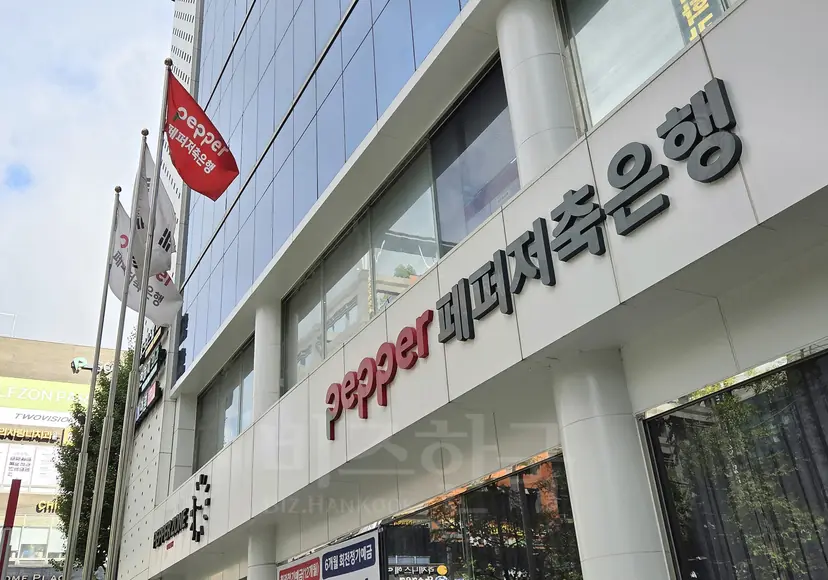
Pepper Savings Bank has faced criticism for its unstable financial structure over the past few years. As of the end of last year, its BIS capital adequacy ratio stood at 11.75%. Financial authorities recommend a BIS ratio of 12% or higher for savings banks with total assets exceeding 1 trillion won. Pepper Savings Bank’s total assets exceed 2 trillion won. The bank attempted to bolster its capital through a 30 billion won paid-in capital increase in January of this year, and raised its BIS ratio to 12.42% in March.
The multi-year deficit is also a problem. The bank recorded net losses of 96.1 billion won in 2024 and 55.5 billion won in 2025. It cannot continue to rely on its parent company without recovering profitability.
Consequently, Pepper Savings Bank has recently been actively working to improve its financial structure and profitability. Following two rounds of voluntary retirement last year, it is pursuing another round involving approximately 150 employees this year. It also sold its professional women’s volleyball team, the AI Peppers, to SOOP. Interest expenses were also reduced, falling 32.35% from 121.1 billion won in 2024 to 82 billion won in 2025.
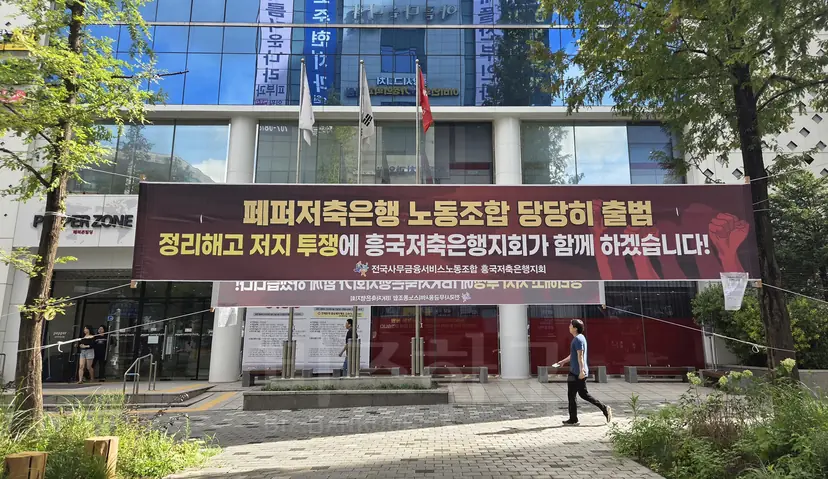
The successive rounds of voluntary retirement have triggered internal backlash. In July, employees established the "Pepper Savings Bank Chapter of the Korean Financial Services Union," opposing what they describe as unilateral restructuring by management. They argue that while the company's crisis is the result of reckless management by the executives, it is the employees who are bearing the consequences.
The union presented five major demands: immediate cessation of negotiations regarding unilateral/illegal forced layoffs and the selection criteria for the third round of layoffs; faithful consultation with the majority labor union in accordance with laws and regulations; immediate resignation of those responsible for reckless management; complete withdrawal of the hasty restructuring plan; and the establishment of concrete measures by major shareholders for business normalization. Furthermore, they declared, "Based on the rights of association and collective bargaining guaranteed by law, we will fight until the end to crush attempts at unilateral dismissals and normalize our workplace."
However, one month after the launch of the union, there is no sign of a resolution to the conflict. A union official said on the 27th, "We met with management for negotiations, but there has been no progress." A spokesperson for Pepper Savings Bank stated, "We are conducting necessary procedures while complying with relevant laws and regulations."
Pepper Savings Bank's management indicators have recently improved. The deficit for the first quarter of this year was 7.2 billion won, a 70% decrease compared to the same period last year. Once the sale of the professional women's volleyball team is finalized, cost-saving effects are expected to grow. The annual operating cost of the volleyball team is known to be around 7 billion to 8 billion won. Given these improvements, some are questioning whether there are ulterior motives behind the continued layoffs.
Some have raised the possibility of a sale, suggesting that downsizing the company would make the sale process easier. Pepper Savings Bank was previously up for sale last year. At that time, OK Financial Group went as far as conducting due diligence, but the sale ultimately fell through.
In July of this year, the parent company of Pepper Savings Bank was changed from "Pepper Europe" to "Pepper Korea Holdings." Pepper Korea Holdings is a domestic entity and a related party to Pepper Savings Bank. Since Pepper Korea Holdings owns 100% of Pepper Savings Bank's shares, acquiring Pepper Korea Holdings effectively means acquiring the savings bank as well.
While the specific shareholder composition of Pepper Korea Holdings has not been disclosed, Australia’s Pepper Group is known to be the largest shareholder, with SG Private Equity (SG PE) as the second-largest. It is reported that SG PE invested approximately 140 billion won in Pepper Savings Bank last year. Choi Chang-hae, CEO of SG PE, is listed as a non-executive director at Pepper Korea Holdings. If the Pepper Group sells additional shares of Pepper Korea Holdings, management control of Pepper Savings Bank will effectively be transferred.
However, Pepper Savings Bank has not officially commented on a potential sale. Regarding the change in the largest shareholder, the bank stated that it is "part of an internal restructuring of the group's governance."