

[BizHanKook] The 2026 regular National Assembly audit concluded its 20-day marathon with the final sessions of the Steering Committee and the Intelligence Committee on the 30th of last month. However, the evaluation is far from positive. The audit was once again marred by political strife and disruptions amid extreme confrontations between the ruling and opposition parties. The entrenched practice of “lining up business leaders” and subjecting them to “shouting and humiliation” continued, with business figures accounting for a staggering 44% of all witnesses and reference witnesses summoned this year. This is why the business world is criticizing the audit as having "changed nothing."
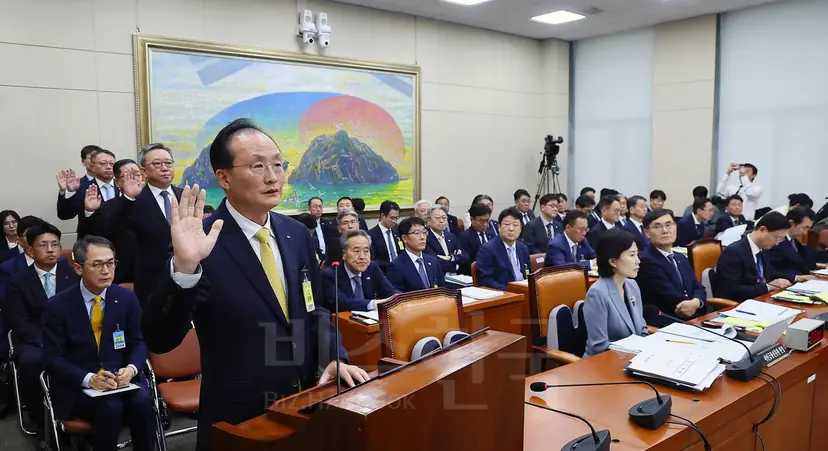
44% of National Assembly audit witnesses and references are business figures
According to data compiled by the National Assembly Audit NGO Monitor Group and the Korea Economic Daily, there were 171 instances where business leaders were summoned as general witnesses or reference witnesses during this year's audit. This figure accounts for 43.6% of the total 392 summons. Excluding duplications, 132 individuals were called, and 97 of them appeared in audit rooms a total of 116 times.
The targets were primarily platform companies. Google Korea CEO Yoon Koo appeared a remarkable five times across various standing committees, including the Science, ICT, Broadcasting and Communications Committee, the National Policy Committee, and the Gender Equality and Family Committee. Beyond long-standing issues like Google’s mandatory in-app payment fees, avoidance of network usage fees, and abuse of YouTube’s market dominance, the recent "digital sex crime victim information exposure incident" was brought to the table, prompting CEO Yoon to offer an apology.
The series of hacking incidents was another major issue raised during this year's audit. Tving CEO Choi Ju-hee appeared three times before committees such as the Science, ICT, Broadcasting and Communications Committee and the National Policy Committee after facing harsh criticism over a massive customer data breach. Addressing lawmakers' rebukes regarding "negligent security management," Choi stated, "It is presumed to be a malicious, AI-based attack," but added, "I acknowledge and deeply regret that our security investments and response speed were insufficient compared to the speed at which hacking techniques and AI are evolving."
On the 19th, the heads of the five major banks—Kookmin, Shinhan, Hana, Woori, and NongHyup—gathered at the National Policy Committee regarding the hacking incidents. This was the first time in four years that all five CEOs had appeared together since the string of major financial accidents in 2022.
Lawmakers criticized them for inadequate responses to hacking. It was pointed out that Shinhan Bank and Hana Bank took 15 hours and 26 minutes and 41 hours and 44 minutes, respectively, to detect hacking attacks, while KB Kookmin Bank failed to prevent additional leaks despite detecting the initial attack. There was also intense criticism regarding the fact that Kookmin Bank and NH NongHyup Bank had only spent 58% and 53% of their respective information security budgets last year. The bank CEOs unanimously promised to increase security investments, hire more personnel, upgrade systems, and compensate for damages.
"They tell us to answer only yes or no..."
Following the conclusion of the National Assembly audit, concerns from the business, financial, and IT platform sectors remain consistent: "We knew it would be like this." Although dedicated public relations teams and executives spent months preparing answers and drafting anticipated Q&As, they were met with shouting in the audit room—"Answer only yes or no," "Keep it short"—leaving no room for substantive explanation.
A public relations official at a platform company noted, "Business leaders clear their schedules all day to prepare for the audit, but the sessions only focus on issues already exposed in the media, and we are given barely one to three minutes to respond. It is disappointing that the method remains one of merely demanding apologies and accountability, while policy support and legislative guidelines are nowhere to be found."
A financial sector official remarked, "While it was meaningful in highlighting significant issues within the management systems of financial firms and authorities, no one could have fully prepared for a situation where AI-assisted hacking is surging across all industries. It felt more like the political sphere was sending a message to the financial sector with an eye on the bank CEOs' tenures."
A business insider advised, "What dominated this audit was not policy or sound criticism, but the creation of 'Shorts' videos designed for algorithms. If they truly respect business leaders, I hope the ruling and opposition lawmakers will refrain from finger-pointing and shouting, and instead transform the audit into a forum where they listen to the industry's difficulties and discuss legislative directions to improve chronic problems together."