

[비즈한국] As the barrier to entry for loans in the financial sector rises, Online Investment-Linked Finance (P2P finance) is gaining attention. With banking loan regulations driving medium-to-low credit borrowers and investment demand into the P2P market, the total loan balance has exceeded 2 trillion won for the first time. Attention is now focused on whether the P2P industry can maintain its growth trend as companies continue to shut down following a prolonged downturn, and as financial authorities begin applying stricter loan regulations to the sector.
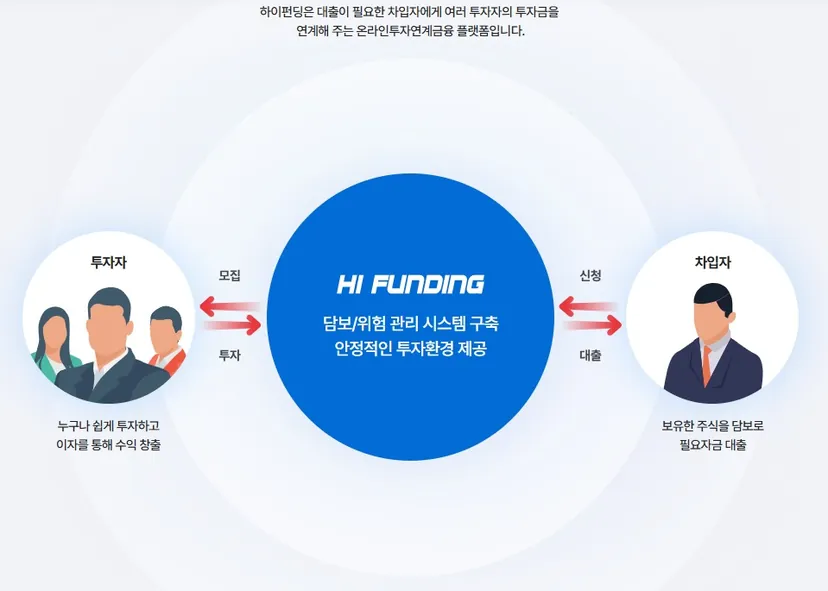
Interest in P2P finance is growing due to loan restrictions in the traditional financial sector. P2P finance refers to platforms that connect investors with borrowers, providing the investors with the right to receive principal and interest payments from the loans. Borrowers who need funds but find it difficult to use traditional financial institutions can receive loans at moderate interest rates, while investors can earn higher returns than savings accounts even with small investment amounts.
According to the Online Investment-Linked Finance Central Recording Management Agency (P2P Center), as of June 2026, there were 47 P2P firms registered with the Financial Services Commission, 46 of which had signed information provision agreements with the P2P Center. As the number of businesses closing in the P2P market increases, the number of institutions using the P2P Center has also declined. The number of participating institutions decreased from 54 in June 2021 to 51 in 2024, and further dropped to 46 by the end of 2025.
Although the number of companies has decreased, the market size has grown. The P2P loan balance has increased rapidly over the past year. This is because P2P loans are gaining attention as an alternative while the government tightens household debt. The loan balance of firms using the P2P Center decreased slightly from 1.1108 trillion won in June 2023 to 1.0813 trillion won in June 2024, before rising to 1.2339 trillion won in June 2025. Following this, the growth rate accelerated, with the loan balance surpassing 2 trillion won in April (2.0611 trillion won) and reaching 2.3027 trillion won in June of this year.
The landscape of the P2P market has also changed. In the past, the largest portion of loans in the P2P market consisted of real estate-backed loans, but that position has been taken over by other collateralized loans such as stock-backed loans (stock loans), music copyright/artwork-backed loans, and solar power-backed loans. The proportion of personal credit loans, which had been in a long-term decline, has also recently turned toward growth.
Looking at the loan balance proportion by P2P product type at the end of 2022, real estate collateral was overwhelmingly dominant at 70%. Other collateral products accounted for only 5%. However, this structure centered on real estate loans changed along with the market downturn, including the insolvency of real estate project financing (PF). By the end of 2023, the share of real estate-backed loan balances had fallen to 60%, while the share of other collateral products had risen to 10%.
The proportion of real estate-backed loans continued to decline. It dropped to 54% at the end of 2024 and 41% at the end of 2025, reaching 39% in January 2026. During the same period, the loan proportion of other collateral products grew to 24%, 39%, and 40%, eventually overtaking real estate collateral. As of June this year, the share of the loan balance for other collateral increased to 44%, while real estate collateral fell to 30%.
In particular, the loan proportion for real estate PF products dropped to 1%, and no new products were released in the first half of this year. Related companies are also experiencing operational difficulties or closing down. Tera Funding, the first domestic real estate P2P platform, shut down late last year, and WeFunding, which mainly handled real estate PF investment products, announced a change in business policy last January due to a management crisis.
WeFunding stated, "We are in a difficult management environment due to the worsening real estate market and the prolonged delay in the recovery of existing claims. We have stopped handling new products and shifted our operations to focus on asset management and recovery for existing investors. We will concentrate all our capabilities on increasing the possibility of recovery." As of June, WeFunding's delinquency rate was 72% for real estate PF products and 80% for real estate-backed products.
On the other hand, stock loans grew rapidly, bolstered by a booming stock market and loan regulations. According to the Financial Services Commission on the 16th, the stock loan balance stood at 898.3 billion won as of June, an increase of 374.5 billion won in the first half alone, marking a 71% rise compared to the end of 2025. Stock loans are products that allow for borrowing up to three times the value of assets (stocks and cash) held in a securities account as collateral. The loan proceeds are deposited into the securities account and cannot be used for other purposes.
However, as demand for stock loans grew, financial authorities stepped in with sanctions to prevent "debt-fueled investing." On the 16th, the Financial Supervisory Service issued administrative guidance ordering P2P lenders to keep monthly new stock loan originations within 30% of the previous month's new originations and to manage individual borrower limits to within 1 billion won. However, those who keep their monthly ending stock loan balance at or below the June balance after July will be exempt from these regulations.
As it became more difficult to obtain loans from traditional financial institutions, more people turned to P2P personal credit loans. The proportion of personal credit product loan balances increased from 10% in January of this year to 19% in June. The share of personal credit products had declined annually from 13% at the end of 2022 to as low as 3% in June 2025, before turning to growth at the end of that year.
Although the P2P loan balance has increased, the situation for the industry remains difficult. This is due to the fact that many firms have suspended operations or closed down amid a long-term slump, and the industry is now feeling the effects of loan regulations. When the government announced household debt management plans last April, it applied loan-to-value (LTV) ratios and loan limit regulations by housing price to P2P finance as well. While demand shifted toward stock loans amid restrictions on real estate loans, the growth trend is expected to face a brake due to the administrative guidance. An industry official noted, "Stock loans are far from the purpose of P2P finance, which is to improve financial blind spots. Furthermore, because these are high-risk products susceptible to forced liquidation, management is necessary."