

[비즈한국] OliX stated that the rejection of its clinical trial application for the macular degeneration treatment 'OLX301A' in New Zealand was due to procedural communication errors, and announced that it would swiftly proceed with a re-application. The company emphasized that the rejection was not caused by any fundamental issues in the clinical trial design.

Around 80 shareholders attended an IR briefing held at the OliX R&D Center in Seongnam, Gyeonggi Province, on the 19th. One attendee remarked, "It seems the company prepared for this meeting with sincerity."
The briefing was arranged to address shareholder concerns regarding the recent rejection of the OLX301A Phase 2a clinical trial application in New Zealand and to share the progress of major new drug pipeline developments.
OliX disclosed on the 12th that the New Zealand Health and Disability Ethics Committee (HDEC) had rejected its Phase 2a clinical trial application for OLX301A. The company explained that the ethics committee determined the application did not meet local ethical standards and relevant regulations. Specific details regarding the unfulfilled requirements were not disclosed.
The stock price fluctuated significantly following the disclosure of the rejection. OliX's stock fell approximately 28% from a closing price of 118,000 won on the 8th to 85,100 won on the 15th. It has since rebounded, reaching as high as 101,700 won during intraday trading on the day of the IR briefing.

Amid growing shareholder anxiety surrounding the trial rejection, OliX CEO Lee Dong-ki, who is currently on an overseas business trip, attended the briefing online to offer a personal apology. "As CEO, I am truly sorry for the concern this announcement has caused our shareholders," Lee said, but added, "This matter does not affect the overall development direction of the OLX301A clinical program or the intrinsic value of the asset."
"Clinical trials applying new approaches can involve various inquiries and additional discussions during the consultation process with regulatory agencies," he continued. "While this is a solvable issue, I take full responsibility for the company's failure to conduct the procedures more closely and smoothly."
Kang Choong-gil, President of Management Support at OliX, also met with reporters after the briefing, stating, "Procedural problems, including a minor communication error, occurred during the submission and clarification process. We plan to re-apply as early as this week."
He added, "While the perspectives of ethics committees may differ slightly from country to country, this is an issue that can be sufficiently clarified. I believe that rather than explaining in words, the most certain answer will be to secure official approval next month."
However, as the specific reasons for rejection and the scope of the required supplements have not been publicly detailed, it remains to be seen whether the company can resolve the issue and receive clinical trial approval through the upcoming re-application.
OLX301A is an siRNA (short interfering RNA)-based macular degeneration treatment that inhibits MyD88, which is involved in inflammatory signaling. OliX completed Phase 1 trials in the U.S. last November and is currently pursuing a global Phase 2a trial involving 64 patients across Australia, New Zealand, the U.S., and South Korea.
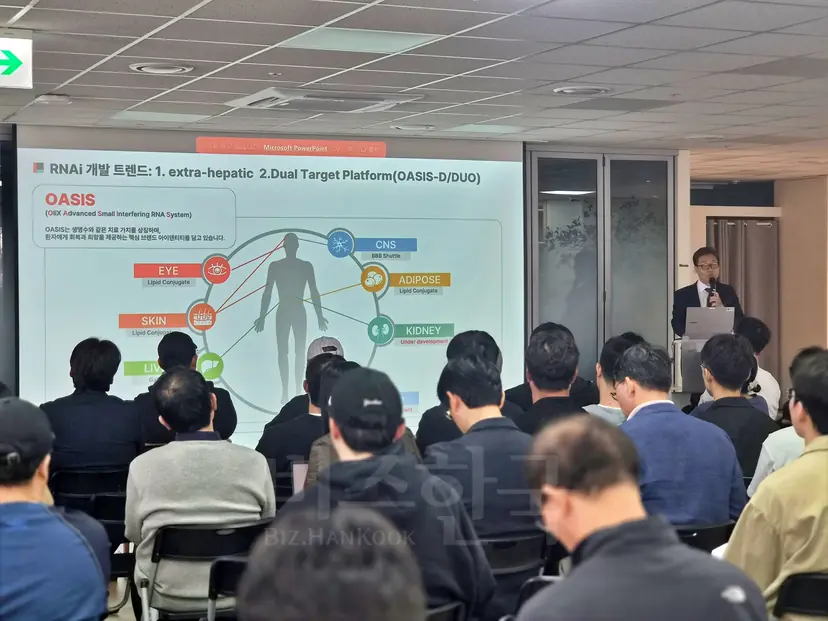
The briefing also covered development schedules and progress, including negotiations for technology transfers for other pipelines.
OliX clarified that the rejection has not impacted technology transfer negotiations. An official in charge of business development, who attended online from abroad, stated, "We are currently in smooth discussions regarding technology transfers with multiple partners."
"We are engaged in in-depth discussions for both our platform and specific pipelines," CEO Lee said. "Some of our various discussions have reached a stage beyond the initial introduction phase."
The obesity treatment OLX501A is targeting an Investigational New Drug (IND) application in the first half of next year. Notably, unlike existing GLP-1 class drugs, it is being developed to selectively reduce fat while minimizing muscle loss, with plans to conduct co-administration tests with tirzepatide in the future. The MASH (Metabolic Dysfunction-Associated Steatohepatitis) treatment OLX702A, which was licensed to Eli Lilly, is expected to receive its Clinical Study Report (CSR) in the fourth quarter of this year.
Regarding finances, the company maintains that it can continue mid-to-long-term R&D without additional capital raising. Kim Young-jin, CFO of OliX, stated, "Considering our current cash reserves and expenditure trends, we can maintain stable operations without additional funding until 2030. We also expect our revenue this year to exceed our R&D expenditures."