

[BizHanKook] NVIDIA’s expanding business in Korea goes far beyond just supplying graphics processing units (GPUs). The company is applying its software to train robots in virtual environments and verify their performance before they are deployed into actual factory floors, while also integrating domestic neural processing units (NPUs) into its server racks. At the ‘NVIDIA AI Day Seoul 2026,’ held at COEX in Gangnam-gu, Seoul, on the 9th and 10th, specific examples of these technologies being applied by Korean companies were unveiled.
Humanoids hanging washing machine covers, sanding robots finding the perfect recipe
For robots to perform tasks on actual manufacturing floors, they must acquire diverse work data, learn from it, and undergo a process of verifying their movements and performance before being deployed in real-world environments. NVIDIA is broadening the scope of its collaboration by incorporating its simulation and learning solutions into this development process.
LG Electronics, centered around its LG Data Factory under the Robotics Business Center, is building a system that covers the entire lifecycle—from collecting, generating, and augmenting data required for Physical AI training, to model learning, and final deployment and verification on the actual manufacturing floor. This is what they call a ‘data flywheel,’ connecting everything from data acquisition to field application.
Park Jung-seop, team leader of the Robotics Intelligence Team at LG Electronics, introduced the collaboration, stating, “We are handling the entire flywheel, from collecting, generating, and augmenting data to refining data, training models, and deploying/verifying them on real manufacturing sites. We are accelerating this process by utilizing various NVIDIA solutions.”
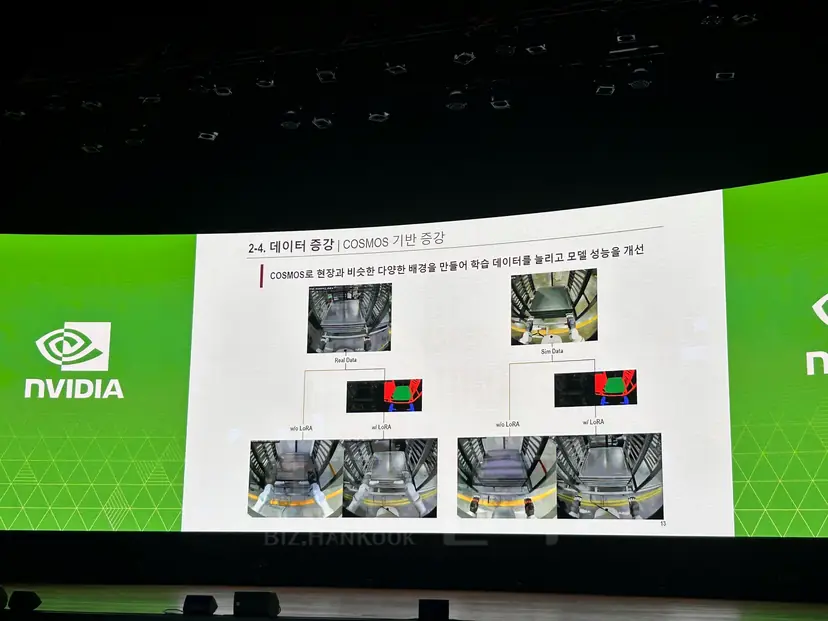
Recently, LG Electronics deployed a humanoid trained at the Yangjae Data Factory to a washing machine production line for live testing. It performed the repetitive task of hanging a top plate of a washing machine, weighing approximately 4kg, onto a hanger. Team Leader Park explained, “Humans find this repetitive task difficult due to risks of musculoskeletal disorders and fatigue, so we deployed the humanoid to replace these specific roles.”
Doosan Robotics is developing technology that allows robots to determine operational conditions on their own before being deployed to a manufacturing process. The target is the sanding (polishing) process for metal surfaces. Sanding quality depends on the ‘recipe,’ which is a combination of the robot's path, sandpaper grit, contact pressure, speed, and number of repetitions. Currently, it is standard practice for workers to set these recipes for every part, check the results, and then re-adjust the conditions.
Son Kyung-chan, team leader of the Physical AI Platform at Doosan Robotics, said, “Most current robotic sanding cells operate on a repetitive cycle where workers manually set recipes for each part, perform the sanding, check the results, and then fix the settings. The problem is that it can take anywhere from a few hours to several days per part, sometimes even over a week on-site.” What Doosan Robotics envisions is an AI agent that derives the optimal recipe for each part and verifies it through simulation before the actual work begins. Team Leader Son emphasized, “If it previously took about 100 iterations to achieve a high degree of part completion, the goal is to create a cost-effective solution by reducing that number through simulation. Simulation is essential in the verification stage before execution.”
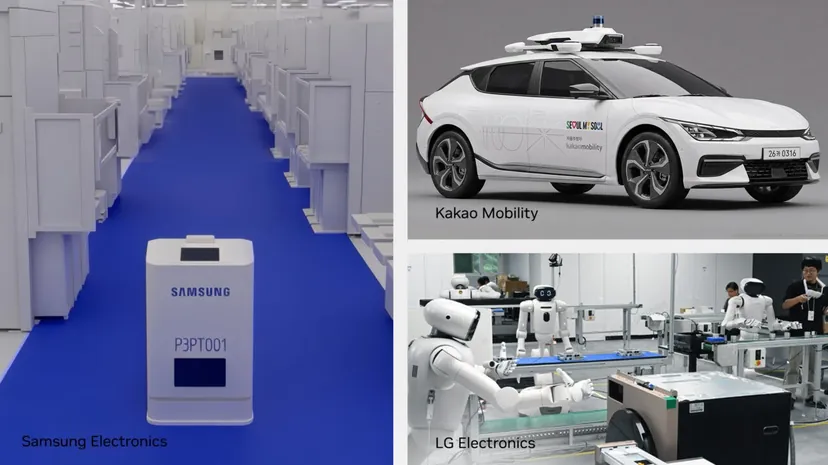
A similar trend is emerging in the semiconductor sector. Samsung Electronics is leveraging NVIDIA’s PhysX Nemo to advance thermal and mechanical analysis at the chip level. In a case combining AI-predicted material properties, coarse computational grids, and GPU acceleration, calculations that used to take about 18 hours on a 32-core CPU were reduced to 41 seconds. This resulted in an approximately 1,600-fold speed improvement for specific simulations.
NVIDIA is widening its scope of involvement in clients' technical development processes by supplying not just GPUs, but also the software and development/verification tools that utilize them.
Embracing domestic NPUs, but what are the variables and challenges?
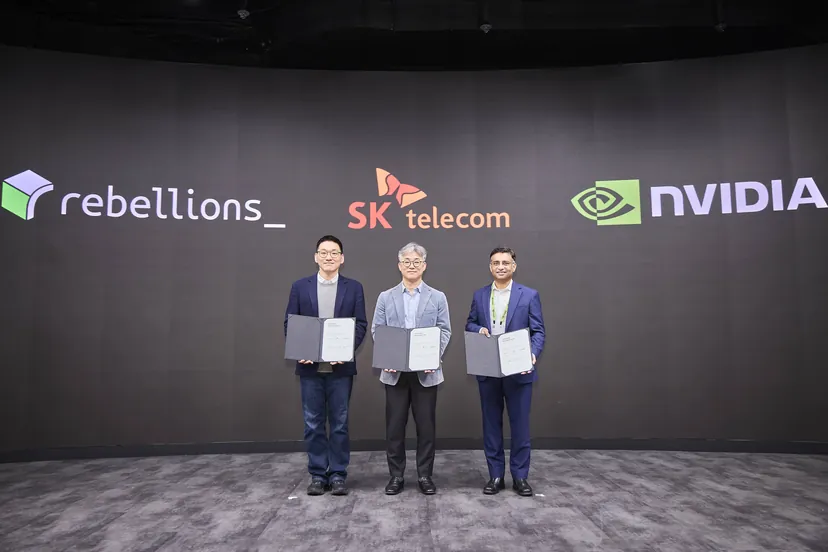
In the field of AI infrastructure, collaboration has been established to connect domestic AI semiconductors to the NVIDIA platform. SK Telecom, NVIDIA, and Rebellions signed an MOU to develop a GPU/NPU integrated system based on ‘NVLink Switch.’ NVLink Switch is a technology that supports the application of external accelerators to NVIDIA’s AI computing systems.
The core of this collaboration is splitting the AI inference process between the GPU and the NPU. NVIDIA GPUs handle ‘prefill,’ which processes input prompts and context, while Rebellions’ NPU, the ‘REBEL R200,’ handles the ‘decode’ phase, which sequentially generates answers. SKT plans to verify an integrated system applying the MGX server rack design standard at its own AI data center and explore its potential for commercialization. This structure allows domestic NPUs to play a role within the NVIDIA platform.
Collaboration with domestic AI models and startups is also expanding. NVIDIA has decided to support the use of its inference optimization software, ‘Dynamo,’ for three consortia selected for the government’s ‘Everyone’s AI’ project and four major domestic foundation model developers. Among Korean AI startups, NVIDIA announced an investment in semiconductor interconnect company Point2 Technology and revealed plans for additional investments in Motif Technologies, Realworld, and Upstage. The scope of cooperation is broadening from AI infrastructure and semiconductors to models and real-world industrial applications.
However, there are still challenges to overcome before Physical AI can spread throughout the entire manufacturing sector. Robots trained in virtual spaces must be able to work reliably under various conditions, such as friction, contact, and variations between parts in real-world environments. Reducing the margin of error between simulation results and actual work is crucial. Vice President Tala also emphasized on-site that “in the field of Physical AI, issues regarding accuracy, reliability, and safety have not yet been fully solved,” noting that these factors, along with economic feasibility, must be secured for large-scale commercialization of Physical AI.
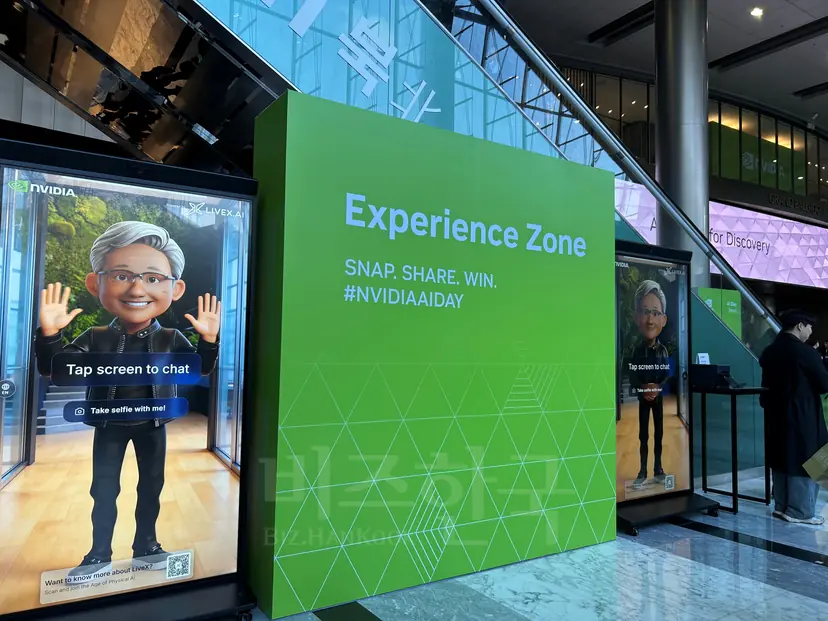
Controversy surrounding NVIDIA CEO Jensen Huang has also emerged as a variable. The Financial Times reported on the 6th (local time) that U.S. intelligence authorities suspect Alice Huang, a former executive at Singaporean data center company Megaspeed, of being recruited by Chinese intelligence agencies and having had a personal relationship with CEO Huang. In an email sent to employees on the 8th, CEO Huang admitted to and apologized for an extramarital affair. The NVIDIA board of directors stated that they have engaged outside legal counsel to launch an independent investigation, adding that there is no evidence to date that national security or company secrets have been compromised.
The visit to Korea by NVIDIA Senior Director Madison Huang, eldest daughter of the CEO, who had been discussing Physical AI cooperation with domestic companies, was also canceled due to family reasons. Originally, meetings with the Minister of Science and ICT and visits to domestic companies were scheduled, but these related events were scrapped.
The chairs of three U.S. House committees—Foreign Affairs, China, and Intelligence—have requested a private briefing from CEO Huang on the 18th. The House Democratic leadership is also urging the passage of a National Defense Authorization Act that includes provisions restricting China’s access to AI semiconductors. If U.S. semiconductor export regulations against China are tightened, it could indirectly impact not only NVIDIA’s product supply strategy but also Samsung Electronics and SK Hynix, which supply the related HBM. Vice President Tala stated on this day, “Korea will play a very important role in the development of Physical AI over the next 10 years.”