

[비즈한국] “I’m investing in your company! And yours! And yours, too!”
On the 14th (local time), Nvidia CEO Jensen Huang stood on a stage at an event in London, England, and shouted this. As if imitating American talk show host Oprah Winfrey, who famously gifted cars to her entire audience in 2004, Huang announced equity investments in five British startups specializing in fields like drug discovery and quantum computing. He then brought their CEOs onto the stage and, claiming he would pass on advice from his own investor Don Valentine, added:
“If you lose my money, I will kill you.”
The audience erupted in laughter. Valentine was the founder of Sequoia Capital, who invested in Nvidia when it was just a startup in 1993. It was a case of a founder who once received investment 30 years ago now becoming an investor and repeating the same words back.
The previous day in Paris, Huang had joked that he was “Europe’s largest VC (venture capitalist)” while announcing plans to invest in four French startups.
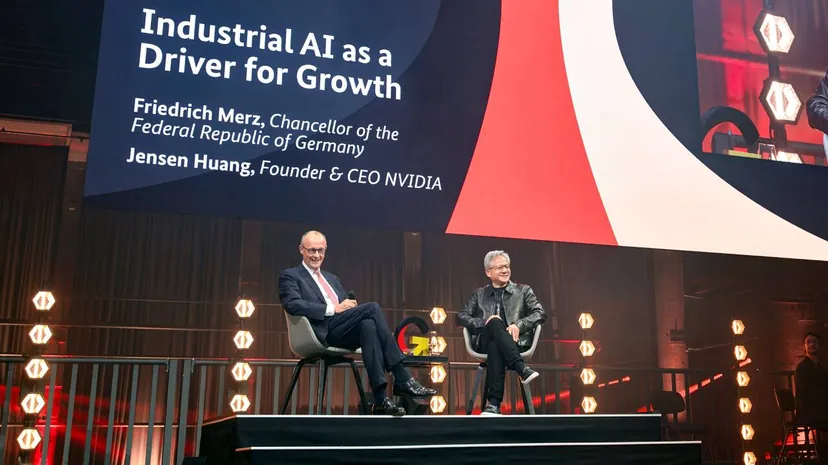
His final destination was Berlin. On the 19th, standing on stage alongside Chancellor Friedrich Merz in Berlin, CEO Huang announced plans to invest in four German startups. Four companies received Nvidia’s nod: Agile Robots, which has been previously featured in this European Startup Series, along with Mirelo, Reflex Aerospace, and Avelios Medical. What common thread connects these companies that have opened Nvidia’s wallet?
Why the Land of Manufacturing Called Nvidia
The atmosphere in Berlin was quite different. While the events in Paris and London were hosted by Nvidia itself, the Berlin event was organized by the German government. The ‘Invest in Germany Summit’ held on the 19th was the first investment attraction event ever held by the German federal government.
This is because Germany’s situation is desperate. After two consecutive years of economic contraction in 2023 and 2024, the German economy barely returned to growth last year, but over 120,000 manufacturing jobs were lost in the same period. The Federation of German Industries (BDI) has even described it as the most serious crisis since World War II. In an event organized by the land of manufacturing to attract investment once again, CEO Huang was inevitably the most important guest.
The two figures sat down at ‘Kraftwerk,’ an event space converted from an old thermal power plant. At the event, Chancellor Merz, the Federal Ministry for Economic Affairs and Climate Action, and the Federal Ministry of Education and Research signed a joint letter of intent with Nvidia. The goal is to combine Germany’s engineering and manufacturing capabilities with AI to jointly develop ‘Physical AI’ models that power robots and autonomous systems.
Chancellor Merz personally called upon the small and medium-sized enterprise (SME) executives in the audience, known as the ‘Mittelstand.’ He stated, “Germany’s greatest strength is the Mittelstand,” and urged them, “Open the doors to AI and utilize your data.” CEO Huang, who had occasionally cracked jokes at earlier events, was serious here. Regarding the knowledge accumulated by German manufacturing firms, he said, “That knowledge is yours and it cannot be replaced,” adding, “AI will only augment your capabilities, not replace them.”
On the 21st, Huang took the stage for his keynote address at ‘GTC Berlin,’ an Nvidia developer event held in Berlin-Kreuzberg. He defined AI not as a software trend but as a new industrial revolution and a form of manufacturing itself, emphasizing that Europe’s manufacturing and machinery base could take the lead in humanoid robots and industrial AI.
From Robots to Satellites, the 4 Cards Chosen by Nvidia
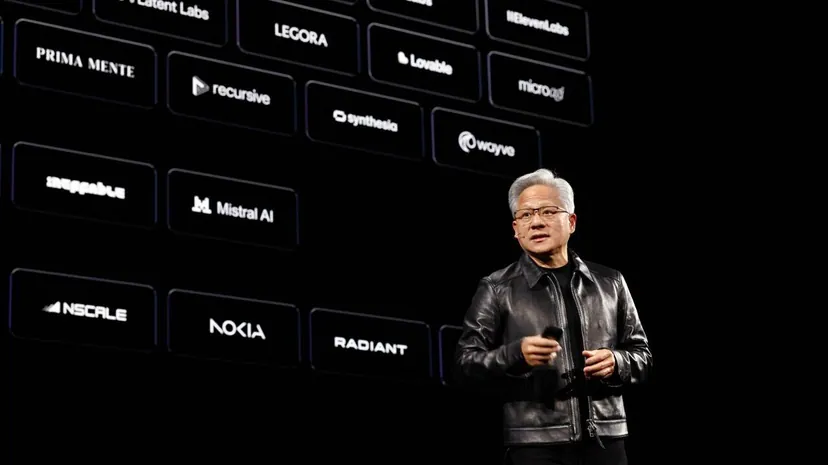
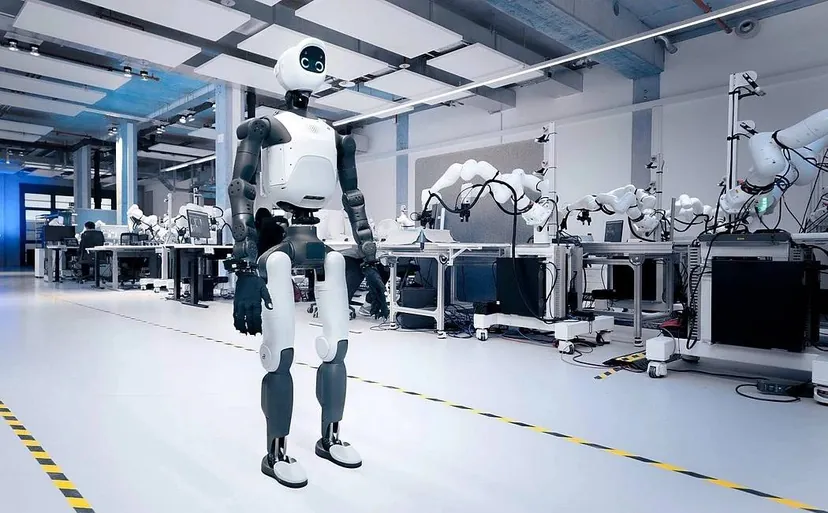
Huang’s words were not empty talk. That day, he unveiled ‘Agile One SN,’ a research model that mounts Nvidia’s robot platform onto Agile Robots’ humanoid, ‘Agile One.’ The goal is to reduce the time developers spend setting up robot experimental environments from weeks to days. Agile Robots, founded in 2018 by alumni from the German Aerospace Center (DLR), is the company most deeply intertwined with Nvidia among the four. It uses Nvidia’s robot AI models and cloud to train its robots.
Founded in 2023, the German startup Mirelo creates AI-generated sound effects that match videos. It generates sounds like footsteps, closing doors, and rainfall to synchronize with movements on screen. The two co-founders are AI researchers and musicians who met at an Amazon research lab. Last December, they received a $41 million (approx. 54.5 billion KRW) seed investment co-led by Index Ventures and Andreessen Horowitz (a16z)—an unusually large sum for a seed stage. The company stated that it had already been using Nvidia’s computing resources and startup support programs.
Reflex Aerospace, which has its headquarters in Berlin and a production facility in Munich, is a satellite manufacturer founded in 2021. While satellites for earth observation, reconnaissance, and communication typically take years to build, this company completes them in about a year. It attracted a 50 million euro (approx. 75 billion KRW) Series A investment last November. Reflex is participating as an initial partner in building a German space reconnaissance system promoted by a joint venture between German defense giant Rheinmetall and Finnish satellite firm ICEYE. Once the investment plan with Nvidia is finalized, it will be used for expanding production and developing in-satellite data processing platforms.
Avelios Medical is perhaps the most unexpected name of the four. Founded in Munich in 2020, this startup creates cloud-based hospital information systems. In 2025, it attracted a 30 million euro (approx. 45 billion KRW) Series A investment led by Sequoia. Hospital information systems are the core foundation where medical and administrative records are accumulated. Avelios was designed from the start to structure and record clinical data, which could become a critical contact point when applying AI to hospital operations. This is similar to Nvidia’s selection of the medical platform Doctolib in Paris. The timing is also good; SAP’s hospital software, used by over 500 German-speaking hospitals, is ending support in 2030, ushering in a time when hospitals must replace their entire systems.
Nvidia did not disclose the specific reasons for selecting each company. However, when looking at the four together, a common denominator emerges. All of them deal with fields where years of expertise must be accumulated—fields that are difficult to replicate with general-purpose AI alone. And these fields become markets that require massive amounts of Nvidia chips once AI is used in earnest. While Europe may have lagged behind the U.S. and China in the screen-based chatbot competition, it can take the lead in the ‘physical world’ of factories, hospitals, and satellites through its data and know-how. Nvidia is simply positioning itself there in advance.
The Double-Edged Sword of Being Both Investor and Supplier
In this tour, Nvidia revealed investments in a total of 13 companies: 4 in Paris, 5 in London, and 4 in Berlin. CEO Huang stated that Nvidia has invested $8 billion (approx. 10.6 trillion KRW) in Europe over the past year and is preparing billions more.
Nvidia’s investments provide European startups with capital, networks, and technical collaboration all at once. However, Nvidia is both an investor and a core technology supplier. As startups grow on the Nvidia platform, they risk being locked into a single company’s ecosystem. Some criticize this as ‘circular investment,’ where the chip company invests in firms that, in turn, buy its chips. While CEO Huang dismisses such criticisms, there is a lack of evidence to judge, as neither the investment amounts nor the chip purchase agreements have been disclosed.
There is also a paradox. Europe claims it will secure ‘digital sovereignty’ by breaking free from its reliance on U.S. Big Tech. Yet, the partner Germany chose for industrial AI and the entity investing in German startups is the U.S. company Nvidia. Even more ironic is that Jensen Huang actively promotes ‘Sovereign AI.’
The sovereignty Nvidia talks about is not about creating AI solely with domestic technology. It is closer to a model where countries keep and control their own data within their borders, while using Nvidia’s chips and software for the infrastructure. The logic is that even if the chips are American-made, sovereignty can be maintained if the data centers are on European soil. This logic may be a realistic way for Europe to gain control over data. At the same time, it changes the criteria for sovereignty while leaving the reliance on core technology intact. Europe’s digital sovereignty goal is quietly shifting from ‘self-reliance’ to ‘management.’
However, this announcement is still just a plan. Investment amounts, equity stakes, and valuations have not been disclosed, and the deals are not yet finalized. The remaining challenge is whether these four companies can actually prove their capabilities in the field.
This Berlin announcement shows that the stage for AI competition is expanding beyond the screen into factories, hospitals, and space. Korean companies are also expanding cooperation with Nvidia on manufacturing and AI infrastructure. The Hyundai Motor Group is pursuing AI infrastructure for manufacturing and autonomous driving, while SK is pushing for AI factories and memory cooperation. In the sense of bringing in chips and platforms to install AI in factories, the path is the same as Germany’s. The remaining question is also the same: Can we turn the data and experience accumulated in our factories into our own technology, or will we remain stuck ‘managing’ an industry on someone else’s platform?
Author Lee Jung-woo is a journalist with 17 years of experience, having covered diverse sectors including major industries such as automotive, secondary batteries, and heavy industry, as well as national defense, diplomacy, environment, education, and health/welfare. He has reported extensively on-site regarding mobility, energy transition, and changes in industrial structure centered on sustainability. Currently, he resides in Berlin, Germany, and serves as a partner at the startup accelerator ‘123 Factory.’