

[BizHanKook] The 'Nuclear Power Public Deliberation Committee (Deliberation Committee),' launched ahead of the establishment of the 12th Basic Plan for Electricity Supply and Demand, faces a crisis of disruption before its first public debate scheduled for November 25. This comes as members of the committee's expert panel representing the pro-nuclear expansion side declared a temporary suspension of activities, citing objections to the premises and scope of the discussions. Having experienced difficulties early on due to environmental groups refusing to participate, the committee now faces concerns that it may degenerate into a "half-baked deliberation" as even the pro-nuclear expansion camp leaves just before the public opinion gathering process.
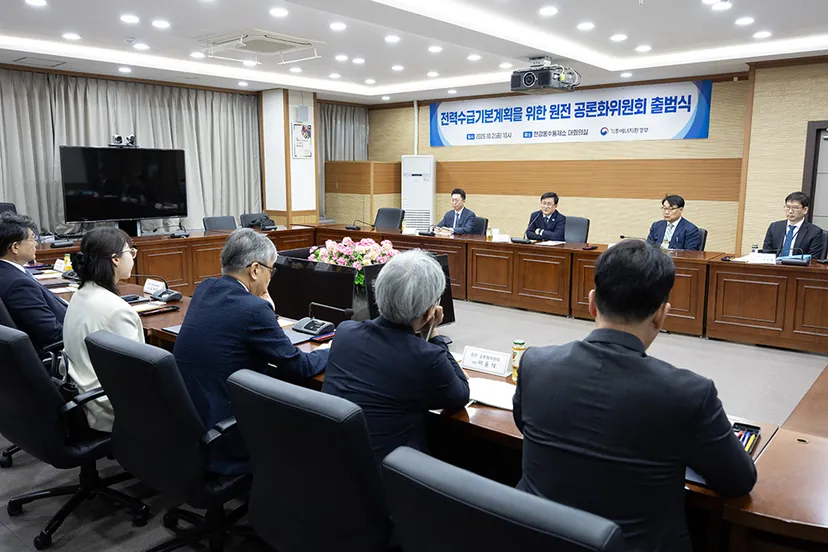
Direct clash over the scope and premises of '2040 vs. 2050' discussions
Three members of the Deliberation Committee’s expert panel representing the pro-nuclear expansion side (Professor Jeong Bum-jin of Kyung Hee University, Professor Jeong Yong-hoon of KAIST, and Professor Choi Sung-yeol of Seoul National University) issued a statement on the 23rd, announcing the temporary suspension of their participation until the objectives and scope of the discussions are clearly defined. The reason for their boycott is a conflict surrounding the "scope of discussion" and "prerequisites" for the deliberation.
The expansionist members argued that it is difficult to gauge the long-term direction of energy transition based solely on the power generation mix in 2040, and that the future share of nuclear power can only be properly reviewed by looking ahead to 2050. They also cited the difficulty of reviewing future nuclear power shares while treating existing renewable energy expansion policies and the 2050 carbon neutrality plan as immovable prerequisites.
The expert panel is a body responsible for advising on deliberation agendas and detailed issues, participating in public debates, and drafting deliberation materials for the civic participation group. It was composed of a total of 9 members on October 21 at the committee’s 3rd meeting: 3 for environment (reduction), 3 for nuclear power (expansion), and 3 neutrals.
The boycott declaration by the expansionist members came two days before the first public debate, which the committee planned to hold on November 25 from 8:30 AM to 12:00 PM at the Jeongdong 1928 Art Center event hall in Seoul. The public debate was designed to feature presentations and mutual discussions between expert members from the reduction and expansion factions across two sessions—"What should our society consider in future power supply?" and "What is the role of nuclear power in our future society?"—followed by a Q&A session with the audience and YouTube viewers. As the debate video was intended to be used as material for the 300-member civic participation group to study in advance, the schedule has now faced a setback.
Reduction side counters: "No personnel or data to review beyond 2050"
There are two points of contention between the expansion and reduction sides. The first is the temporal scope of the "future nuclear power share" to be included in the civic participation group's deliberation survey. The expansion side insists on asking for the proportion of power generation sources not only for 2040 but also for 2050.
The expansionist members criticized, "According to existing plans, the electricity supply and demand plan up to 2038 can be considered already established, so the future that this deliberation should address is from 2039 onwards," adding, "The initial committee proposed presenting projections for power generation sources for both 2040 and 2050 and asking for the civic group's opinion, which we accepted. However, the reduction side insisted on discussing only the 2040 share, and the committee postponed it, saying they would discuss it gradually in the future." They emphasized, "2040 is only two years after 2038, when the 11th Basic Plan period ends. It is difficult to achieve the initial goal of determining future nuclear power shares by discussing only 2040."
Conversely, the three expert members from the reduction side (Professor Yoon Soon-jin of Seoul National University’s Graduate School of Environmental Studies, Seok Gwang-hoon, expert committee member at the Energy Transition Forum, and Han Byung-hwa, Director at Eugene Investment & Securities) issued a counter-statement, criticizing the expansionist side's claims as "irrational behavior and psychological warfare."
The reduction side retorted, "Long-term power demand forecasting is a task established by a support group with practical capabilities that aggregates statistics and projections by economic sector and institution. Even the 12th Basic Plan working group, which has been reviewing power demand and power mix up to 2040, has accumulated data over more than 10 months," adding, "There is no separate working-level personnel or objective data to handle a 2050 power demand and power mix that transcends this, and it is not a problem that can be handled in a short period of two to three weeks."
The reduction side argued, "Asking for a 25-year power demand forecast and mix, which exceeds the 15-year plan period of the 12th Basic Plan, based on the intentions of nuclear pro-and-con factions without objective evidence and practical support, is unscientific behavior that damages the credibility and authority of the entire deliberation process," and added, "The only reason the expansion side is insistently pushing for 2050 can be seen as psychological warfare to stimulate public anxiety with hasty demand forecasts and power mixes to add new nuclear plants beyond the Basic Plan."
Some analysts suggest that the expansion side is insisting on 2050 due to the realistic constraint of nuclear construction time. Lee Heon-seok, policy committee member of Energy Justice Actions, explained, "The Yeongdeok nuclear plant finalized in the 2023 11th Basic Plan is scheduled for completion in 2038. Counting backward, even if the deliberation committee decides to build new nuclear plants, they cannot enter the power plan by 2040." Lee added, "The nuclear industry knows that most of the power demand from the three major mega-projects is needed in the 2030s, and that nuclear power cannot contribute to that. Isn't that why they are insisting on extending the deliberation scope to 2050?"
The second point of contention is whether to take existing energy policies as a premise. The expansion side raised the issue, saying, "The committee asks us to discuss future shares while keeping existing renewable energy expansion policies and the Carbon Neutrality 2050 plan established by the Moon Jae-in administration as prerequisites. It is difficult to broadly review the policy directions we can choose if we treat existing plans as immovable premises."
However, the premises and scope of the deliberation were already decided and announced during the committee's launch and early meetings. On September 22, in a briefing on the deliberation promotion plan, Minister of Climate, Energy, and Environment Kim Sang-hwan presented the purpose of forming the committee for the 12th Basic Plan along with the premise of reducing carbon emissions in the power sector to achieve carbon neutrality. The Basic Plan, established every two years under Article 25 of the Electric Utility Act, is a 15-year plan; the 12th Basic Plan’s planning period ends in 2040.
The committee also decided at its 2nd meeting on October 14 to exclude four items from the scope of discussion: whether to continue operating individual nuclear plants, individual nuclear projects for which sites have already been confirmed, the government-announced renewable energy supply targets, and the selection of sites for specific regions. Expert members, including those from the expansionist side, were appointed after this principle was announced.

Committee: "If they don't participate, it will be converted to an information session… deliberative debate to proceed in December"
The committee stated its position to proceed with the scheduled itinerary according to its principles. Releasing a press reference on November 23, the committee stated, "We will keep the door open for the expert members from the nuclear expansion side to rejoin at any time," but added, "If participation is not confirmed by just before the public debate, we will convert the event into an 'information session' led by neutral members of the expert panel to explain the topics of the deliberation and the points of contention from both expansion and reduction sides." This decision was made based on the judgment that if only one side participates to present their arguments, biased information could be delivered to the public and the civic participation group.
The committee also proposed a compromise to bridge the conflict. The proposal was to ask for upper and lower limit figures for the nuclear power generation share in 2040, while suggesting long-term directions for nuclear power (reduction, maintenance, expansion) instead of figures for the period after 2041. It was a mediation plan to leave the presentation of 2050 power demand forecasts as an optional matter, where if one side deems it necessary, they can present their position and evidence, and the other side can rebut it.
The committee explained, "We are not trying to exclude the future beyond 2041 from the deliberation, nor are we trying to adopt the 2050 forecast as a common premise. Since the two sides have different approaches to looking at the mid-to-long-term future, the intention is to have each side present their evidence in their own way, allow mutual review, and then entrust the judgment to the civic participation group." The expert members from the expansionist side did not accept this mediation plan and continued their boycott.
The committee plans to proceed with the deliberative debate for the civic participation group, scheduled for three days and two nights from December 11 to 13, as planned. It also announced that it would include the arguments and evidence prepared by the expert panel in the deliberation materials to be delivered to the civic participation group.
This disruption crisis is seen as being in line with the limitations that were predicted from the time of the committee’s launch. The government launched the committee on October 2 after reporting to the State Council on September 22, aiming to supplement the limitations of the rough public opinion polls conducted during the 11th Basic Plan and to decouple the nuclear issue from partisan and ideological frames. The plan was to submit recommendations to the government in December while considering carbon neutrality, economic feasibility, and safety, while preparing for the increase in power demand due to the spread of AI and the growth of high-tech industries such as semiconductors and electric vehicles.
However, difficulties have persisted since the launch. Environmental groups protested, claiming the government was pushing for deliberation with the necessity of new nuclear plants in mind, and refused to recommend expert members. Although the committee appointed environmental experts by its own authority to complete the lineup, the nuclear expansion experts have now declared a boycott, shaking the schedule. It appears that both the expansion and reduction camps are leaving while protesting against the framework and method of the deliberation.
With the gap between the expansion and reduction sides not narrowing, concerns are being raised that if the deliberation process proceeds with one side missing, the representativeness and social acceptability of the recommendations the committee will derive could be diminished. The Ministry of Climate, Energy, and Environment plans to finalize the government's proposal for the 12th Basic Plan by reflecting the committee’s recommendations, but if the controversy surrounding the legitimacy of the deliberation process does not subside, difficulties are expected to continue during the finalization process of the Basic Plan.