

[비즈한국] The controversy surrounding the reform of the National Agricultural Cooperative Federation (NongHyup) continued during the parliamentary audit. While the ruling party emphasized the need for reform by pointing out weak internal controls at NongHyup, the opposition party countered that strengthening the government's supervisory authority could lead to government-controlled management. Kang Ho-dong, Chairman of the National Agricultural Cooperative Federation, promised to improve internal controls but opposed the introduction of an independent external audit body. He also drew a line at calls for his resignation due to allegations of misconduct. With disagreements still surrounding the key issues of NongHyup reform, attention is focused on whether a consensus can be reached in the discussions on the revision of the NongHyup Act.
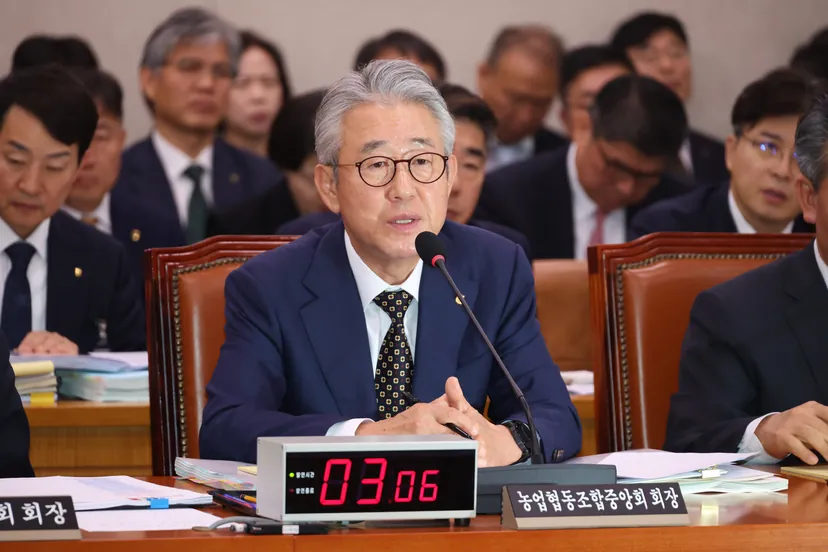
At the National Assembly Agriculture, Food, Rural Affairs, Oceans and Fisheries Committee audit held on October 16, the ruling and opposition parties engaged in a war of words over the reform of the National Agricultural Cooperative Federation. Even while facing harsh criticism for NongHyup's internal control issues and misconduct cases, Chairman Kang Ho-dong did not agree to the introduction of an independent external audit body.
During the audit that day, People Power Party lawmakers raised concerns about government intervention in NongHyup reform and put the brakes on it. Rep. Kim Yong-tae of the People Power Party criticized the Ministry of Agriculture, Food and Rural Affairs for failing to properly utilize its supervisory authority, noting that while there were no disciplinary actions against executives in NongHyup audits between 2021 and 2025, seven cases emerged this year. Rep. Kim pointed out that the government already has powerful authority but is choosing not to exercise it, while simultaneously trying to create a separate independent body.
Rep. Lee Sang-hwi of the People Power Party also argued that the revision of the Agricultural Cooperative Act strengthens the government's personnel and supervisory authority, claiming, "The justification for NongHyup reform is to strengthen governance and transparency, but in reality, it is a structure that secures government control over NongHyup's personnel and governance."
The ruling party actively refuted the opposition's claims of government intervention. Rep. Lim Mi-ae of the Democratic Party of Korea pointed out, "There is an opinion that NongHyup reform started for political purposes, and claims that it is being pushed through in a rush without properly using the minister's authority, but we must first set the facts straight. The starting point of the reform is not the government, but NongHyup." She added, "The scale of financial accidents at local agricultural and livestock cooperatives over the past five years has reached 96.1 billion won. However, half of these embezzlement cases were uncovered by external reports, not internal audits."
She further emphasized, "The core of the reform plan is for the 1.87 million members to directly elect the chairman, who was previously selected by 1,100 cooperative heads. If the goal was for the government to seize control of NongHyup, would they return the power to elect the chairman to the members?" She added, "I believe opinions on the direction of reform can differ, but talking about it as if it's for government intervention or neutralizing NongHyup is a different matter."
In response, Chairman Kang said, "The judicial risks surrounding me have been going on for over a year, and it seems to have become the catalyst for NongHyup reform. If there is a problem, I will take responsibility. I will create a reform plan and regain the trust of the public."
Rep. Ju Cheol-hyeon of the Democratic Party of Korea pointed out the issue of NongHyup's "protecting its own" regarding internal disciplinary cases and the omission of criminal referrals. Rep. Ju said, "Out of 21 criminal cases involving employees internally disciplined by the National Agricultural Cooperative Federation since 2022, there were 6 cases with clear evidence of crimes that were not referred to the authorities." He added, "If they wanted to exclude a case from referral when there are criminal charges, it requires the deliberation and resolution of the Personnel Committee, but they didn't even go through that. This is protecting their own to an extreme degree."
He also pointed out the internal control issues. Rep. Ju stated, "The employee disciplinary committee consists only of internal staff. We need an independent control mechanism that includes external figures." He noted, "Local cooperatives also seem to have almost no internal control. In 2023, an employee of a Hanaro Mart in Geoje embezzled 130 million won, but the cooperative head, even after confirming the fact, did not report it to the police, let alone discipline the employee. Instead, he gave the employee 100 million won in severance pay and forced them into honorary retirement. This is why the government and the public consider it a subject in urgent need of reform."
Chairman Kang Ho-dong replied regarding the failure to report and inadequate internal controls, "I do not know the specific details," but added, "I will address the shortcomings."
Regarding the arrest of a secretary in connection with the purchase of expensive gifts, Chairman Kang denied any involvement. Rep. Shin Jang-sik of the Rebuilding Korea Party brought up the case where the National Agricultural Cooperative Federation used 240 million won of public funds to purchase luxury gifts and delivered them to the offices of the chairman and vice-chairman. He asked Chairman Kang if he had directed, conspired, or aided in the matter, citing the arrest of two secretary office employees, but Chairman Kang denied all allegations. The police raided the secretary's office of the NongHyup chairman in July in connection with the case.
Rep. Shin asked Chairman Kang if he was willing to resign and be investigated as a private citizen, but Chairman Kang said, "It is difficult to agree to that." When Rep. Shin asked again, "What will you do if your involvement is revealed during the investigation of the secretary's office staff?" Chairman Kang replied, "If a situation arises where I can be held legally responsible, I will take responsibility."
Rep. Shin and Chairman Kang also engaged in a war of nerves over the introduction of external audits. While Rep. Shin emphasized the installation of an independent external audit body, arguing that internal audits of the chairman and executives were insufficient, Chairman Kang opposed it, citing NongHyup's independence and autonomy.
Rep. Shin strongly criticized, "I could not find any records showing that past chairmen have ever undergone a proper internal audit. If there is a record of you being inspected, let me know. Is the independence and autonomy NongHyup talks about the right to not be audited? It is absurd to turn the principles of auditing upside down." Chairman Kang countered, "I find it difficult to fully agree with the opinion that we must undergo external audits just because internal audits on the chairman or executives were not conducted."
Meanwhile, NongHyup reform, centered on the revision of the NongHyup Act, has been postponed as NongHyup, the National Assembly, and the government have failed to reach an agreement on issues such as who bears the cost of introducing the direct election system for the NongHyup chairman, the legal consistency of the direct election system, and the installation of an independent audit body. The amendment to the NongHyup Act is scheduled to be re-discussed at the Legislative Review Subcommittee of the National Assembly Agriculture, Food, Rural Affairs, Oceans and Fisheries Committee on the 27th.