

[비즈한국] When prices rise too quickly, central banks raise interest rates. When the economy worsens, they lower them instead. While this economic policy is familiar today, one question remains: do people necessarily reduce consumption when rates rise? Do companies immediately increase investment when rates are lowered? Reality is not that simple. People looking to buy a house don't just look at current interest rates; they also consider what those rates will be in the future. Likewise, companies don't build factories based solely on this year's revenue; they weigh whether next year's economy will improve, whether inflation will climb further, or if interest rates will rise again.
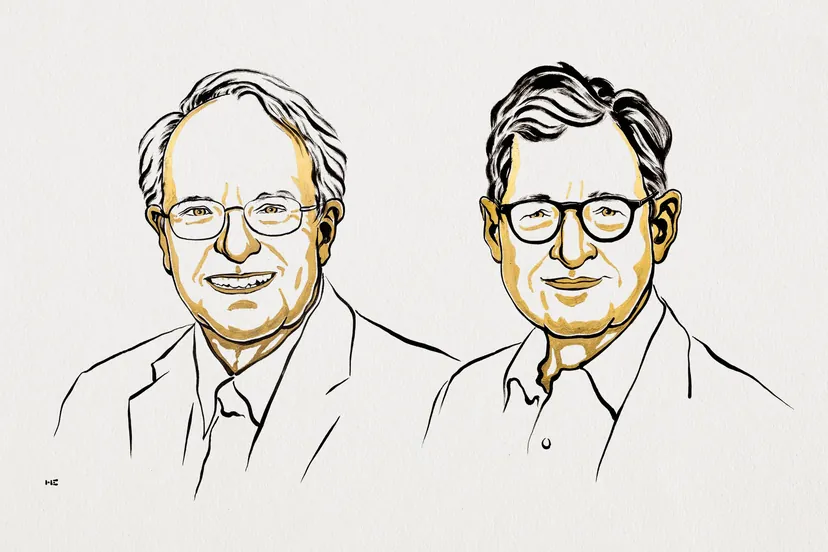
The 2026 Nobel Prize in Economics was awarded to the economists who delved into this very issue. On the 12th, the Royal Swedish Academy of Sciences selected Robert Hall, a professor emeritus at Stanford University, and Michael Woodford, a professor at Columbia University, as this year's laureates. They were honored for establishing the 'microeconomic foundations of macroeconomic stabilisation.' The Nobel Committee assessed that their research led to the development of new macroeconomic models for analyzing business cycle stabilization policy and provided the theoretical basis for the policy models used by central banks and governments worldwide today.
Simply put, these two economists introduced the choices of people and firms behind the 'average numbers' that drive the massive economy. In past macroeconomic models, it was common to statistically estimate how much consumption increases with income or how much investment decreases when interest rates rise, and then link these into a single equation. The problem was that people change their behavior when policies change. If households and businesses anticipate that the government will consistently follow a certain policy, they act in advance to reflect that policy. In other words, there is no guarantee that relationships observed in the past will hold true in the future.
Why does the unemployment rate remain high even after a recession ends?
Robert Hall's research has had a significant impact, particularly on understanding the labor market and recessions. When the economy struggles, companies hire fewer people; some even reduce their workforce. While unemployment rises, these individuals do not necessarily find new jobs immediately once the economy recovers. This is because it takes time for people to find jobs that match their skills, and companies also need time and money to find the right employees. Hall viewed this process of people and jobs searching for each other as crucial to the economy.
For example, if companies halt large-scale hiring due to a recession, it is not just the unemployment rate that rises. The number of people without work experience grows, and companies fail to secure the talent they need. Even when the economy recovers, these problems can persist for a long time. Therefore, policies to prevent recessions do not stop at simply boosting annual growth numbers; they also serve to prevent the collapse of the link between jobs and people.
Michael Woodford's research is more directly linked to today's central bank policies. What Woodford emphasized is 'people's expectations.' For instance, let's say a central bank maintains the base rate at 4%. If people believe that "the rate will be significantly lowered in a few months," loan rates or market interest rates may fall beforehand. People might bring forward their decisions to buy houses or cars, and companies might increase investment.
The opposite is also possible. Even if the central bank lowers interest rates slightly, if the market thinks, "they will raise rates again if inflation picks up," consumption and investment may not increase significantly. This is why financial markets today do not just watch whether a central bank raised or lowered rates. They also scrutinize what the central bank governor says and how they explain future interest rate movements. This is the same reason why stock and bond prices react to a single word from a central bank press conference.
Why price tags remain stagnant even when inflation shifts
The research of these two scholars led to the development of the 'New Keynesian' school, a primary analytical framework in modern economics. The starting point of this theory is surprisingly simple: in reality, prices and wages do not change instantly. If the price of flour rises, a bakery does not immediately raise the price of bread the next day. They have to consider competitor prices and how customers will react. The same applies to wages; it is difficult for a company to cut employee salaries by 20% starting next month just because the economy has worsened.
Because prices and wages are sticky, when a central bank changes interest rates, it affects not just inflation, but also consumption, investment, and employment. Economists use this to calculate how much consumption will decrease, how much corporate investment will shrink, and when inflation will fall after a rate hike. These ideas are incorporated into the economic forecasting models that central banks around the world use to set interest rates today.
The reason this year's Nobel Prize in Economics is receiving attention is that their research resonates with the current global economic situation. In recent years, central banks have faced very difficult choices. After COVID-19, inflation surged, but there was not just one cause. There was the impact of a sudden surge in consumption, as well as the impact of product shortages due to factory shutdowns and logistics disruptions. On top of this, energy prices rose.
While all of these manifested as inflation, the causes were different. If inflation is caused by people spending too much money, a policy of raising interest rates to curb consumption can be effective. However, if inflation is caused by a surge in oil prices or blocked supply chains, raising interest rates will not produce more oil or normalize logistics. In fact, raising rates too high might fail to curb inflation while only dampening corporate investment and employment. Therefore, central banks must now consider not just the inflation figure itself, but also the underlying causes of the price increase.
This award is particularly noteworthy as it comes at a time of ongoing controversy surrounding the independence of central banks in the United States. President Trump repeatedly demanded interest rate cuts from the Federal Reserve, and political pressure surrounding Fed officials persists. Of course, there is no evidence that the Nobel Committee selected the winners to target a specific politician. However, the message delivered by Hall and Woodford's research strangely overlaps with the current situation in the US.
In particular, Woodford emphasized that a central bank is not merely an institution that moves interest rates, but an institution that manages the expectations and trust of the market. Cutting interest rates to satisfy political demands does not necessarily improve the economy. On the contrary, if people start to believe that the central bank considers political demands more important than inflation, inflation expectations may rise and long-term interest rates may climb, leading to the exact opposite result. In this sense, central bank independence is not just an institutional principle, but a condition that determines the effectiveness of monetary policy.
Ultimately, it is 'people's belief,' not interest rates, that determines inflation
What makes the problem even more complex is people's expectations. If inflation remains high for a while, people may think, "prices will continue to rise." Employees might demand higher wages, and companies might preemptively raise product prices in anticipation of rising costs and labor expenses. Then, a temporary price increase could actually persist for a long period.
This is why central banks repeatedly emphasize their commitment to curbing inflation. Making people believe that prices will be stable in the future is just as important as actually moving interest rates. This is why Woodford's research remains critical today.
Of course, the two scholars' theories do not perfectly explain every economic problem. During the 2008 global financial crisis, they were criticized for failing to adequately reflect the risks of banks and financial markets. After COVID-19, problems such as supply chain collapse or asset inequality emerged, which existing economic models could not explain properly. However, modern economics has not discarded this framework but has continuously supplemented it. By adding financial markets, household debt, income inequality, and supply chain issues to the existing model, it has been evolving toward a more realistic economic model.
The message of this year's Nobel Prize in Economics is also simple: there is no absolute formula in economics such as 'raising interest rates lowers inflation.' When a central bank moves interest rates, people think about the reason why. Companies also decide whether to invest by anticipating the future economy. Financial markets predict the next policy in advance. The results then shift consumption, investment, employment, and prices.
Hall and Woodford's greatest achievement lies precisely here. They shifted the question of economic policy from "How much should we raise interest rates?" to "How will people and firms react when we raise interest rates?" In today's global economy, where central banks must avoid recessions while curbing inflation, this question remains the most difficult homework they must solve.