

[비즈한국] The ‘breadwinners’ of the Korean gaming industry have been working for too long. Games that were released around 20 years ago, such as Lineage, MapleStory, and Dungeon & Fighter, are still propping up the earnings of major game companies, while new signature IPs to succeed them are rarely appearing.
On the other hand, Chinese game companies are expanding their influence by successfully launching a series of global hits, starting with Genshin Impact. As there is a limit to growth by only extending the lifespan of long-running IPs, the question of what to create anew has now emerged as a more critical task for domestic game companies.
According to the Korea Creative Content Agency, the domestic game utilization rate dropped by approximately 24 percentage points (p) in three years, from 74.4% in 2022 to 50.2% last year. Even compared to the previous year, it fell by 9.7%p. It was found that about 8 out of 10 users who stopped playing games chose alternative leisure activities such as Over-The-Top (OTT) services, TV, movies, and animation, which do not require long hours of immersion.
The valuations of major game companies have also fallen significantly. Krafton, the No. 1 company by market capitalization among domestic game firms, recorded 8.9491 trillion won based on the closing price of 199,700 won on the 1st. Its market cap, which had climbed to the 17 trillion won range last year, has now fallen below 9 trillion won. During the same period, Netmarble’s market cap, which was in the 5 trillion won range, also dropped by more than 40% to 2.9022 trillion won on the 1st.
Shift Up’s market cap, which exceeded 4 trillion won last year, has slid to 1.8033 trillion won. Meritz Securities lowered its target price for Shift Up on the 2nd, citing sluggish short-term performance and a lack of catalysts for stock price growth next year. Pearl Abyss also saw its stock price weaken as market expectations for sales performance following the release of its new game, 'Crimson Desert', were lowered, coupled with concerns over a void in follow-up content.
While the reasons for the stock price decline vary by company, uncertainty regarding the performance of new titles and future growth engines is cited as a common challenge. Since game development takes several years, if a company has few core IPs, a decline in sales from existing games or delays in new releases can lead to a significant gap in earnings.
20-year-old IPs remain the ‘icons’… G-Star missing major game companies
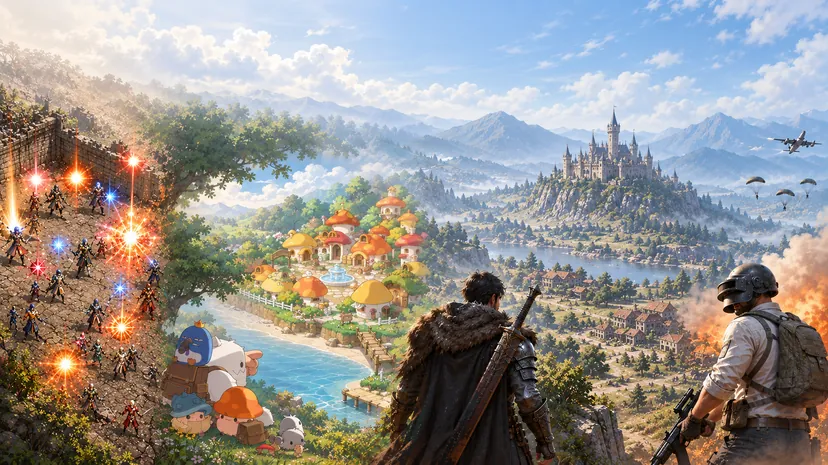
Many of the representative IPs that support the performance of major domestic game companies are well over 10 years old. NCSoft’s ‘Lineage’ first appeared in 1998 and is now 28 years old. Nexon’s ‘MapleStory’ began service in 2003, and ‘Dungeon & Fighter’ in 2005. Pearl Abyss’s ‘Black Desert’ was first released in 2014, and Krafton’s ‘PUBG: Battlegrounds’ in 2017.
Game companies have extended the vitality of these IPs by porting them to mobile or other platforms, or by releasing sequels. Lineage was expanded into Lineage M, Lineage 2M, and Lineage W, and Nexon has also consistently introduced new titles using the MapleStory and Dungeon & Fighter IPs. Krafton also expanded the Battlegrounds IP to mobile and other platforms. Even now, decades after their release, these long-running IPs remain the main growth axes for each company. In contrast, cases of cultivating separate source IPs as new growth axes remain relatively sluggish.
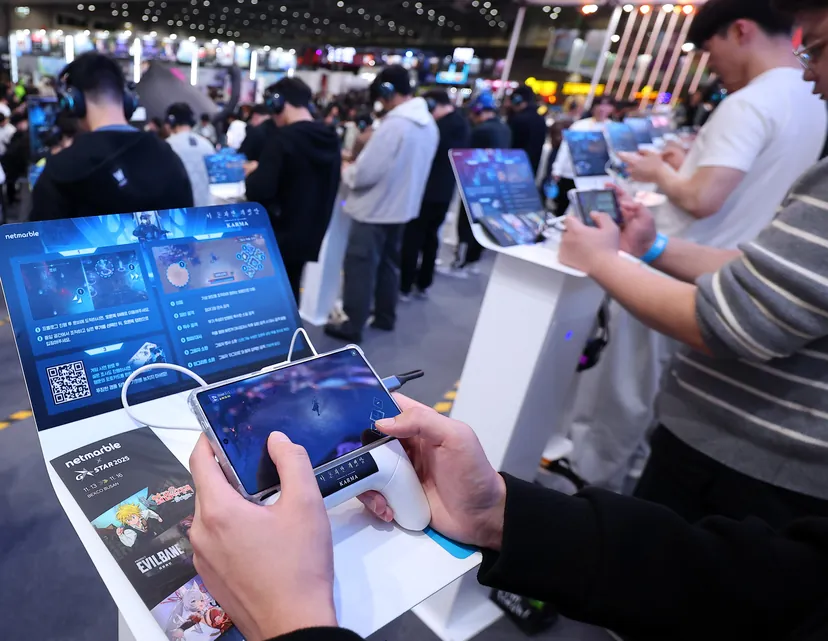
This situation is also evident at G-Star, the largest domestic game exhibition. This year’s main sponsor is for the first time a non-gaming AI company, Wrtn Technologies. Meanwhile, major game companies like Nexon, Netmarble, and NCSoft are expected to be absent from the event. Regarding this, Kang Shin-chul, chairman of the G-Star Organizing Committee and head of the Korea Association of Game Industry, stated, “Major game companies themselves do not have many new titles to showcase at G-Star.”
Even when new IPs are released, it’s hard to become an ‘icon’
While major domestic game companies have also set out to secure new IPs, it is rare for them to create new hits that can succeed existing flagship titles. To secure IPs other than Battlegrounds, Krafton has expanded its overseas developer acquisitions and equity investments in addition to in-house development. Although it released a new IP, ‘The Callisto Protocol’, through Striking Distance Studios, which it acquired in 2022, the sales performance fell short of expectations, leading to staff reductions. The mobile strategy game ‘Defense Derby’ and the turn-based strategy game ‘Moonbreaker’, introduced in 2023, also failed to grow into mainstay titles following Battlegrounds.
Since last year, Krafton has re-strengthened its strategy to secure new IPs. Its plan is to expand in-house production investment and increase publishing scale over the next five years to secure ‘big franchise IPs’ that will follow Battlegrounds. Next year, it will launch five new titles centered on new IPs.
Pearl Abyss began developing new IPs after Black Desert, but it is taking a considerable amount of time to reach release. DokeV and Plan 8, first unveiled in 2019, have not had sequels released even after 7 years. In March, the company succeeded in bringing ‘Crimson Desert’, its first new IP since Black Desert, to the actual market, but the schedule for follow-up content is being delayed. The first DLC (Downloadable Content), ‘Unknown Journey’, was originally scheduled for release on the 16th of this month but was delayed by two weeks due to quality and stability issues.
Chinese game companies see global success… Overseas investment also expanding
On the other hand, during the same period, Chinese game companies have increased their presence in the global market by leading with new IPs. Following the global success of ‘Genshin Impact’ in 2020, HoYoverse has released a series of new IPs such as ‘Honkai: Star Rail’ and ‘Zenless Zone Zero’. Kuro Games’ ‘Wuthering Waves’ and NetEase’s ‘Where Winds Meet’ have also expanded their reach beyond the Chinese domestic market to overseas markets.
Chinese game companies are also securing IPs and development capabilities through overseas investments and acquisitions. Kingnet decided to invest approximately 400 billion won by participating in the Neopulse consortium, which is pushing to acquire management rights of the domestic game company Wemade. Neopulse signed a contract in June to acquire a 39.33% stake held by Wemade Chairman Park Kwan-ho for 920 billion won, and plans to secure a 40.25% stake in Wemade by combining existing holdings.
As the global influence of Chinese game companies grows, securing new IPs continuously is cited as a task for domestic game companies. Kim Jin-gu, a research analyst at Kiwoom Securities, analyzed, “I believe that only by building a diverse range of IPs that can appeal to global users and securing visibility and growth in annual earnings can domestic game companies resolve the current multiple derating phenomenon facing the Korean gaming industry.”
Within the industry, there are also voices saying it is more important to create differentiated IPs rather than competing head-on with Chinese game companies in terms of capital or development workforce. An official from one game company said, “China produces games based on massive capital, with hundreds or thousands of people poured into a single game. Instead of competing head-on with the quantity and quality of resources, domestic game companies should think about what special experience only that IP can provide from the planning stage.” He emphasized, “It is more important to create an IP with unique strengths that will not easily lose users, rather than following the success formulas of other games.”