

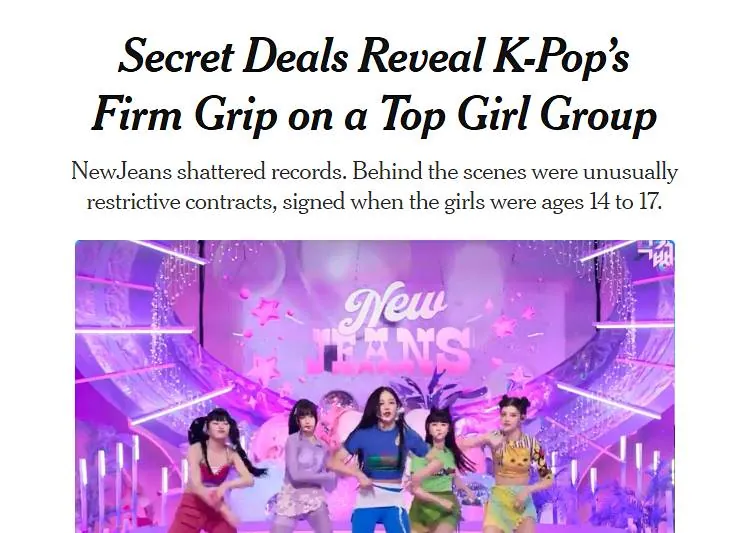
[BizHanKook] The New York Times recently published an analysis of NewJeans’ exclusive contract. It sought to frame the NewJeans case as a systemic issue across the entire K-pop industry. In fact, it suggested that other idol groups might be in even worse situations. The inference is that if the contract of a globally popular group like NewJeans is this way, those of other agencies must be even more exploitative. At the time of signing, NewJeans was not yet a global group. Nevertheless, reading this article brings to mind the reality of K-pop idols, as contract issues within K-pop agencies are not problems that emerged overnight.
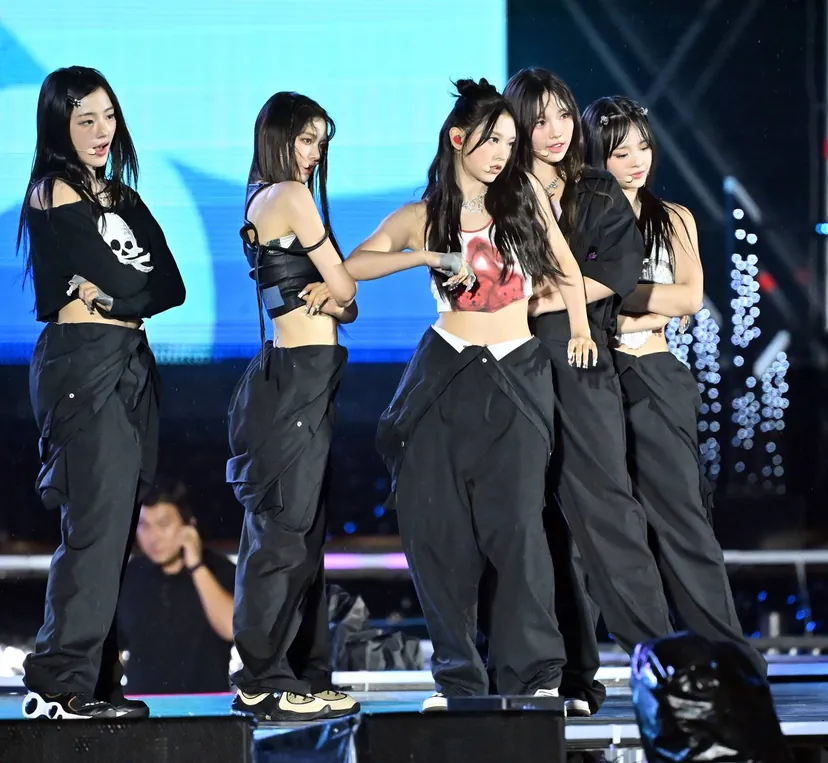
The report lacked testimony from the members of NewJeans, who are the parties to the contract. Consequently, it could not confirm the fact that the youth protection clauses refuted by HYBE might exist in separate special agreements or annexes. There is also the possibility of a fallacy of generalization. Using the contract of a specific agency and idol group to claim it represents the entire K-pop landscape may not be the standard approach to argumentation. However, the agency also failed to disclose specifically how they guaranteed the rights to education, health, and rest.
NewJeans' agency, as well as K-pop production organizations centered on domestic record labels and distributors, strongly protested the New York Times report. In particular, they argued that the characterization of "oppressive control" ignores the K-pop training system. Their perspective is that because it has a unique nature, it should be treated as an exception.
However, being a unique case in one country does not exempt it from ethical evaluation. Prohibitions on dating, plastic surgery, or criticism involve elements of human rights violations, such as the right to self-determination and freedom of conscience—even if consent was obtained from the individuals or their guardians. Let us consider the Korean situation, which must adhere to global standards, let alone universal human rights sensitivity. K-content is often called an export trade. Considering that it earns foreign currency through exports, K-pop can also be seen as an export product. It must comply with global trade standards.
It is a well-known fact that the movement for "Fair Trade" is strengthening globally. Unlike traditional trade, which overlooked the maximization of corporate profit, fair trade emphasizes mutual respect, equity, and the protection of rights. Corporate ESG (Environmental, Social, and Governance) evaluations now encompass human rights, labor environments, health and safety, and ethical compliance. The reason for examining these is to judge long-term risk management capabilities and sustainability.
Specifically, the United States, the world's leader in the popular arts industry, holds up customs clearance for certain items or products suspected of involving forced labor. In fact, Korean sea salt was banned from import as it was judged to have been produced through forced labor. In 2022, following the implementation of the Uyghur Forced Labor Prevention Act (UFLPA), products containing even a small amount of parts or raw materials from companies related to the Xinjiang Uyghur region in China were completely blocked. Furthermore, the Office of the United States Trade Representative (USTR) imposes additional tariffs on countries that do not implement or enforce bans on products made with forced labor, in accordance with Section 301 of the Trade Act. As a result, forced labor tariffs of 10–12.5% were imposed on 60 countries, including South Korea and Japan.
The EU’s regulations are even more stringent. In November 2024, it completely banned the distribution of products made with forced labor, and it will be fully enforced starting December 14, 2027, after a three-year grace period. Any product involving forced labor cannot be imported into the EU or sold online or offline. Previously, on July 25, 2024, the EU enacted the Corporate Sustainability Due Diligence Directive (CSDDD). It mandates that companies investigate, prevent, mitigate, and remedy negative impacts on human rights in their product supply chains. The due diligence includes child labor, forced labor, and infringement on freedom of association.
This trend may not be limited to industrial products. In other words, there is no guarantee it won't apply to K-pop content. While idols and trainees are getting younger, the actual situation remains unknown because the industry is approached from a cultural perspective rather than a human rights one. The U.S. or Europe could, at any time, define K-pop content as products associated with human rights abuses. Emphasizing the uniqueness of the K-pop system or stressing confidentiality clauses only highlights the lack of transparency. Before asserting the uniqueness of K-pop, there is a need to evaluate it objectively from a universal perspective.
K-Culture has been able to gain a positive response and build a fandom because it has resonated and kept pace with people around the world. What has been achieved this way could be lost all of a sudden one day. We must use this report as an opportunity to improve and correct any potential sources of human rights violations that could occur. This is the way to not only adapt to the deepening trend of fair trade but also to internalize the value of human rights democracy. Isn't that what the K-pop worldview aims for? Before pointing out the fallacy of generalization, it seems to be a time for internal reflection to eliminate the cases that make such generalizations possible. It is time for relevant government ministries, such as the Ministry of Employment and Labor, the Ministry of Education, the Ministry of Health and Welfare, and the Ministry of Culture, Sports and Tourism, to seek alternatives through investigations of the actual conditions in K-pop and ensure transparency.
The author Kim Heon-sik has been navigating or pushing through the forest of popular culture phenomena since his 20s with the expectation that there is a way to make the world a better place through culture. He continues on the same path with the same belief even in the 21st century, where artificial intelligence and quantum computers are in full play.