

[BizHanKook] Can you find a Solar System object in the photo below? Among the countless dots filling the screen, there is an object drifting beyond Neptune. Its existence was unknown until recently, and it only just came to light. It feels impossible to know where it might be hiding, but when you place photos taken on different dates side by side, its form begins to emerge. While the surrounding stars remain still, this one alone moves slightly among them.
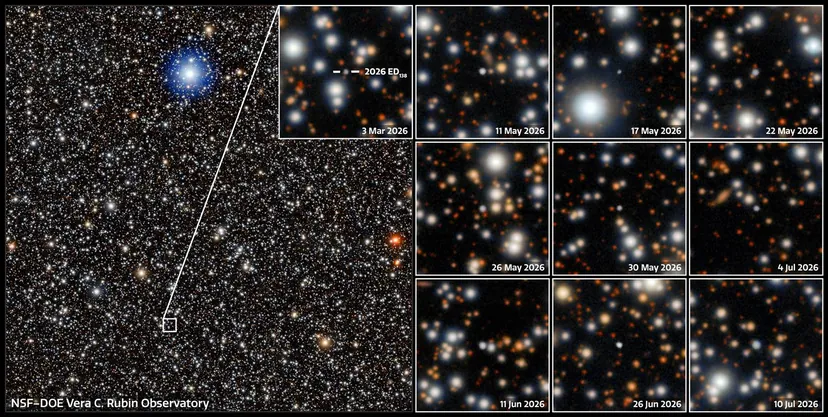
This subject is currently known by the temporary serial number 2026 ED138. It is the first dwarf planet candidate discovered by the Vera C. Rubin Observatory in Chile. It may even turn out to be the largest dwarf planet discovered since Pluto. The International Astronomical Union's Minor Planet Center officially announced the discovery on October 27, 2026. However, an unexpected fact was revealed shortly after: this object had actually been captured in photographs as early as 1954. Long before the advent of digital cameras, it was clearly visible on glass photographic plates.
How could it have been captured on film and yet gone unnoticed for 70 years?
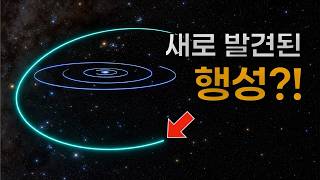
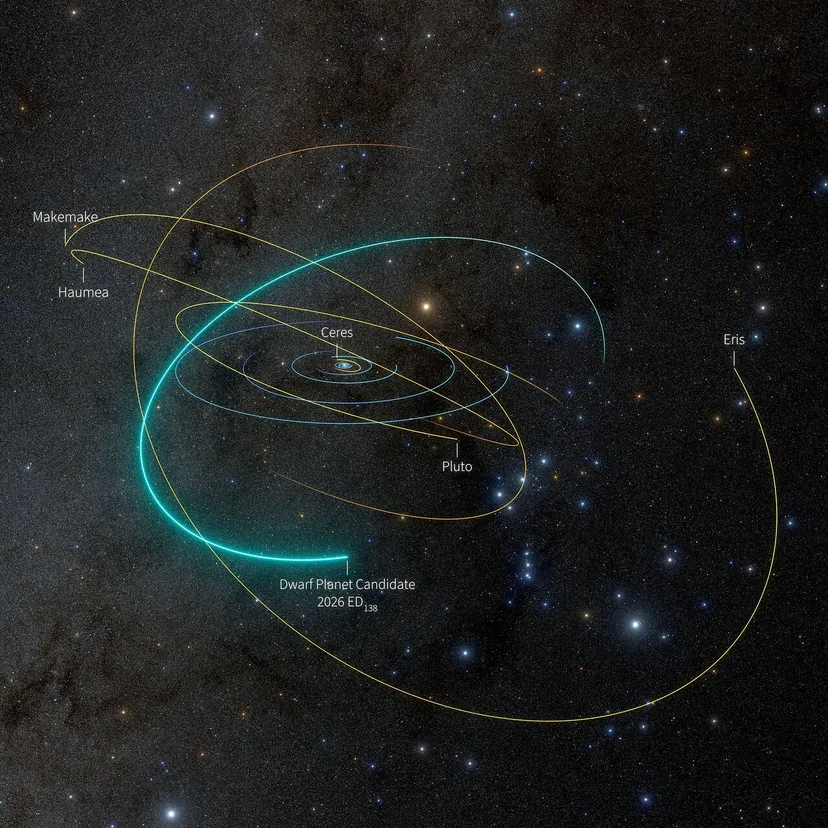
The distance between the Earth and the Sun is defined as 1 AU, which is approximately 150 million km. Neptune is 30 AU from the Sun, while the newly discovered ED138 is 37 AU away at its closest approach to the Sun. At its farthest, it reaches 49 AU. When it was first discovered in June 2026, it was about 47 AU away from the Sun, or roughly 7 billion km.
Based on its currently estimated orbit, it takes this dwarf planet 283 years to complete one revolution. Pluto's orbital period is approximately 248 years. However, when viewing its orbit from the side, it feels distinctly different. The orbit of ED138 is inclined by 24 degrees relative to the Earth's orbital plane. Even at the time of discovery, its position in the sky was about 20 degrees south of the ecliptic. It is difficult to find such objects through conventional observations that simply scan around the ecliptic.
However, there was another obstacle that prevented this object from being identified for so long: our Milky Way galaxy.
As luck would have it, this dwarf planet was moving against the background of the Milky Way, where stars are densely packed. Telescope cameras capture both the billions-of-kilometers-away ED138 and stars hundreds or thousands of light-years away in a single frame. Because similar-looking small dots—completely unrelated to one another—are captured at once, the dwarf planet naturally blends into the cluster of stars.
If you trace its current estimated orbit backward, ED138 crossed the Milky Way in 2011. From 2000 to 2023, it remained within 10 degrees of the Milky Way. Furthermore, because it was slightly tilted further toward the south of the celestial sphere, it did not enter the field of view of various wide-area survey telescopes in the Northern Hemisphere. While there are telescopes that look to the south, most avoid the densely packed region of the Milky Way. In fact, the Rubin Observatory, which found ED138 this time, initially excluded the area within 10 degrees of the Milky Way from its search range. At the time, ED138 was barely hanging on just 2 degrees outside the boundary of the observation range.
There are a total of 38 observations confirming the appearance of this small dot in Rubin’s photos. Among them, 24 observations featured the dot in the photo, but it was initially missed by the computer's automated analysis list. This is because, when there are too many stars in the background, the program does not analyze the light in detail if it appears to overlap with other stars. If too much data is omitted in this way, it is difficult to complete the orbit due to a lack of snapshots to track the movement of this small dot.
In October 2026, astronomers analyzed the Rubin observation data again using newly updated software. The program began to automatically link slowly moving dots captured on different dates that could represent the motion of a celestial body. The points initially connected were 10 dots captured over eight nights between May 1 and June 5. Calculations began from there. They estimated the orbit roughly with those 10 points, and by calculating where it should be on other dates, they narrowed down the search range.
The search went back to the days of glass plates, before digital cameras. They found ED138 in 12 photographic plates taken up to the year 2000, including two glass plates taken by the Palomar Observatory 31 minutes apart on April 3, 1954. It was clearly present exactly where the orbital back-tracing predicted it would be. It was also confirmed in data observed by the VISTA telescope since 2010. A faint dot was also confirmed in the predicted position on a glass plate from 1937, but this photo was somewhat ambiguous, so it was left as a tentative candidate.
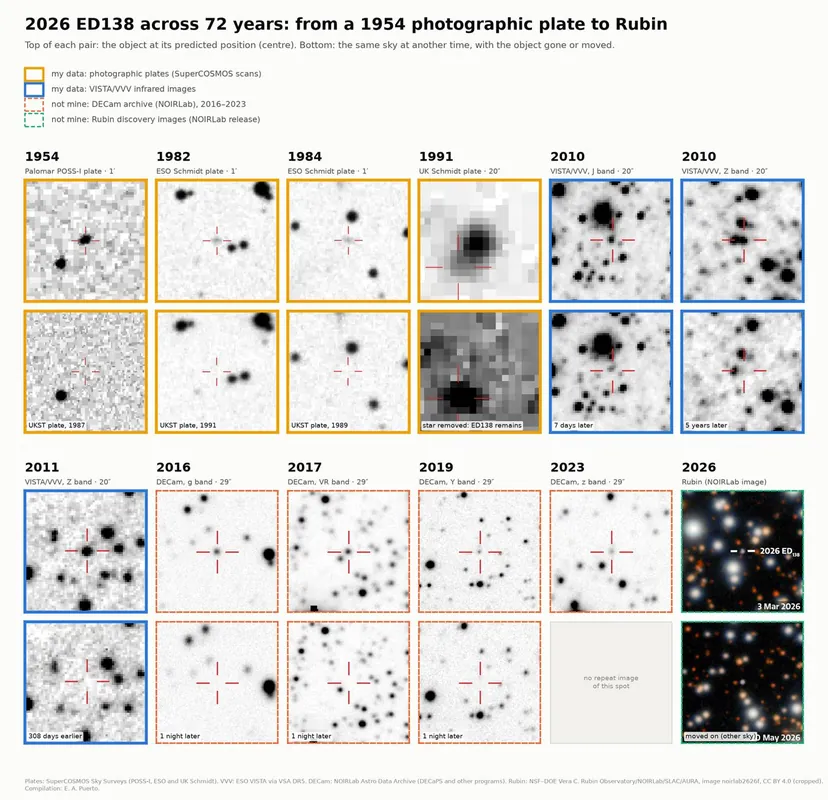
When someone accidentally witnesses and records the existence of an unknown celestial object much earlier than its official discovery, it is called a "pre-discovery." A classic example is the case of Galileo, who recorded Neptune while observing Jupiter between December 1612 and January 1613, a full 200 years before Neptune’s existence was officially announced in 1846. Though we became aware of 2026 ED138 through an 8-meter giant telescope built in the 21st century, it had actually been quietly showing itself since the era of glass plates without anyone knowing.
Could this newly discovered object also be the "Planet Nine" everyone has been searching for? To know that, we must determine its precise size. It is difficult to gauge its size from just a small dot in a photo. It is shining by reflecting sunlight, appearing dim from a vast distance.
The absolute magnitude of this observed dot is 3.19. One thing to note is that, unlike stars, Solar System objects use their magnitude when placed at a distance of 1 AU, not 10 parsecs, as the standard for absolute magnitude. Therefore, just because ED138 has an absolute magnitude of 3.19 does not mean it is bright enough to be seen with the naked eye. However, it is quite bright and ranks among the top known objects beyond Neptune.
In fact, the brightness of a Solar System object is greatly influenced not only by its size but also by its albedo (reflectivity). Even if it is small, an object that acts like a mirror with a smooth ice surface can appear much brighter. If we assume the albedo of this object is 25%, its diameter is estimated to be around 600 km. If the albedo is as low as 4%, the diameter increases to 1,530 km. This is larger than Ceres. Considering the typical albedo of known small bodies around Neptune, it is most likely that the planet is between 600 and 900 km in size. Once its exact size is determined later, ED138 may remain an asteroid or be named a new dwarf planet.
The orbit of ED138 shows clues to a peculiar relationship with Neptune. For every 12 orbits Neptune completes, ED138 completes seven. This ratio causes both objects to return to a similar configuration. The minor gravitational effect of Neptune can consistently accumulate on ED138's orbit over time. This is called resonance. Another previously known dwarf planet, Haumea, shows similar resonance, but Haumea underwent a violent collision long ago and its fragments are drifting together. Haumea's fragments are rich in water ice. In contrast, ED138 has a redder hue than Haumea, so it is assumed to be an object unrelated to Haumea's collision.
The Rubin telescope has now started to discover dwarf planet candidates. In fact, in initial Rubin observations, there were 10 candidates showing suspicious movement over several dates. Among them, eight were re-observed, and ED138 is the one that has now been definitively identified. If we can continue to hunt for new objects in the outer Solar System at this rate, many more dwarf planets may be added to the Solar System’s membership in the future.
If additional observations confirm the existence of ED138, complete its orbit beyond Neptune, and it proves to be of a size worthy of a dwarf planet, this object will need a new name. What name would you give it?
References
https://rubinobservatory.org/news/rubin-first-dwarf-planet-candidate
About the author Ji Woong-bae: Loves cats and the universe. Developed a dream to share the beauty of the universe after watching 'Galaxy Express 999' as a child. Currently serving as an assistant professor at the Sejong University College of Liberal Arts, he is involved in various science communication activities, including lectures and writing. He has authored books such as "On the Uselessness of Astronomers," "We Are All Born Astronomers," and "Strange Questions That Come to Mind When Looking at the Universe," and translated works including "How I Killed Pluto," "Quantum Life," and "UFO."