

[BizHanKook] We live in an age where artificial intelligence (AI) has leveled the playing field, even when it comes to the "ability to create." As new platforms emerge and disappear rapidly, and as AI becomes capable of producing content and even designing, the expressive options available to brands have expanded. Choi So-hyun, Head of Creative & Experience (C&E) at Naver, emphasized that for a brand to survive, it must ask what to preserve and what to subtract before asking what to change.
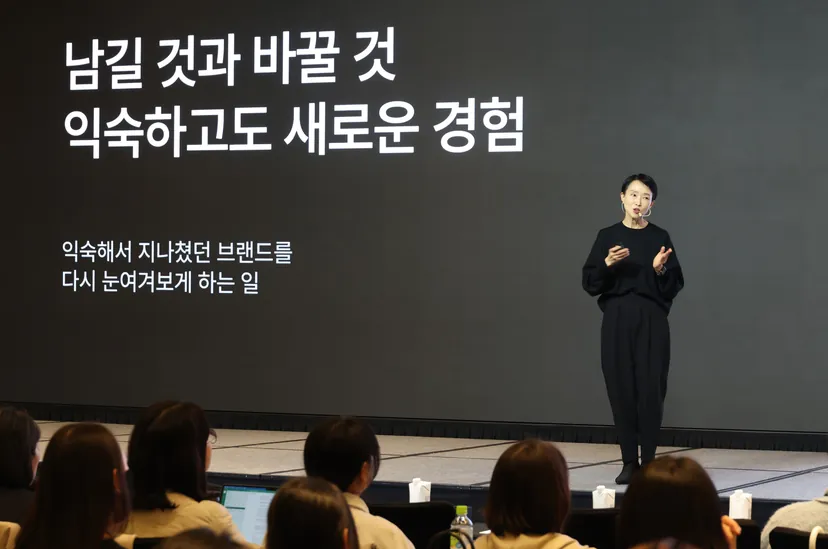
Director Choi delivered the final keynote speech at the "Brand Biz Conference 2026," held on the 29th at the Four Seasons Hotel Seoul in Jongno-gu, Seoul, under the theme "How Do Brands Survive?" The event, which began in 2017 and marked its 10th anniversary this year, was held under the theme "THE NEXT ORIGINAL—In an age where everyone can create well, how do brands become unique?"
Director Choi began her career as an early member of the first-generation venture firm Freechal and led Perception, a brand consulting group she founded in 2002, for 20 years. After joining Naver in December 2022, she is currently in charge of the overall user experience, covering design, branding, marketing, and spatial design.
“Can we succeed if we change red to yellow?”
When creating or renewing a brand, those in charge tend to start by changing visible elements like logos and colors. However, the first things to examine are the values the brand aspires to and the promises it must keep to its customers, as well as identifying which tasks done out of habit should be subtracted.
During her time at Perception, when she was in charge of the 2012 Hollys rebranding, the company asked her, “Can we succeed if we change our color from red to yellow?” Director Choi recalled, “Before talking about making or changing things, we had to discuss what these elements actually meant to the users and to the organization.” Red and the crown were positive assets that helped customers recognize and choose Hollys. Instead of keeping both elements, Director Choi removed the practice of saturating stores with the color red and redesigned the store experience, including the movement paths of customers and baristas. This implies that rebranding is not about erasing all existing assets.
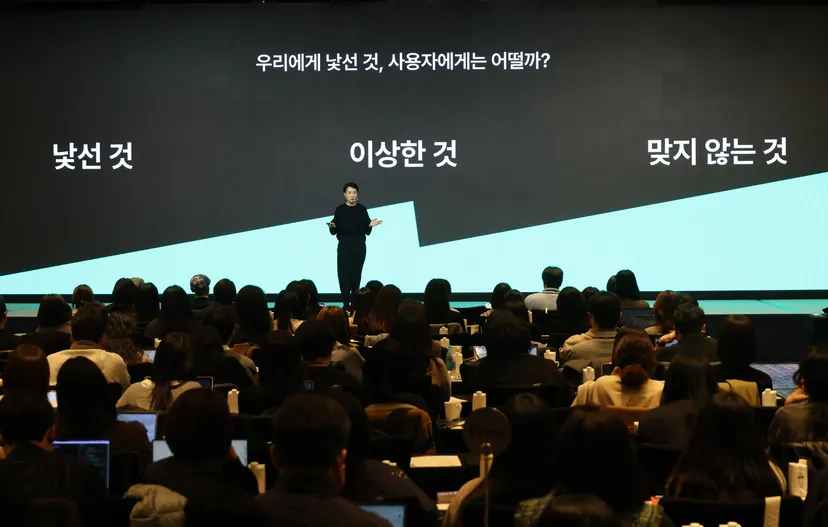
Conversely, Naver’s live streaming platform CHZZK opted for a different approach. The keywords that emerged during a workshop held in late 2023 while preparing for the launch were “unfamiliar,” “strange,” and “mismatched.” As a latecomer to the gaming streaming platform market, they needed a choice that would make users take a second look rather than a generic name. Reactions to the keyword "CHZZK" varied depending on the generation’s experience. Director Choi said she asks her team, “What kind of experience should our service really provide? Why should we do it that way?” Her point is that something should not be dismissed as unsuitable for users just because it is unfamiliar to the organization.
She summarized this point as the difference between "steadfastness" and "stubbornness." Director Choi emphasized, “Sometimes, people repeat familiar things and think that the repeated method is the principle. Steadfastness and stubbornness are really separated by a fine line. The standard that distinguishes the two is the question: ‘What kind of experience should our service provide?’”
How to decide 'what not to do'… The importance of 'record and reflection' in the AI era
Since joining Naver, she has also been attempting to expand the platform's identity into the offline world. The Inventario Stationery Fair, held at COEX last June, attracted over 40,000 visitors over five days. Naver participated in this event as a master sponsor. The intention was to help record and share experiences beyond the screen, a tradition continued from Naver Blogs, Cafes, and Knowledge iN.
In the lounge, Naver significantly "subtracted" its signature brand color. Director Choi stated, “There is a view that sees Naver as a ‘boring, ordinary honor student.’ This characteristic is a huge advantage as a platform,” adding, “Because it is a platform, it must be able to contain everyone. At the event, we connected the user journey—searching, booking, paying, and reviewing—with services from different teams.”
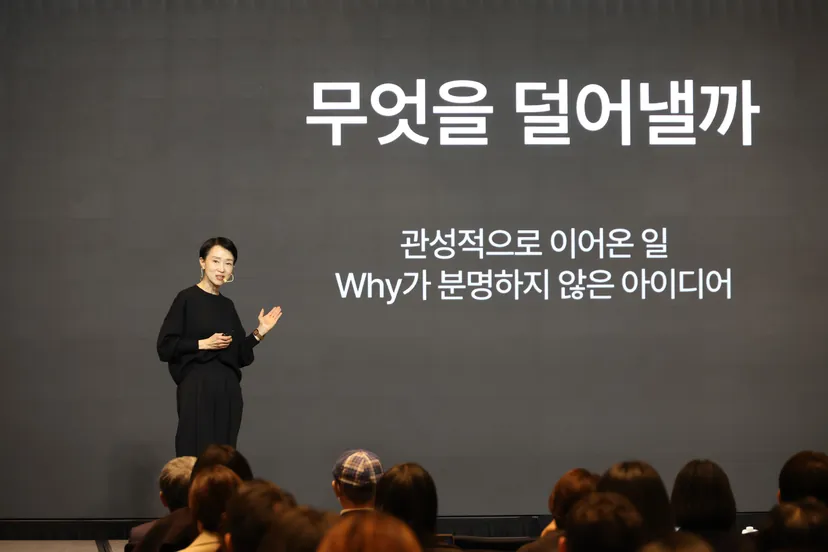
It is also important to ensure that the brand’s philosophy, actions, and visual expression do not clash. Director Choi explained that one must distinguish and examine why a brand exists (Why), how to realize its purpose (How), and what customer touchpoints to create (What), such as services and products. However, she emphasized that while one should maintain the essence, the method of expression must be adjusted to the context, noting, “If you only use the same grammar, you’ll eventually hear people say it’s boring or tedious.”
The "Be Local" campaign by Naver Map, which helps travelers experience cities like locals, began in Seoul last May and has moved through Gyeongju to Busan this summer. This campaign features real people instead of "convenient and efficient" AI-generated images. The explanation is that they invested the resources saved by increasing productivity in other tasks into capturing genuine human expressions.
The perspective on outdoor advertising is no different. Even in a world where everyone looks at their smartphones, travelers experience the city by walking through it, passing through airports and train stations, and meeting people. Director Choi said, “We, who possess physical bodies, encounter scenes while walking through an actual city. It is important to create things, but it is even more important to consider in what context those created things will be shown.”
Director Choi believes that as more things become possible to do, the judgment of deciding what not to do becomes increasingly important. She suggested recording and reflection as ways to achieve this. She argued that individuals and organizations must reflect together on what they expected from a project, what kind of experience was created, and what they should continue or change next time. She stated, “Just because you can do more things doesn’t mean you have to do everything,” adding, “If you record and share your personal, lived experiences, they become assets for the next task, and the learning of many can lead to the growth of the organization.”
Director Choi added, “I think of a brand as something that resembles a human and is a living entity. You never know when or how its life will end, or when or how it will grow further. If you form a relationship through a meaningful experience, that relationship will be remembered for a very long time.”