

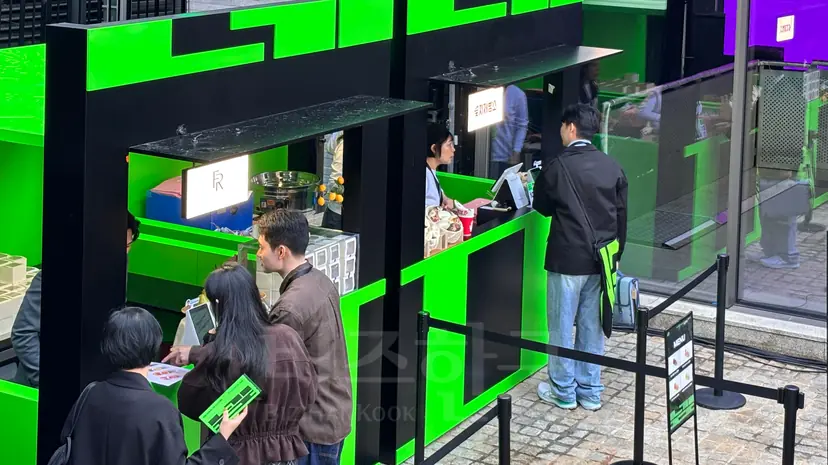
[BizHanKook] On the 30th of last month, at the entrance of the 'Npay Festa' venue in Seongsu-dong, Seoul. As a visitor stands before the gate, their face is scanned, and the entry process is completed in an instant. There is no need to search for booking details on a smartphone or show a ticket. Once inside, the experience continues with collecting stamps via a digital wallet and making payments through facial recognition. While it may be just a day of enjoying a concert for the audience, for Naver, it marks the starting point of creating new payment habits for users. The key is to ensure that users continue to return to these services even after leaving the venue. This is why Naver invested significant costs in hosting an event in Seongsu-dong featuring performances and interactive experiences.
Entry without a ticket? A hub of the latest technology at the concert venue
Naver hosted 'Npay Festa' at Anderson C Seongsu in Seongsu-dong, Seoul, from the 30th of last month to the 1st of this month. It is an event that extended the benefits of the Naver Plus Membership, which had been operated primarily online, to the offline realm. Alongside performances, the event showcased products and experiences from over 50 brands across fashion, food, beauty, and living. The site integrated facial recognition for entry and payment, as well as an NFT (non-fungible token) stamp tour.
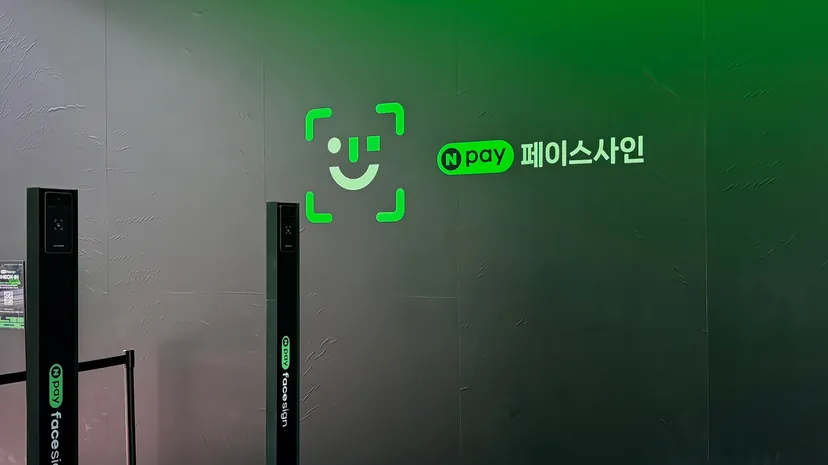
'Face Sign,' applied at the entrance of the event venue, is a technology that supports identity verification and payment through facial recognition. According to Naver, they applied anti-spoofing technology to detect attempts at facial forgery using photos or videos, as well as post-quantum cryptography. Visitors can enter using pre-registered facial information and make payments at stores equipped with the relevant terminals by using facial recognition.
The digital asset wallet 'Npay Wallet' was also included in the experience path. It is a wallet based on a Naver ID, which recorded approximately 1.2 million issuances and a cumulative 3.2 million NFTs issued as of last September. At Npay Festa, visitors could receive prizes like Npay points by collecting NFT stamps from each booth.
Lee Jae-hoo, Head of Naver’s Entertainment Division, explained, "We want to solve the difficulties that arise when many spectators participate at concert venues," adding, "Our goal is to ensure authentication procedures are secure in a safer environment."
Naver plans to expand the scope of its technology application to concert venues as well. They signed a strategic partnership and naming rights agreement for Inspire Arena, and decided to cooperate on on-site entry using Face Sign and Npay Wallet-based NFTs, as well as augmented reality (AR) wayfinding using Naver Labs' digital twin technology. The name 'Naver Arena' will be maintained for three years starting this coming December.
Beyond convenience, the key is building user 'usage habits'
To understand Naver's recent moves, one must look at the gap between technology development and widespread adoption. Even if facial recognition or digital wallets are developed, users accustomed to existing payment and authentication methods do not change their services immediately. It takes time to register and set up, and one must also bear the burden of providing facial information. In addition to explaining the convenience of the technology, a reason for users to try it out for themselves must be created.
Npay Festa can be interpreted as an attempt to narrow this gap with performances and benefits. An audience member coming to see a concert experiences facial recognition during entry and uses a digital wallet to receive prizes while going around booths. Instead of encouraging users to search for and sign up for services one by one, they have arranged it so that users can try them out for the first time while moving through activities they enjoy.
The fact that payment and concert benefits were linked even before the event also stands out. Naver provided early booking opportunities to Naver Plus Membership users who spent over 200,000 won using Npay within a certain period. According to Naver, the 3,000 early booking tickets sold out in 40 minutes. It is a structure that connects interest in a performance to payments and membership usage.
In this design, the event cost takes on the character of an investment to attract customers and revitalize services. Performances gather people, and the process of entry, experience, and purchase creates usage experience for various services. The calculation is that a single event can promote membership, payment, authentication, and digital wallets all at once. However, the fact that one has experienced various services does not prove cost-effectiveness. Repeated transactions follow only if the same service is chosen again in daily life later.
The effect of increasing reasons to maintain membership can also be expected. If competitors offer similar conditions for accumulation rates and discount amounts, differentiation weakens. Early concert booking or member-exclusive experiences are benefits that are difficult to compare by price alone. If the value of membership is expanded from discounts received when shopping to cultural life experiences, the incentive for users to maintain their subscriptions may also increase.
Beyond online to offline payments... Aiming for an expansion to the 130 trillion won scale
Naver's active expansion into offline business is interpreted as a strategy to broaden the profit structure of its existing online platform. While Naver has been connecting users and offline business owners through its platform, payments were often made separately at the stores. If offline payments are also connected to Naver services, it becomes possible to cover the entire consumption process, from a user's product search to purchase.
Naver is expanding various services such as payments, point accumulation, reviews, and coupons to offline stores through its integrated payment terminal 'Npay Connect.' By linking online and offline transaction data, they can analyze and provide business owners with sales trends and customer demand. Furthermore, based on this, they plan to expand their business areas into advertising, marketing, and AI services.
In the second-quarter earnings call, Naver CEO Choi Soo-yeon presented a goal to expand the annual volume of offline payments based on Naver IDs to 130 trillion won within the next five years. The vision is to expand the search, advertising, shopping, and payment businesses built online to the offline world and develop them into an AI platform for business owners.
However, it remains a challenge whether the commercialization of technology can lead to actual widespread adoption and profit generation. For facial recognition or digital wallets to replace existing payment and authentication methods, they must provide convenience and benefits that make users choose them. Whether the application of technology in specific spaces like concert venues will lead to actual daily usage is also a key factor.
This is directly linked to the challenge of maintaining the growth of existing advertising and commerce businesses while securing new revenue sources. Naver's consolidated revenue for the second quarter of this year was 3.3888 trillion won, up 16.2% from the same period last year, but operating profit was 520.3 billion won, down 0.2%. Investments in AI infrastructure affected the increase in costs.
Naver is scheduled to announce its third-quarter earnings on the 12th. The main interest is how much they have managed the cost burden resulting from AI investment while maintaining the growth momentum of advertising and commerce. The speed of expansion of the offline payment business and the timing of monetization of the AI infrastructure business are also considered variables that will determine future performance.