

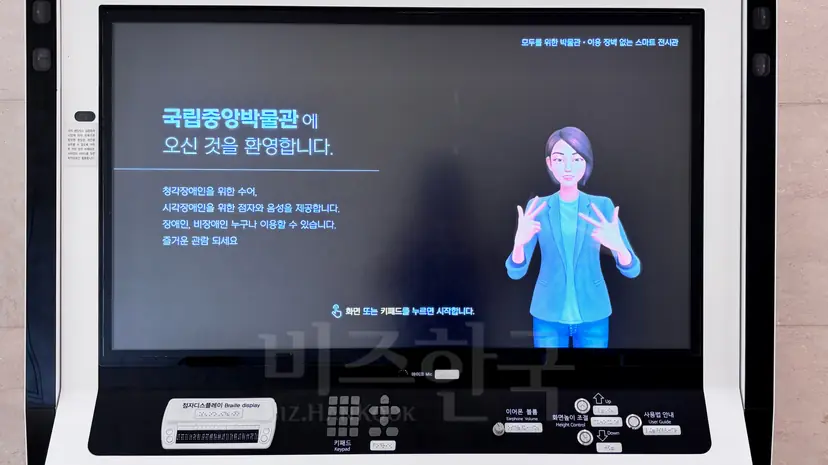
[비즈한국] The 3D avatar on the screen began to move its hands. It was a sign language guide provided by the National Museum of Korea to help visitors with disabilities experience the exhibits. The name and description of a Neolithic artifact also appeared on the screen. The avatar seemed to be explaining the content in sign language. However, the actual meaning of the sign language the avatar provided was this:
“I am sorry. There is no sign language available.”
On the afternoon of the 24th, at around 1:00 PM, I visited the permanent exhibition hall of the National Museum of Korea in Yongsan-gu, Seoul. Next to the entrance on the first floor, a kiosk for the “Barrier-Free Smart Exhibition Hall,” designed to assist visitors with disabilities, was installed. Even when selecting an exhibit for which sign language content has not been developed, the 3D avatar appears as usual and begins signing. To someone who does not know sign language, it might look like a commentary is being provided, but for a deaf visitor who actually uses sign language, the only message they receive is that “no commentary is available.”
Out of 713 items, only 270 have sign language commentary
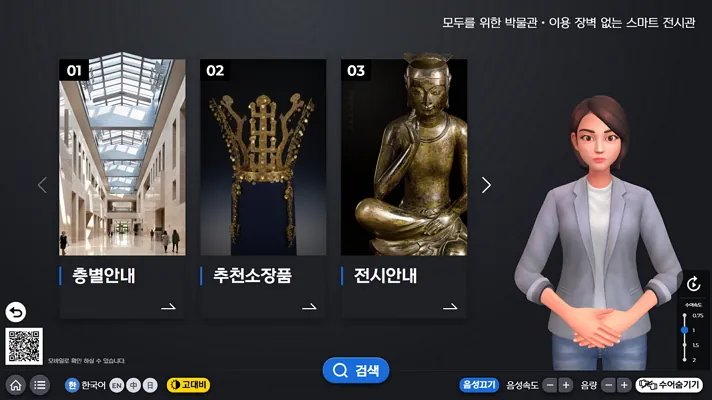
The “Barrier-Free Smart Exhibition Hall” is an AI-based barrier-free guidance service created to allow people with and without disabilities to access exhibition information together. Through kiosks and mobile devices, it provides exhibition information tailored to user needs, such as screen, voice, braille, and sign language. Deaf visitors can check exhibit descriptions through the kiosk using sign language avatars or sign language videos. The National Museum of Korea has a total of four kiosks installed at the main entrance, side entrances on the first floor, and on the second and third floors.
This project was launched in 2022 as part of the Ministry of Science and ICT’s “Digital Public Service Innovation Project,” and services began the following year. At the time, a budget of approximately 1.7 billion KRW was allocated in the “Cultural Digital Innovation Implementation Plan” to create an exhibition environment providing sign language and language translation. In 2024, 1.1 billion KRW was allocated for related projects, and last year, a project budget of approximately 500 million KRW was set. The National Museum of Korea has expanded the service, which started at the main building, to its affiliated museums in Gyeongju, Gwangju, and Buyeo.
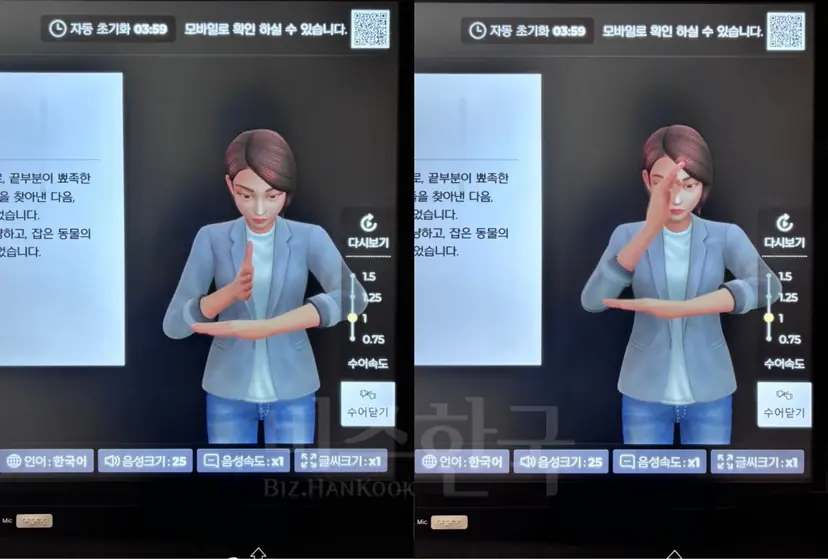
However, even three years after the service launch, only a portion of exhibits offer sign language descriptions. According to the National Museum of Korea, the smart exhibition hall currently holds information for 713 major artifacts selected for their representativeness from among the permanent exhibits. Among these, only about 270 items, or 38% of the total, have 3D sign language commentary. For the remaining 440 or so items, while descriptions can be viewed in text, the same content cannot be accessed in sign language.
When I tested the kiosk myself, I found that commentary using sign language videos or 3D avatars was provided for 41 “representative collection” items separately selected by the museum. Conversely, when selecting an exhibit without sign language content, the name and description of the artifact were displayed normally on the screen, but the avatar only conveyed the message, “I am sorry. There is no sign language available.”
There is also a discrepancy with the initial plan. In the 2022 proposal for the Digital Public Service Innovation Project, the National Museum of Korea set the “percentage of database-ready Korean sign language” as a performance indicator and presented a goal to complete 100% by 2025. Subsequently, in the 2023 Cultural Digital Innovation Implementation Plan, the completion date for sign language content was pushed back to 2027. Although the museum stated in 2024 that it would continue to expand its braille and sign language databases, the museum is currently taking the position that it is difficult to guarantee whether the project will be completed by 2027.
“Production of one sign language content piece costs 800,000 KRW… We will replace sign language videos that have no content with text”
The National Museum of Korea stated that it is developing sign language content in stages due to production costs and inspection procedures. An official from the National Museum of Korea explained, “It costs about 800,000 KRW to produce one piece of sign language content, so just 100 pieces would cost nearly 100 million KRW. We also have to go through inspection and various consultation processes for the produced sign language. Due to realistic reasons, it is difficult to build it all at once, so we are continuing to add it in stages.”
Exhibition reorganization is another variable. The museum official said, “As it is tied to the reorganization of exhibition rooms, there are matters that need to be discussed with the exhibition department, so it is difficult to answer specifically how many items will be added. It is difficult to give a definitive answer as to when it will be finished, but we will continue to add as much content that can be provided in sign language as possible.”
The guidance method is also changing. Instead of a 3D avatar using sign language to say, “I am sorry. There is no sign language available,” the system will display “Sign language content is not provided” in text. The National Museum of Korea announced that it decided to improve the guidance method in consideration of feedback that users might find the previous expression uncomfortable.