

[비즈한국] There was a time when mysterious celestial objects like ‘Oumuamua and 3I/ATLAS suddenly visited our solar system. They arrived from distant star systems far beyond our own and sped past the Sun. ‘Oumuamua exhibited unexpected acceleration, and 3I/ATLAS was confirmed as the third interstellar object to fly in from outside the solar system. For a brief moment, they even sparked imaginations that they might be spacecraft sent by an extraterrestrial civilization.
However, there is no evidence to date that these objects are artificial. Both ‘Oumuamua and 3I/ATLAS appear to be natural objects composed of rock and ice that were ejected from other star systems.
Yet, in the far distant past, an entity incomparably larger than these visited the solar system. It was not just a single comet or asteroid; an entire star skimmed past the solar system.
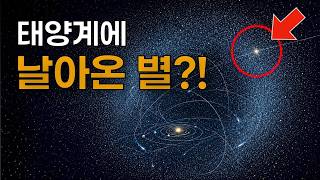
This does not mean the star passed between Earth and Jupiter. The path it took was much further out, through the Oort Cloud, which surrounds the solar system like a massive cloud. Even more surprising is the fact that this event may not be entirely in the past. Comets disturbed by the star that passed about 2.5 million years ago have been raining into the inner solar system for millions of years, and it has been suggested that the influence of this event persists to this day.
The star that left these traces is named HD 7977. The solar system is not an isolated island floating alone in an empty void. The Sun orbits the center of our galaxy, and neighboring stars also move at different speeds and in different directions. Over very long periods, the distance between stars constantly changes. Most stars pass by far enough not to have any significant impact on the solar system. However, occasionally, a star approaches close enough to violently shake the Oort Cloud.
The most famous example is Scholz's Star. This dim binary system, currently about 22 light-years from the Sun, approached within about 50,000 AU of the Sun some 70,000 years ago. While 50,000 times the distance between the Earth and the Sun, considering the scale of the Oort Cloud, it effectively passed through its interior.
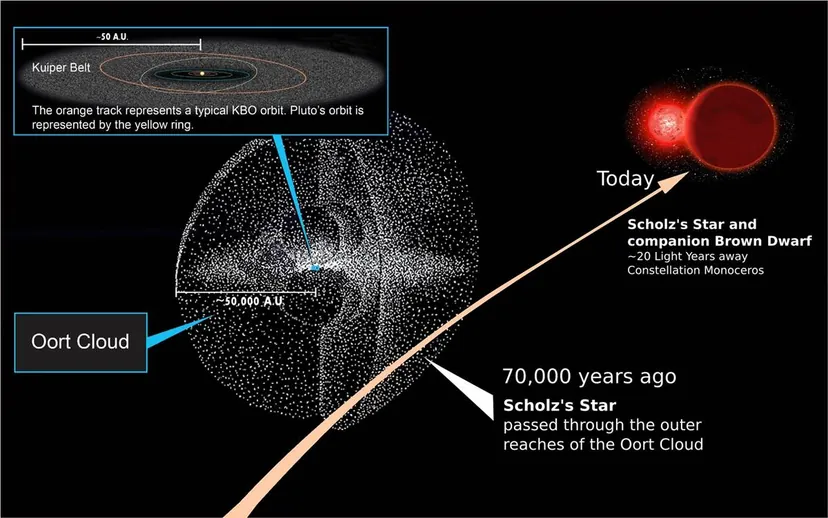
It is possible that Scholz's Star altered the orbits of some comets as well. However, this event occurred only 70,000 years ago. It typically takes hundreds of thousands to millions of years for a comet from the Oort Cloud to reach the inner solar system. It is highly likely that the main impact of the comets sent by Scholz's Star has not yet arrived.
In contrast, HD 7977 passed through the solar system much longer ago. It would not be chronologically strange if the comets it disturbed have reached the inner solar system by now. The Oort Cloud is the most distant reservoir of small celestial bodies in our solar system. Although it has never been directly observed, it is estimated to be a massive spherical structure extending from thousands to tens of thousands of AU, or even up to 100,000 AU.
It may contain anywhere from billions to trillions of icy bodies. Long-period comets, which take hundreds of thousands to millions of years to orbit the Sun, mainly come from here. Normally, the gravity of the galactic disk pulls at the Oort Cloud bit by bit. This is called galactic tidal force. Galactic tidal forces slowly twist the orbits of comets, changing the perihelion distance at which they come closest to the Sun. When some of these fall inside the orbits of Jupiter and Saturn, they become long-period comets that we can observe.
This process is not entirely random. If galactic tidal force were the primary cause, the orbital directions of comets entering the inner solar system should retain a specific bias based on the galactic disk. Simply put, there would be preferred orbital directions when galactic tidal forces push comets toward the Sun. Therefore, comets arriving from the Oort Cloud for the first time should not appear in perfectly equal proportions from every direction in the sky.
However, actual observations did not match this expectation. The research published in the ‘Planetary Science Journal’ in 2026 categorized long-period comets into two groups for investigation. The first group is ‘dynamically new comets.’ These are comets with a semi-major axis greater than 10,000 AU, which have not been significantly influenced by the gravity of giant planets and are essentially visiting the inner solar system for the first time. The second group is ‘young returning comets.’ These have a semi-major axis between 1,000 AU and 10,000 AU and have already passed through the inner solar system one or more times before returning.
The research team only used comets discovered since 1990, when systematic all-sky surveys began. By strictly limiting orbital error margins, 107 dynamically new comets and 112 young returning comets were included in the analysis. A strange difference emerged: the orbital directions of young returning comets matched simulations dominated by galactic tidal forces, meaning there was no clear conflict between observation and the model. However, the comets visiting the inner solar system for the first time were excessively isotropic. If only galactic tidal forces were at play, more comets should have entered from certain directions, but the actual comets arrived from almost every direction similarly. It was very close to a random distribution.
This is a strange result. Young returning comets are typically formed when dynamically new comets pass through the inner solar system and return. Yet, while the current influx of new comets arrives from almost random directions, the returning ones still remembered the directional influence of galactic tidal forces.
The research team hypothesized that the two types of comets departed the Oort Cloud at different times, and they identified the star that strongly shook the Oort Cloud about 2.5 million years ago as the culprit. The Gaia space telescope precisely measures the current positions and motions of stars. By calculating these motions backward in time, the past positions of stars can be tracked. The results revealed that HD 7977, a star similar to the Sun, passed near the Sun about 2.47 to 2.76 million years ago. While it is currently about 246 light-years away from the Sun, in the past, it entered deep into the Oort Cloud.
The researchers conducted 13 simulations with HD 7977 passing at different distances ranging from 3,162 AU to 51,190 AU. They factored in the influence of the Oort Cloud, the four giant planets, galactic tidal forces, and the effects of other weak stellar passages. The scenario that best reproduced the actual comet orbits was when HD 7977 passed between about 6,000 AU and 10,000 AU from the Sun—a mere 0.1 to 0.16 light-years away.
Considering that the average distance to Pluto is about 40 AU, the distance between the Sun and HD 7977 was about 150 to 250 times the radius of Pluto's orbit. While this feels vast by everyday standards, it is practically a flyby compared to the average distance between stars.
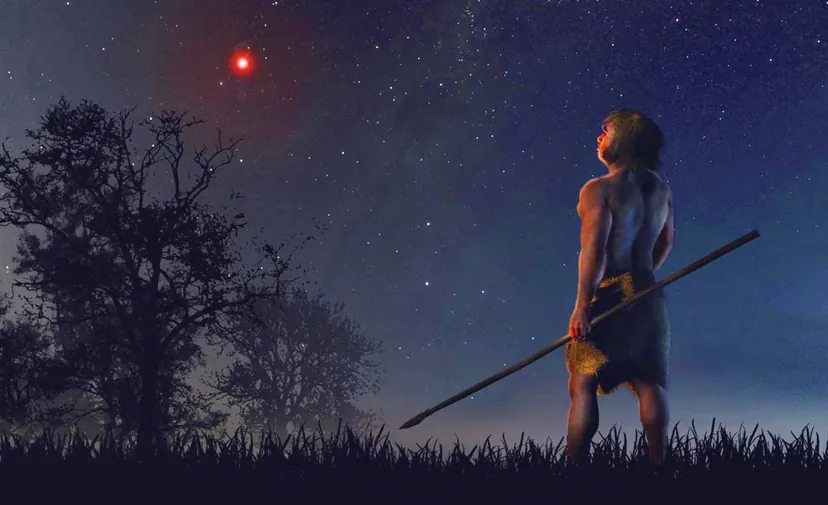
If HD 7977 was indeed a star with brightness similar to the Sun and approached within 6,000 to 10,000 AU, it would have appeared much brighter than Venus in the night sky at that time. It potentially had an apparent magnitude of roughly -7 to -8. While not bright enough to illuminate the night like a full moon, it would have been noticeable, perhaps comparable to a thin crescent moon. At that time, Earth had either not yet seen the appearance of Homo erectus, or early humans were just emerging. Although they could not leave behind books or records, it is possible that our ancestors of that era saw this unusually bright star that suddenly appeared in the night sky.
The gravity of this star scattered the comets of the Oort Cloud in all directions. Comets that were around 10,000 AU from the Sun have relatively short orbital periods. These objects arrived in the inner solar system relatively quickly after HD 7977 passed. After having their orbits altered by the gravity of the giant planets and returning, they formed today’s group of young returning comets. Although these comets were influenced by HD 7977, the star's passage was not strong enough to completely erase the orbital directionality, which is why some traces of the previously acting galactic tidal forces remain.
On the other hand, comets that were over 20,000 AU from the Sun have much longer orbital periods. These objects are only now arriving in the inner solar system, 2 to 3 million years after the star passed. Comets in the outer reaches of the Oort Cloud were more easily disturbed by the gravity of HD 7977. The star's passage almost completely scrambled the directionality of their existing orbits. Because they are now observed as dynamically new comets, they appear to arrive similarly from all directions.
Immediately after a star passes, comets do not arrive near Earth all at once. Because the scale of the Oort Cloud is so vast, the comet shower unfolds slowly over millions of years. In the simulation where HD 7977 passed between 6,000 and 10,000 AU, the average number of long-period comets entering the inner solar system over the past 2.5 million years was about 7 to 12 times higher than when only galactic tidal forces were at play. This is not a short, isolated burst; comets with a semi-major axis of 20,000 to 50,000 AU take 3 to 10 million years after a star passes to exit the Oort Cloud and reach the inner solar system. Thus, even today, 2.5 million years later, the inflow rate of long-period comets could be about 2 to 2.5 times higher than normal. We are not just observing the traces of a past comet shower, but are living through the latter half of a shower that has not yet ended.
This result also impacts how we estimate the scale of the Oort Cloud. Because the Oort Cloud is so far and dark, it is difficult to count the objects within it directly. Astronomers estimate the total number of objects in the Oort Cloud by counting the number of new long-period comets entering the inner solar system and comparing it with the rate of comet arrival in simulations. However, if this is a special period where more than twice the normal number of comets are arriving, then existing calculations, which assumed current inflow rates as the baseline, would over-estimate the number of objects in the Oort Cloud. The paper points out that if HD 7977 is the cause of the isotropy in current comet orbits, existing estimates for the total number of Oort Cloud objects may need to be lowered by about 2 to 2.5 times.
Regardless, it is clear that the history of the solar system is not determined solely by the Sun and its planets. Neighboring stars that travel with us through the Milky Way occasionally encroach upon the solar system's boundaries, leaving behind changes that persist for millions of years. And such events will happen again in the future. About 1.3 million years from now, the K-type star Gliese 710 is expected to approach within about 10,000 AU—or 0.16 light-years—of the Sun. Gliese 710, too, could disturb the Oort Cloud and potentially trigger a new comet shower millions of years thereafter.
If humanity in the distant future survives long enough to conduct interstellar exploration, a star that has approached this closely could become a stepping stone of sorts. Of course, 10,000 AU is still a distance that cannot be easily crossed with current manned space technology. However, if a star that usually resides several light-years away approaches within 0.16 light-years, the difficulty of interstellar exploration changes significantly.
At one time, ‘Oumuamua and 3I/ATLAS visited the solar system as small fragments from other star systems. However, in the meeting of stars, the visitor does not always have to be a small rock. Sometimes, the star itself approaches the threshold of the solar system. And that star does not leave without leaving a trace; it shakes the distant Oort Cloud and sends comets into the inner solar system for millions of years to come.
Reference
https://iopscience.iop.org/article/10.3847/PSJ/ae7a65
https://www.nature.com/articles/s41598-025-29033-y
About the author Ji Woong-bae: Loves cats and the cosmos. After watching ‘Galaxy Express 999’ in his childhood, he dreamed of sharing the beauty of the universe. He is currently an assistant professor in the College of Interdisciplinary Studies at Sejong University, engaged in various science communication activities including lectures and writing. He has written books such as ‘On the Uselessness of Astronomers,’ ‘We Are All Born Astronomers,’ and ‘Strange Questions That Come to Mind When Looking at the Universe,’ and has translated books including ‘How I Killed Pluto,’ ‘Quantum Life,’ and ‘UFO.’