

[비즈한국] Three teams—Upstage, SK Telecom, and LG AI Research—have passed the second stage of the government's 'Independent AI Foundation Model (DOK-PA-MO)' project. Motiv Technology, which recorded the highest scores in global performance metrics, was eliminated due to relatively lower evaluations in usability and practical application. With only the final third round remaining, the government plans to comprehensively review the competition format, support scale, and even the final selection goals themselves. Strategies such as concentrating national resources on a select few teams to narrow the gap with global frontier AI models are being considered.
Industrial Integration and Usability Were the Deciding Factors
In the second round, 'utility' was just as important an evaluation factor as the AI model's performance. While the first stage evaluation held in January focused on verifying the model's performance and technical prowess, this round saw real-world application, service expansion, and user experience emerge as the key factors determining success or failure.
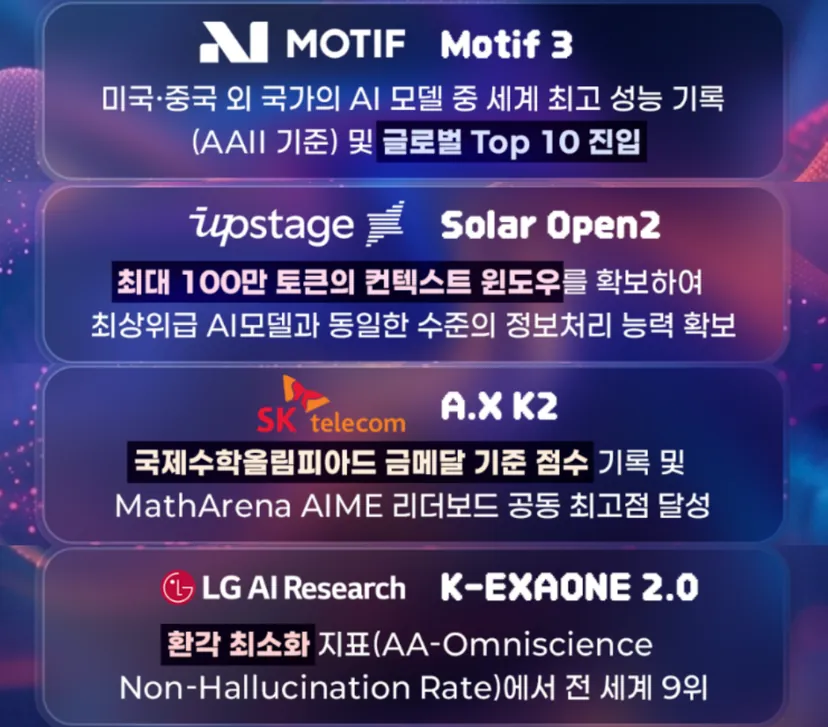
The teams that advanced to the third round were highly regarded for connecting their respective models to actual services and industries. Upstage was recognized for demonstrating its service in conjunction with the portal 'Daum' and the AI agent platform 'Timely,' as well as for utilizing FuriosaAI's domestic neural processing unit (NPU). SK Telecom showed excellent performance in mathematical reasoning and the Korean language, and received high scores for applying specialized models to industrial fields such as defense and manufacturing. LG AI Research proposed collaboration with international organizations, "Agentic AI," and development strategies for trustworthy AI.
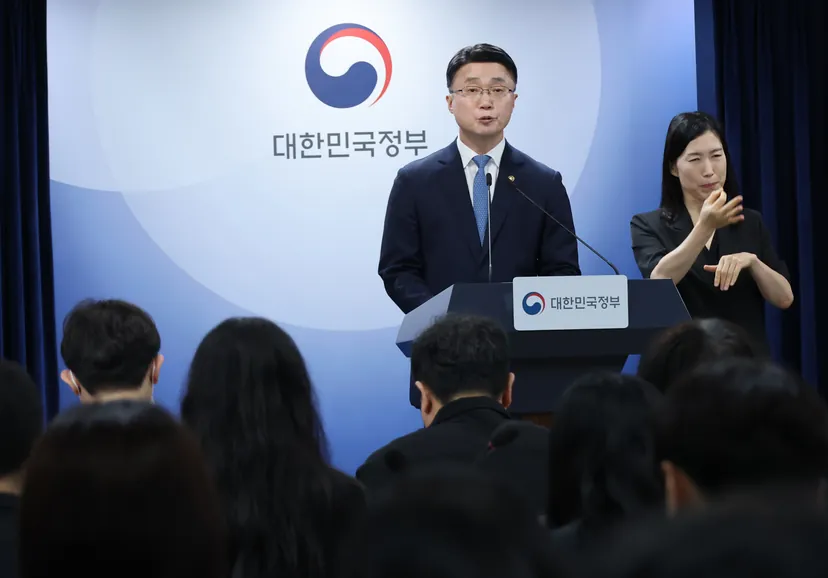
On the other hand, Motiv Technology recorded the highest score among the four teams in the benchmark index AAII (Artificial Analysis Intelligence Index) with 47 points, but was eliminated. Ryu Je-myung, First Vice Minister of Science and ICT, said in a briefing on the 18th, "While (Motiv's) technical prowess was excellent, they received a relatively lower evaluation compared to other companies in terms of usability and practical application, which carried significant weight in this evaluation."
The Ministry of Science and ICT stated that the top-ranked team in each of the three evaluation areas—benchmarks, experts, and users—were all different, and no team consistently took first place. The score gaps between categories were also narrow. In the benchmark evaluation (worth 40 points), the gap between 1st and 4th place was 4.0 points; in the expert evaluation (worth 35 points), it was 2.4 points; and in the user evaluation (worth 25 points), it was 5.0 points.
1,000 Additional GPUs to Elite Teams… Hinting at a Major Reorganization for Round 3
The schedule, point allocation, and even the final selection method for the third evaluation have yet to be finalized.
If the first round was a "performance battle" to compete on model capability and the second round was a "practicality battle" to verify industrial application and user experience, the third round is highly likely to see a change in the framework of the competition itself. This is because the government hinted at a complete review of the DOK-PA-MO competition format and support system alongside the announcement of the second evaluation results.
In particular, with officials stating it is unclear whether the original goal of selecting two out of the three remaining teams will be maintained, there is speculation that the third round could effectively transition to a new competitive system.
This is driven by the rapid performance improvements of global frontier AI models. As high-performance AI models have been released successively in the US and China while the DOK-PA-MO project has been underway, the development resources required for domestic models to compete at the global top tier have also increased. This is interpreted as a growing awareness that the current method of dividing limited budgets and GPUs among multiple teams may have limitations in narrowing the gap with global leaders.
When asked if the DOK-PA-MO goal of "selecting two final models" could change, Vice Minister Ryu replied, "This is also unknown. We are considering a complete and total reorganization of the current approach." He added, "We are discussing with the companies, who are the actual stakeholders, whether we should disperse or concentrate the resources invested so far, and whether it is desirable for companies to form a consortium."
The ministry also plans to discuss a new, unconventional support system that goes beyond existing support methods with relevant departments. "There is a consensus that we should reorganize in a way that allows us to compete on par with the models of frontier companies," Vice Minister Ryu said. "Once the government budget is finalized, we will announce the details regarding the new competitive system as soon as possible."
As a result, the axis of competition in the third round is expected to shift. The ability to secure performance competitive with global frontier models when additional national resources are injected, and how quickly development capabilities can be expanded, are expected to be critical evaluation factors.
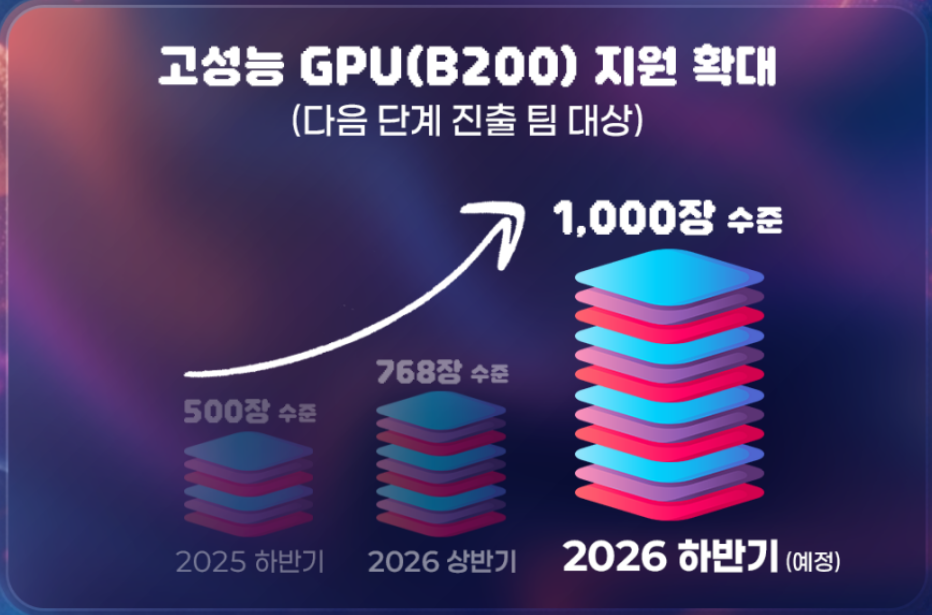
The three teams advancing to the final stage—Upstage, SK Telecom, and LG AI Research—will receive expanded support for high-performance graphics processing units (GPUs). Each elite team is scheduled to be provided with an additional 1,000 of NVIDIA's next-generation B200 GPUs by January next year. Converted into currency, this is worth approximately 40 billion KRW per team, totaling about 120 billion KRW for the three teams.