

[비즈한국] Although the South Korean men's football team clinched the gold medal at the 2026 Aichi-Nagoya Asian Games, the achievement has sparked a new social debate rather than pure joy. In the past, discussions would have centered on the players' brilliant performances or the key contributors to the victory, but now, online communities are overflowing with debates about ‘military service exemptions’ instead of football.
The controversy centers on the arts and sports military service exception system, fueled by public anger over videos of players wearing military discharge caps brought from Korea, or clips mimicking foreign players’ social media trends by pulling gold medals out of their shoes. This controversy goes beyond the thoughtless behavior of a few athletes; it is an event that sharply highlights how disconnected the 50-year-old justification of ‘promoting national prestige’ is from the current zeitgeist.
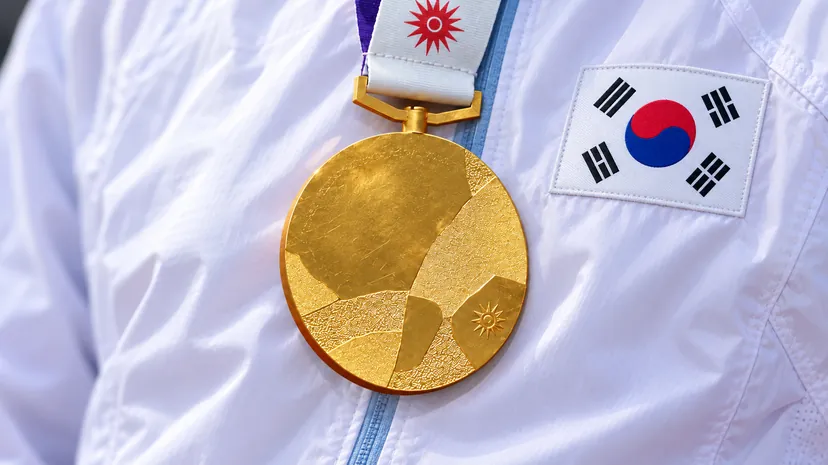
First, it is necessary to examine the roots of the current arts and sports personnel system. This system was first introduced in 1973, when South Korea was a developing nation that needed to boost national pride and make a name for itself on the global stage. At the time, military service exemptions were a kind of ‘strategic investment’ to compensate for the nation's lack of power. Since a single medal at the Olympics or Asian Games was a key means of raising the country's brand value, it was justified for the state to protect their talent and prevent career disruptions.
However, looking back objectively, the government's intention to emphasize national achievements in arts and sports at that time has many ‘suspicious’ aspects from the perspective of South Korea, a democratic nation in 2026. The Park Chung-hee Yushin regime was at a point where democratization protests were at their peak. Shortly after the exemption system was introduced, the government faced global condemnation for the kidnapping of former President Kim Dae-jung, who had been engaging in anti-Yushin activities abroad in August 1973. Meanwhile, conductor Chung Myung-whun, the first recipient of the arts and sports personnel system, received his award in Moscow—the heart of a communist nation—just two months after the People's Revolutionary Party incident and the invocation of Emergency Decree No. 4. In other words, the inception of the current system was effectively a policy started by the Park government, which had a rock-bottom international reputation as a dictatorship, to camouflage its own moral failings.
However, there is a significant gap between the reality of today and a logic from half a century ago. South Korea has already grown into a top-10 global economic and cultural powerhouse; the era when a single sports medal determined a nation's status has passed.
What is noteworthy is the trajectory of Taiwan, which has a similar strategic environment to ours. Taiwan also used to grant military service benefits to international competition medalists, but as controversies over ‘military draft evasion’ by high-ranking officials and celebrities arose recently, the Ministry of National Defense has been strictly tightening exemption criteria. This is not just an administrative measure, but a result of the judgment that, in a situation where national security threats are escalating, public integration and mobilization cannot be expected without ‘fairness’ and ‘equity’ in military service.
However, this does not mean the answer is to blindly abolish all exemption systems, succumbing to populist logic. We must focus on the ‘strategic relocation’ of who the beneficiaries of these exceptions should be. If past promotion of national prestige meant a gold medal on the field, future survival and security lie in silicon wafers and code. Artificial intelligence (AI), semiconductors, cybersecurity, and the cutting-edge defense industry have now become the core bastions that determine national survival, transcending mere economic value.
Some may question whether military service exemptions should be applied to semiconductor and AI technicians when they are already highly valued in the Korean industry. Furthermore, out of the 6,300 slots allocated for military service exemption personnel in 2027, there are already assignments for the defense and high-tech strategic industry sectors. Specifically, in the case of the defense industry, the requirements of each company have been fully reflected, and the number of personnel for the semiconductor and materials/parts/equipment industries has increased by 200 compared to this year.
However, for the semiconductor industry, small and medium-sized enterprises (SMEs) often use the lure of military service substitution to fill poor working conditions, which is closer to ‘mobilizing 3D labor’ than attracting high-level industrial talent. Therefore, the system often fails to align with the original purpose of securing high-end talent and supporting research.
To solve this, instead of blindly opening military service exemptions to large corporations across the board, one could consider a plan to selectively designate only large corporations conducting projects that correspond to national strategic technologies, focusing on support for companies where research outcomes benefit the growth or competitiveness of SMEs.
Also, it is worth studying ways to utilize the military service exemption system to reduce instances where talent with expertise in AI and information security hesitate to return to Korea after studying abroad or acquiring foreign citizenship due to military service issues. Since many talented individuals working at companies like Anthropic or OpenAI are in their early 20s, it is worth considering a mechanism where military service issues are resolved for Korean talent working at large overseas AI firms if they transfer to a Korean company.
It is time to shift the weight of exceptions, which had been concentrated on the arts and sports fields, toward national survival strategic assets. Arts and sports have already secured a world-class status and possess the momentum to sustain themselves without institutional support, whereas the brain drain in AI and semiconductors leads directly to the collapse of defense competitiveness.
Ultimately, the direction of reform for the military service exemption system must be a complete transition from ‘honor’ to ‘strategy.’ The exceptions for arts and sports should be phased out, or redesigned through a strict social consensus process, such as returning a portion of the income earned during the service period to a military welfare fund. At the same time, it is urgent to build a ‘strategic human resource acquisition system’ that allows talent in AI, semiconductors, cybersecurity, and defense technology to contribute substantively to national security without leaving their research fields. This should not be a mere privilege to reduce service, but a national security strategy to build a modern-day ‘technological wall.’
Military service is the heaviest duty and sacrifice for the youth of South Korea. The era when this sacrifice was seen as a ‘free pass’ for some is over. Now, the Ministry of National Defense should stop hiding behind the ambiguous rhetoric of ‘promoting national prestige’ and coolly judge who the true core assets protecting the nation's security are. The winds of controversy blowing from Nagoya will be the final opportunity to clear away the outdated system and achieve the optimization of South Korea’s national defense human resources.