

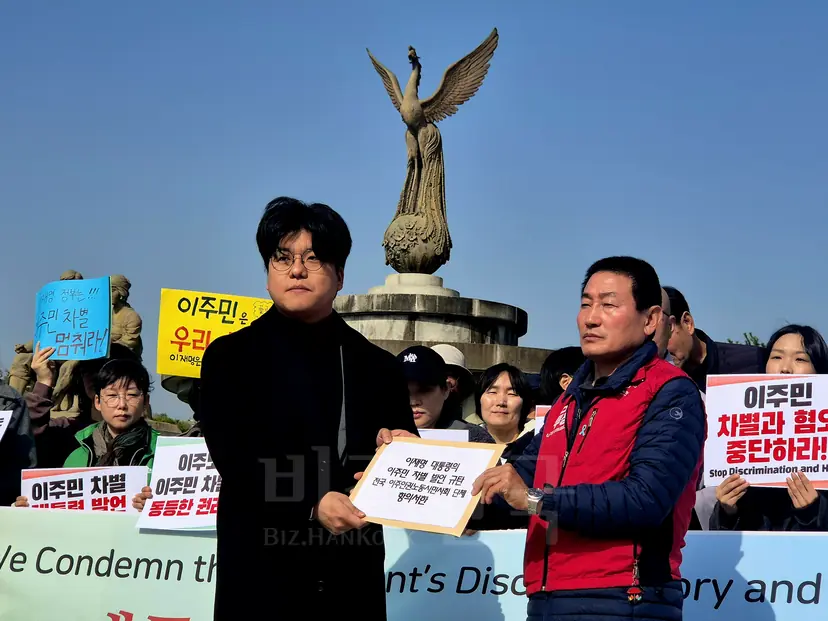
[BizHanKook] A press conference condemning President Lee Jae-myung’s recent remarks regarding migrant workers and multicultural families was held on the morning of November 3 in front of the Blue House fountain. At the event, co-hosted by 114 migrant, human rights, civic, social, and labor organizations along with concerned citizens, participants demanded an apology and measures to prevent a recurrence. They argued that the President’s remarks—which suggested that migrant workers do not contribute significantly to the national economy—send a message that migrants are subjects acceptable for exclusion. The Blue House held a meeting with these organizations that afternoon.
Economic and Social Contributions Cannot Be Measured by ‘Remittances’ Alone
The controversy began at the 46th Cabinet Meeting held at the Blue House on the 27th of last month. While discussing measures to address labor shortages in the agricultural sector, President Lee instructed Minister of Agriculture, Food and Rural Affairs Song Mi-ryung to consider labor cost subsidies for domestic agricultural workers, stating, “Even if we bring in foreign workers, it doesn’t contribute much to the national economy. This is because they send all their earned wages back to their home countries.”
Following this, President Lee posted on X (formerly Twitter) raising issues with preferential treatment for multicultural families. He stated, “Systems where local governments like Seoul provide preferential treatment to multicultural families are becoming a problem,” and announced that he would conduct a deep review—including consultations with local governments and potential revisions to enforcement decrees—on whether it is necessary to abolish these policies. He cited granting extra points for daycare center admissions and priority access to public postpartum care centers as examples where it is difficult to find reasons to prioritize multicultural families over domestic ones without exception, and asserted that the claim that all multicultural families are struggling also requires verification to see if it aligns with the facts.
Press conference participants countered that such a perspective ignores the essence of labor that sustains the foundational industrial ecosystem. Udaya Rai, head of the Migrant Workers' Union, emphasized, “The daily essentials we use—the food we eat, the cars we ride, the homes we live in, and the mobile phones we use—are produced through the hands of migrant workers. Migrant workers are making a massive contribution to the Korean economy and society through their labor itself.” They explained that the agricultural, livestock, fishing, manufacturing, and construction sectors, which domestic workers often avoid, are structured in a way that cannot function for even a single day without this labor force.
They also pointed out that the premise that 'remitting all wages means they don't contribute to the economy' is factually incorrect. At the conference, speakers highlighted that migrant workers are consumers who spend their daily living expenses, such as housing and food costs, within Korea as members of society, and are taxpayers who pay earned income tax, consumption-related taxes, and health insurance premiums. Critics noted that dismissing the economic utility of their wages simply because they are 'not spent entirely within the country' is an act that undermines the legitimacy of labor compensation.
Lee Jae-san, Secretary-General of the Association of Foreign Workers and Human Rights, pointed out, “The current migrant worker system is designed as a short-term, circular structure that restricts family accompaniment and long-term settlement, so sending a portion of their income to their home country is a structural result of the system. If you want the economic benefits of migrant workers and the revitalization of the domestic economy, it is reasonable to reform the system in a direction that improves living conditions and guarantees their rights.”
The Arisel Disaster: Sacrificed While Filling Jobs Avoided by Locals
Before even calculating economic utility, there was an outpouring of criticism regarding the structure and cost of Korean society shifting dangerous and inferior jobs onto migrant workers.
Lee Soon-hee, representative of the Arisel Industrial Accident Victims' Family Association, expressed her anger: “Our migrant workers, treated like disposable items without receiving even minimal safety training or evacuation guidance, supported Korea's high-tech battery industry with their lives. Migrant workers are entering the dangerous worksites that Koreans turn away from. Is it a statement a President can make to point fingers and say they ‘don't help the economy’ over the few blood-stained wages they received for working with their lives, after pushing them into those dangerous workplaces?”
In reality, migrant labor sites are constantly exposed to high risks of industrial accidents in addition to long hours and low wages. Speakers pointed to the dire reality that the rate of industrial accident deaths and wage arrears for migrant workers is three times higher than that of settled domestic workers. Park Hee-eun, an executive committee member of the Gyeonggi Migrant Equality Solidarity, raised her voice, stating, “On the 15th of last month, an undocumented migrant worker was killed by flying debris at an auto parts factory in Gimpo, but the business owner evaded responsibility. Korean society is being maintained on the sacrifices of workers who toil in the smallest, most inferior, and dangerous places without even their basic rights guaranteed.”
Urging the Government to Abolish Discriminatory Clauses and Implement a Support Roadmap
Beyond a simple apology for the President’s remarks, the organizations presented the government with three core demands for guaranteeing the basic rights of on-site workers and fundamental institutional reform.
First, the groups demanded the proactive elimination of discriminatory clauses against foreigners within social security systems. The intent is to guarantee institutional rights so that migrants can fully enjoy social security benefits, including the national pension.
They subsequently urged an immediate amendment to Article 63 of the Labor Standards Act to normalize labor environments in the agricultural and fisheries sectors. They pointed out that toxic clauses that exempt these sectors from regulations on working hours, holidays, and rest periods—thereby pushing workers into a legal blind spot—must be corrected.
Furthermore, the demands included the swift implementation of policies previously promised by the government. The 'Integrated Foreign Labor Support Roadmap,' originally scheduled for the first half of this year, has yet to be released due to disagreements between ministries. Through the press conference, the organizations urged the prompt promotion of comprehensive institutional improvements and human rights protection measures, such as accident prevention. They also repeatedly demanded an official apology and a promise to prevent the recurrence of anti-migrant sentiment and conflict-inducing rhetoric currently spreading in online spaces.
After the press conference, a delegation from groups including the Migrant Workers' Equality Solidarity, the Korea Migrant Women’s Human Rights Center, the Borderless People's Voice Research Institute, the Migrant Center FRIEND, and MinBYUN - Lawyers for a Democratic Society held a meeting with Jeon Sung-hwan, the Blue House Secretary for Listening and Integration, that afternoon.
During the meeting, the groups criticized the President’s remarks about migrants for fostering social stigma and exclusion, calling for an official apology. They also requested institutional improvements regarding various pending issues, including the problems of seasonal agricultural workers, the reality of wage arrears, blind spots in welfare for multicultural families, and the reduction of budgets for supporting victims of sexual and domestic violence among migrants.
It is reported that the Blue House responded that it would convey these requests to the relevant ministries. Jeon Sung-hwan, the Blue House Secretary for Listening and Integration, stated, “Migrant worker issues have been discussed as a major agenda item in regional civil society meetings as well. We will actively listen to voices from the field and continue to communicate to ensure that systemic blind spots do not occur.”