

[BizHanKook] On the 12th, Mercedes-Benz announced a total freeze on its investments within Germany. According to German business newspaper Handelsblatt and others, Michael Siebe, the Board Member for Production, stated on the company intranet: “The Board of Management has collectively decided to stop all additional investments in German facilities.” He added that the current cost structure makes further German investment impossible, and they have no choice but to carefully review which German plants will need to be closed.
Previously, in February of last year, Mercedes-Benz announced a restructuring plan to lower production costs and reduce total expenditures by 5 billion euros (approximately 7 trillion won) by 2027. At the time, they stated that there were no plans to close any plants in Germany. However, this stance has been reversed in just over a year and nine months.

Mercedes-Benz Hobbled by High Production Costs
The backdrop is a decline in performance. Mercedes-Benz’s passenger car sales in the third quarter of this year reached approximately 407,000 units, down nearly 8% compared to the same period last year, while the adjusted operating margin in the passenger car division plummeted to 2.5%. As recently as 2022, the company’s adjusted operating margin stood at 14.6%. The firm has lowered its annual target from 3–5% to 2–3%. The hit was particularly severe in the Chinese market, their largest profit source, where sales evaporated by 31% in the third quarter due to being squeezed by local electric vehicle makers like BYD.
Expensive German labor costs also remain a long-standing risk. Just before the announcement of the investment freeze, CEO Ola Källenius explained the cost issue with figures at an event hosted by the German daily Süddeutsche Zeitung in Berlin. According to his cost index, if Germany is set at 100, Hungary is at 30, Romania at 20, and China at 10–20. Even the United States, also a high-cost nation, is at 80. While he clarified that he is not trying to turn Germany into Romania or Hungary, he remarked that “lowering it from 100 to 80 is possible.”
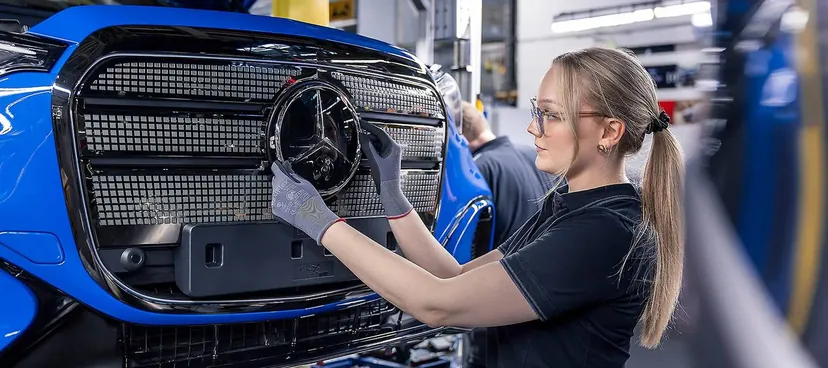
Negotiations with labor unions have also hit a stalemate. Management has requested that the workweek be increased from 35 to 40 hours without wage compensation, and that Christmas bonuses, vacation pay, and performance incentives be reduced. Conversely, IG Metall (the metalworkers' union) opposes any rollback in wages and working conditions. The union is currently in conflict with management, staging warning strikes while demanding a 5% wage increase during collective bargaining in the metal industry. Even so, reducing the workforce is difficult. In March 2025, Mercedes-Benz reached an agreement with the General Works Council, promising not to carry out layoffs for economic reasons for approximately 91,000 German employees until the end of 2034.
In addition, several other factors have had a negative impact, including a significant deterioration in the profitability of export volumes due to pressure from U.S. tariffs and intensified competition from the pursuit and expansion of electric vehicle makers.
Amid the Mercedes Crisis, Startups are Smiling
On the very day Mercedes announced its freeze on German investment due to labor costs and other issues, different news emerged from Munich, about 230km away from the company’s Stuttgart headquarters. A startup developing industrial robots to assist or partially replace factory workers secured a large investment. The main character is ‘Agile Robots,’ which has been featured here before (Related article: [European Startup Report] Germany Joins the ‘Global Robot War,’ Finally Unveils ‘Secret Weapon’).
On the 12th, Agile announced that it had secured $500 million (670 billion won) in Series F funding. This pushes the company’s valuation to $8.5 billion, putting it on the threshold of becoming a decacorn (a company with a valuation of $10 billion). Participants in this round, led by SoftBank Group, included Nvidia and Hitachi. Agile is a deep-tech startup founded by researchers from the German Aerospace Center (DLR) and produces the industrial humanoid ‘Agile ONE.’
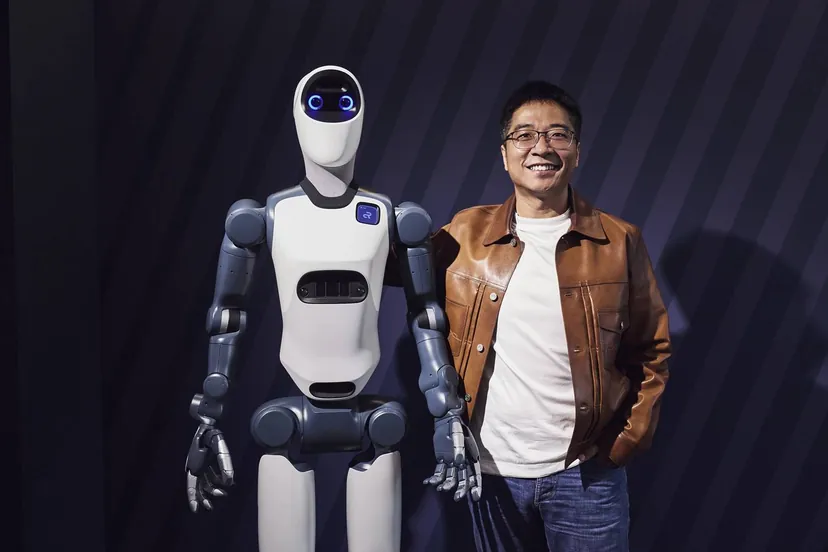
Zhaopeng Chen, founder and CEO of Agile Robots, said, “Physical AI will fundamentally change the way the world builds, moves, and creates things,” adding, “We are taking physical AI out of the lab and introducing it into various industrial sites such as logistics, automotive, electronics, and manufacturing. With this investment, we will not only expand globally and strengthen our position in key markets but also increase our production capacity.”
No formal partnership between Agile and Mercedes has been announced yet. Among automakers, they are conducting a Proof of Concept (PoC) at the Audi (Volkswagen Group) Ingolstadt plant to automate parts sorting.
These two events, occurring on the same day in the same Southern German manufacturing belt, symbolically show where the industry's transformation is headed. One could interpret this as the crisis of a traditional large manufacturing firm becoming an opportunity for a startup.
Mercedes Seeks Breakthroughs in Startup Technology
While Mercedes has halted further investment in German plants, it is actively bringing in external technology to increase production and development efficiency. A significant portion of this involves startups.
The company they are working with most closely is the American humanoid startup Apptronik. Since 2024, Mercedes has been testing Apptronik’s robot ‘Apollo’ at its plants in Berlin-Marienfelde and Kecskemét, Hungary, and invested tens of millions of euros in the company last year. The testing began with simple, repetitive tasks such as in-plant logistics, moving parts to the assembly line. Experienced production staff taught the robots tasks via remote control and augmented reality.
On the 10th, Google DeepMind announced that ‘Apollo 2,’ equipped with its robot AI ‘Gemini Robotics 2.5,’ successfully performed the task of picking and sequencing parts for each car at Mercedes’ Sindelfingen and Kecskemét plants with a 96% success rate. However, this is still at the stage of Proof of Concept on active lines. Mercedes plans to deploy humanoids on a large scale in factory logistics over the next few years.
Development methods are also changing. On the 16th of last month, Mercedes announced it would invest approximately 500 million euros (700 billion won) in its AI-based Product Lifecycle Management (PLM) system, ‘PLM.AI.’ PLM is a system that manages tens of thousands of parts data and engineering tasks in one place, from the moment a car is conceptualized through design, procurement, prototype testing, mass production, and after-sales service.
For instance, let’s say they want to slightly change the shape of a headlight to reduce air resistance. Normally, each department—body frame, wiring, regulatory review, crash simulation, and supplier pricing—would need to re-examine the change, and the coordination and approval between departments would take months. PLM.AI is designed to allow various AI agents to simultaneously analyze how such changes impact cost, crash safety, and production processes, presenting the development team with the basis for their decisions.
Mercedes has set a goal of reducing new car development time by up to 30%, or about 17 months, through this. The core platform is provided by CONTACT Software, a boutique software firm in Bremen, while Siemens handles design, simulation, and digital validation.
German startups are also involved in the streamlining of factories and offices. The Munich-based digital twin company NavVis has been converting Mercedes plants around the world into 3D virtual models since 2023. By simulating line rearrangements and traffic flows in a virtual factory within a computer before physically changing the production line, they can save on physical equipment investment costs.
Munich-based process mining company Celonis connects Mercedes’ production and logistics system data to predict delivery times and optimize production sequences. In May of this year, Mercedes partnered with Berlin-based AI unicorn n8n to allow employees across all departments—including development, production, sales, and HR—to create and use their own AI-driven work automation tools.
Most of these are still in the pilot stage, or the specific results have not been publicly quantified. Still, the direction is clear: they intend to spend money on technology that makes existing factories and organizations run more cheaply and faster, rather than building new ones.
Restructuring of Giants, Startups Step onto Center Stage
The crisis at Mercedes cannot be explained solely by the management mistakes of one company. Bosch has decided to cut over 23,000 jobs in Germany in its mobility sector alone, and ZF will cut 14,000 by 2028. The entire German manufacturing model, which stood on three pillars—cheap Russian gas, an expanding Chinese market, and a highly skilled workforce—is being shaken.
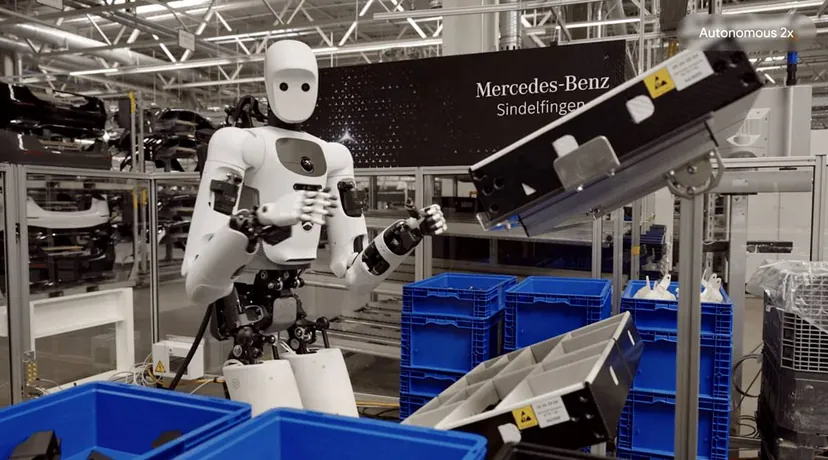
It will take several more years before robots can completely replace humans even in the final assembly process, which involves assembling tens of thousands of parts. Nevertheless, the fact that automotive and component giants have begun to "transfuse" external AI and robotics to survive is in itself a massive inflection point.
In the past, large automotive corporations were customers that European tech startups had to knock on the doors of. Now, they are expanding their position as partners changing the very way those giants manufacture. The contrast of Agile Robots securing $500 million on the same day Mercedes halted its German investment symbolically captures this change. In the future, the main players behind "Made in Germany" will not be limited to automakers alone.
Author Lee Jung-woo worked for 17 years as a journalist, covering a wide range of fields including major industries such as automotive, secondary batteries, and heavy industry, as well as national defense, diplomacy, environment, education, and health and welfare. In particular, he has reported from the field on industrial structural changes centered on mobility, energy transition, and sustainability. He currently resides in Berlin, Germany, and serves as a partner at the startup accelerator ‘123 Factory.’