

[비즈한국] The Seoul Museum of Photography is Korea’s first public art museum specialized in the medium of photography. Opened in May 2025 after a decade of preparation, this “new” museum offers not just photography exhibitions, but also experiences such as a photobook café, a darkroom, and a photo library. I headed to Chang-dong in Dobong-gu after hearing that it is currently hosting a large-scale retrospective of the late master of contemporary photography, Martin Parr.
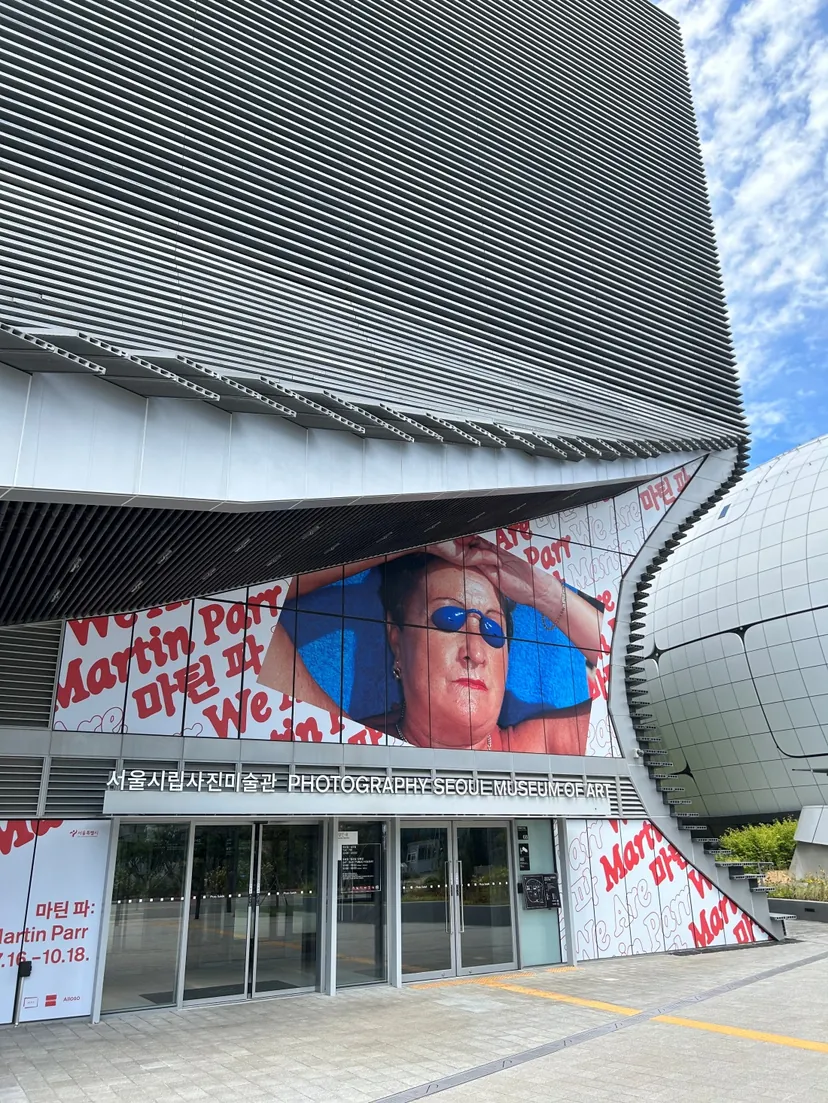
Exit 1 of Chang-dong Station, walk, and turn left, and you will spot the modern-looking Seoul Museum of Photography nestled between buildings. As you walk straight toward it, a massive sculpture in front of Seed Cube Chang-dong catches your eye. This is sculptor Im Young-hee’s “Space and Reflection-II,” a 13-meter-tall figure of a person standing with binoculars. The body is divided into black and white sections, and interestingly, it is shaped with a thin, flat profile, making its volume appear completely different depending on the viewing angle. In addition to this, several other sculptures harmonize with the Seoul Museum of Photography, creating a unique urban landscape in Chang-dong, which is a typical residential district.
The Seoul Museum of Photography firmly establishes its identity starting from its exterior. The texture of the building, made of stacked rectangular modules, is distinctive and was inspired by the pixel, the smallest unit of a photograph. The entrance was also designed based on the principle of a camera aperture opening and closing. The fact that the building's exterior color is designed to change according to light and time is also an architectural expression of light, the core element of photography. In short, the entire building is like a work of art itself, well worth taking the time to admire from various angles. A collaboration between Austrian architect Mladen Jadric and Korean architect Yoon Geun-joo, the building was named a winner in the museum category at the 11th Korea Cultural Space Awards.
Upon entering, visitors are greeted by a 10-meter-high lobby and the work "Autoportrait, Benidorm, Spain," which features Martin Parr’s face inserted into a shark. The current exhibition, "Martin Parr: We Are Martin Parr," runs from July 16 to October 18 and offers a chance to view about 500 of Parr's representative works and 90 photo books published between 1982 and 2026. As a member of the world-renowned Magnum Photos collective, Martin Parr has spent decades obsessively observing the daily lives and visual culture of modern society. He has consistently recorded how people reveal themselves through images, not only in his native Britain but also in tourist destinations, sports stadiums, fast-food restaurants, and streets across the globe. Because of this, his work has a fun quality of making the familiar look strange, through the use of exaggerated colors, dense compositions, and exquisite capturing of moments in what are otherwise very familiar landscapes.
As a Korean, you will likely be surprised and lean in closer when you see his photograph of a group of Korean tourists taken at the Acropolis in Athens, Greece, and you will burst into unexpected laughter upon seeing his photos taken in South and North Korea in the late 1990s and early 2000s. There is no need to hesitate just because you feel you know nothing about photography. The intense colors and tight focus we encounter every day on social media and in advertisements are already captured in his works. As the title "We Are Martin Parr" declares, the exhibition is meant to be something that everyone can enjoy in a friendly way.
The exhibition also asks how we should read photography in an era where everyone takes pictures and records their daily lives with their smartphones. Mirrors are placed throughout the exhibition to make visitors confront themselves, and Martin Parr's quotes—such as "The world is funny. People are, too," "Boring things are surprisingly interesting," "The easiest person to fool is yourself," and "All photography is propaganda"—are inscribed on the walls to give visitors food for thought.
The way visitors can sit on sofas provided by the furniture brand Arso and freely browse Martin Parr's photo books is also unique. While it may carry risks—recalling an incident where an out-of-print book provided for viewing was lost at a recent Yoo Young-kuk retrospective—seeing visitors sit down calmly to read and enjoy the photo books rather than just sticking their cameras in front of the works makes me think this is an important experience. Therefore, I recommend a leisurely visit with plenty of time. If your interest in photography has grown after seeing the exhibition, be sure to visit the photo library on the 4th floor. You can browse various photography-related materials, photo books, and academic databases. Of course, you can find Martin Parr's photo books there as well.
The Martin Parr retrospective, as well as the Seoul Museum of Photography itself, is free of charge. Keep in mind that you can enjoy a leisurely visit until 8 PM on weekdays and until 7 PM on weekends and public holidays (closed on Mondays). If you are with children, consider visiting the Seoul Robot & AI Museum located right next door or taking a stroll along the nearby Jungnangcheon Stream.