

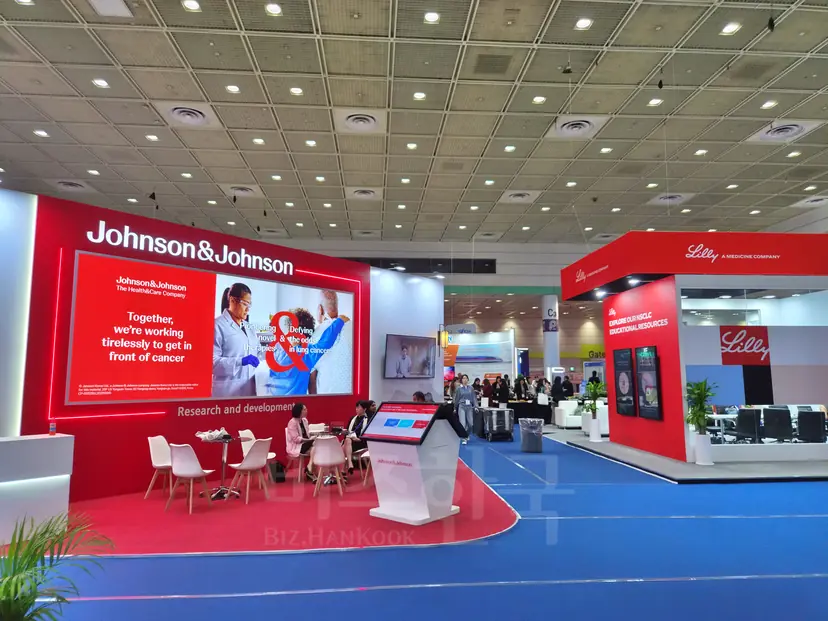
[비즈한국] At the World Conference on Lung Cancer (WCLC) 2026, where global pharmaceutical companies such as AstraZeneca, Eli Lilly, MSD, and Johnson & Johnson set up booths, a booth for the Korea Lung Cancer Patient Association was also present. It drew attention as a space where patients directly share their voices, situated among corporate booths promoting new drugs and clinical data. The Korea Lung Cancer Patient Association is a non-profit patient organization that provides treatment information, advocates for the expansion of insurance coverage for new drugs, and promotes awareness for early screening for lung cancer patients and their families.
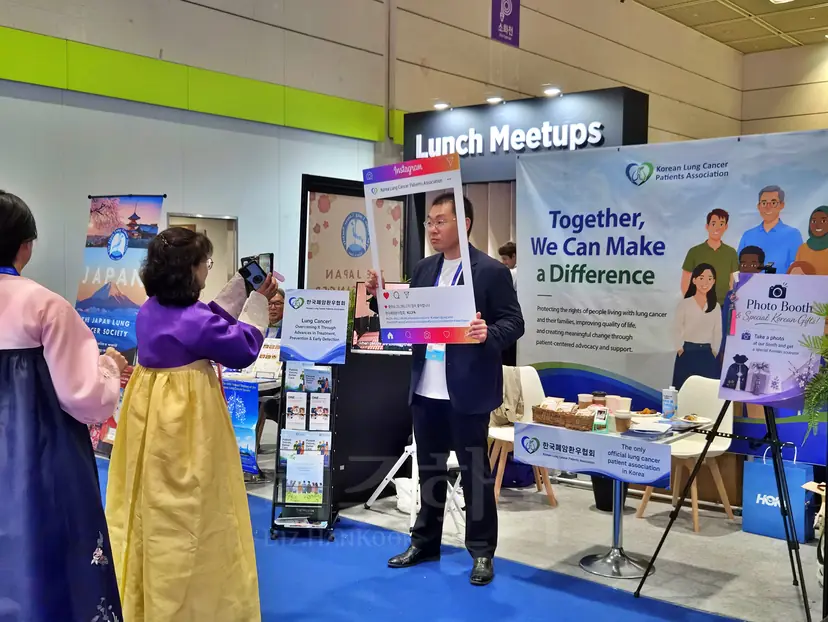
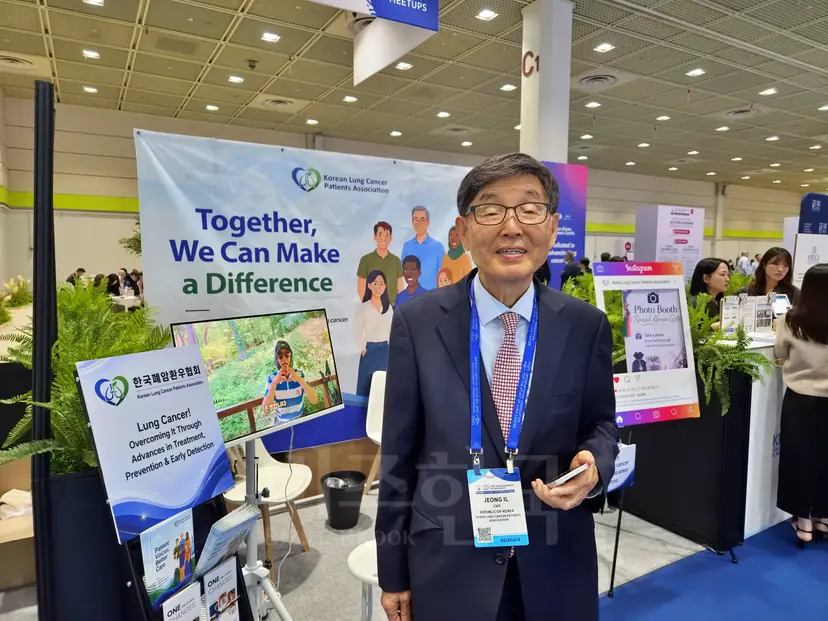
Cho Jung-il, Chairman of the Korea Lung Cancer Patient Association, met with our reporters on the 13th at the WCLC—the first to be held in Korea in 19 years—and said, “We are operating this booth to raise more awareness about our patient advocacy activities and to accelerate lung cancer treatment, ultimately bringing hope to patients.”
Furthermore, on the 12th, the day before, he held separate meetings with representatives from patient groups in Japan, Hong Kong, Singapore, and Thailand to exchange information on early screening policies, new drug accessibility, and health insurance systems in each country to find models that could benefit Korean patients.
Chairman Cho and association officials explained that because lung cancer often lacks clear early symptoms, it is frequently discovered late; they shared early diagnosis policies and screening information with overseas patient groups. Domestic data shows that approximately 65% of non-small cell lung cancer patients are already in stages 3-4 at the time of diagnosis. In particular, as the proportion of non-smokers is known to be high among female lung cancer patients, finding ways to detect patients who fall outside the existing screening system focused on high-risk smoking groups is considered a key challenge.
New drug accessibility is also a major agenda item shared with overseas patient groups. They explained that since drug approval and health insurance systems differ by country, they are comparing how quickly patients can access new therapies to seek improvements for the domestic system.
An association official emphasized, “No matter how many new drugs are developed and policies are created, there are far too many cases where patients cannot actually use them. Our goal is to network with other countries to see how their health insurance is applied and which patients are eligible, so that effective models from abroad can be quickly adapted for Korean lung cancer patients.”
Insurance Hurdles Even After Ministry Approval… Demands for Improved New Drug Access
Chairman Cho specifically pointed out the process that new drugs must undergo after development before reaching domestic patients.
In South Korea, even if a new drug receives item approval from the Ministry of Food and Drug Safety (MFDS), it does not mean patients can use it immediately. It must go through subsequent procedures such as the Health Insurance Review and Assessment Service (HIRA)’s evaluation of benefit adequacy and the National Health Insurance Service (NHIS)’s drug price negotiations.
In particular, innovative new drugs recently approved by agencies like the U.S. FDA are often high-cost treatments reaching hundreds of millions of won per year, making it inevitable that factors like clinical utility as well as the impact on the health insurance budget must be considered.
Chairman Cho expressed frustration that even if the MFDS approves a drug for use in domestic patients, because the drugs are so expensive, they must be covered by insurance for patients to use them; yet, due to factors like national budget limitations, access is often blocked at the HIRA or NHIS insurance coverage evaluation stage.
He also pointed out that, compared to other countries, the speed of access to new drugs felt by domestic patients is relatively slow.
Chairman Cho argued, “In countries like Japan, once a drug is approved, it is almost immediately eligible for insurance benefits, allowing patients to start treatment. Other countries usually allow the use of a drug once it is released, but in Korea, besides the cost issue, many drugs are blocked from being prescribed even as non-reimbursed items.”
MFDS approval does not automatically lead to patient access to treatment. The theoretical time frame for the current domestic new drug registration process is about 240 days, including HIRA evaluation, NHIS price negotiation, and official notification procedures. The problem is that this does not represent the total time from approval to insurance coverage. If the Cancer Disease Deliberation Committee does not set coverage criteria, or if the Pharmaceutical Benefit Evaluation Committee rejects the adequacy of coverage and data needs to be supplemented or re-evaluated, it could take years for patients to actually receive health insurance benefits.
In fact, there are many cases of lung cancer drugs in Korea that took years to gain insurance coverage after approval. AstraZeneca’s non-small cell lung cancer treatment ‘Tagrisso’ expanded its indication as a first-line treatment in December 2018, but insurance coverage for first-line use was not granted until January 2024. It took about five years for the coverage to expand. During this time, Tagrisso failed to pass the Cancer Disease Deliberation Committee multiple times, and patients waiting for coverage even filed national petitions while bearing the high costs of the medication.
Johnson & Johnson’s bispecific lung cancer drug ‘Rybrevant’ is similar. Although it received domestic approval as a second-line monotherapy for EGFR exon 20 insertion-mutant non-small cell lung cancer in 2022, it failed to enter the insurance coverage list several times. It passed the Pharmaceutical Benefit Evaluation Committee in June of this year and completed drug price negotiations with the NHIS last August, making it likely to be listed for insurance coverage this coming October. If listed, it will have taken about 4 years since its initial approval to enter the health insurance system.
Interest in Innovative Small Cell Lung Cancer Drugs… 50 Million Won a Month, Who Can Afford It?
What area is the Korea Lung Cancer Patient Association particularly focusing on at this WCLC? They are keeping a close eye on small cell lung cancer (SCLC) treatments.
According to the latest statistics released by the Korea Central Cancer Registry in 2026, out of 32,924 lung cancer cases in 2023, 3,261 were small cell cancer—about 10% of total lung cancer patients. However, it is an area with high unmet demand for new treatments due to its rapid progression and high recurrence potential. Major clinical results for new SCLC drugs were revealed one after another at this WCLC.
ADC (Antibody-Drug Conjugate) drugs targeting B7-H3 received the most attention. In a phase 3 trial for relapsed SCLC patients, ‘Tarlatamab-like drugs’ (e.g., ifinatamab deruxtecan) reduced the risk of death by 54% compared to the existing treatment topotecan, and the median overall survival (OS) was 13.3 months, longer than topotecan's 9.4 months. Another ADC, ‘ifidatamab,’ also recorded a median OS of 18.5 months in phase 3, significantly extending survival compared to topotecan’s 10.3 months.
In addition, attempts to expand treatment options for SCLC continue, such as the bispecific antibody tarlatamab targeting DLL3, for which clinical studies on extending dosing intervals or subcutaneous administration were presented at this conference. As new mechanisms of treatment emerge one after another, patients' expectations are growing.
However, how quickly patients can actually access these high-cost new drugs remains another challenge. Chairman Cho pointed out that because the prognosis for SCLC is poor, every drug is worth watching, but because costs are the ultimate issue, patients cannot access these innovative SCLC drugs.
He shared the case of a SCLC patient to highlight the accessibility problem caused by expensive treatments. This patient, whose cancer had metastasized throughout the body and whose life was in danger, recovered significantly after participating in a clinical trial for a new treatment. Chairman Cho explained that if it weren't for the clinical trial, the cost of treatment would have been unbearable for the patient.
“The cost of that drug was nearly 50 million won per month,” Chairman Cho said. “They were only able to use it because they were in a clinical trial; otherwise, who would be able to afford it?”
Must Use Effective Drugs First… First-Line Treatment Coverage Restrictions Also a Problem
The Lung Cancer Patient Association also believes that it is important to consider at what stage of treatment a new drug can be used once it enters the health insurance system.
In cancer treatment, even for the same drug, the actual opportunity for a patient to be treated depends on whether it can be used from the first-line stage or only in the second-line or subsequent stages after existing treatments fail. The patient association’s stance is that patients should be able to use effective treatments first before their condition worsens.
Chairman Cho explained, using the non-small cell lung cancer treatment Rybrevant as an example, that there is a gap between the treatment timing patients desire and the actual coverage criteria.
However, he sympathized with the difficulty from the perspective of HIRA, which must consider the health insurance budget. “From a patient’s perspective, it is natural to want to use the most effective drugs first, but I also understand the position that if all the best drugs are used from the start, the budget cannot be sustained,” Chairman Cho explained.
Chairman Cho’s central concern is that the mere fact that a new anti-cancer drug has been developed is not enough for the patient. A new treatment option only truly becomes an option when a drug that has proven its efficacy in clinical trials receives domestic approval, enters the health insurance system at a level patients can afford, and can actually be prescribed at the necessary stage of treatment.
This is why the Korea Lung Cancer Patient Association set up a booth for the first time at the WCLC held in Korea after 19 years. Even if innovative new drugs and clinical results are released one after another at the conference, the meaning of therapeutic innovation is limited if patients cannot actually use the drugs. The voice of the Lung Cancer Patient Association is that patient accessibility must be improved, extending beyond new drug development to include early diagnosis, approval, insurance coverage, and use at the appropriate stage of treatment.