

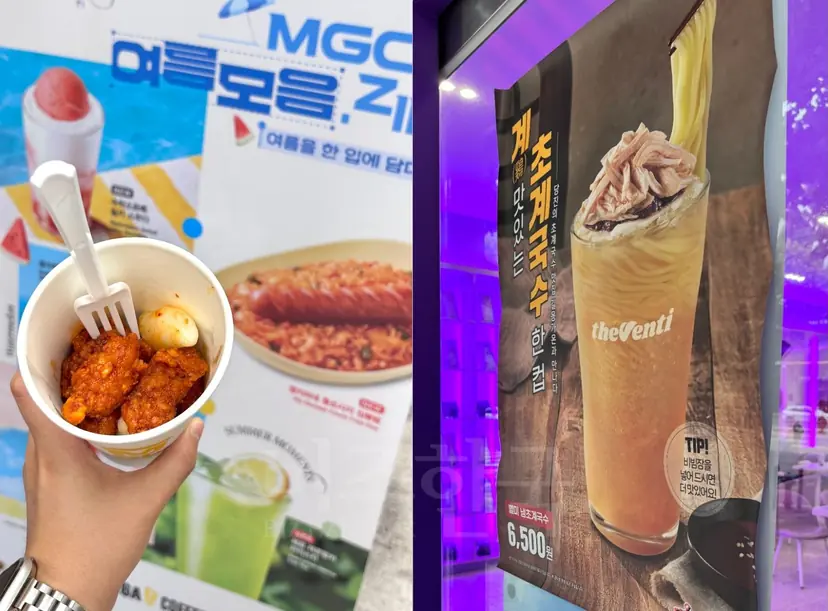
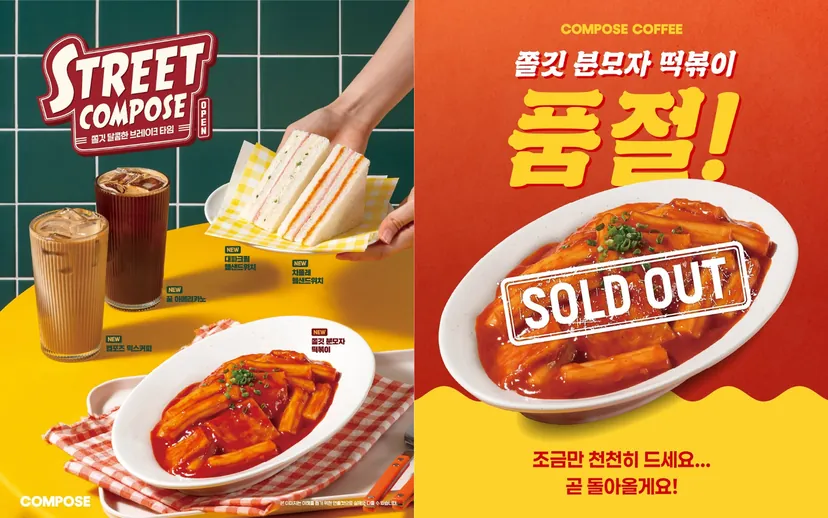
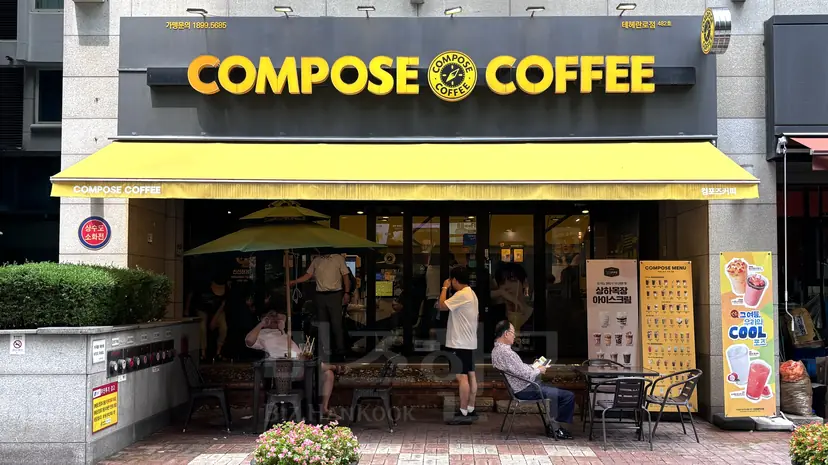
[비즈한국] At a Mega MGC Coffee store in Gangnam-gu, Seoul, "Seasoned Cup Chicken" has taken a spot on one side of the menu board, which used to feature only coffee and bread. Just a few steps away at a The Venti store, customers can order rose tteokbokki, mala tteokbokki, and soboro rice. Compose Coffee sells bunmoja tteokbokki. Now, budget coffee shops have become places where you can solve not just a cup of coffee, but an entire meal.
Competition in the budget coffee industry is expanding beyond drink prices to "what else can we sell." As major brands see their store counts grow rapidly, making it difficult to rely solely on new store openings for growth, meal menus that increase the average transaction amount at existing stores have emerged as a new means of expansion. In particular, menu diversification is accelerating, centered around brands that have attracted external capital, such as private equity funds (PEF). However, as the range of items—from tteokbokki and fried rice to chicken—increases, the operational burden on franchisees, including cooking time, ingredient management, and dishwashing, is also growing.
More Than 10,000 Budget Coffee Stores... Selling Only Coffee Is Not Enough to Compete
The domestic budget coffee market has grown rapidly over the past five years. According to the National Data Agency, the number of stores for major budget coffee brands such as Mega MGC Coffee, Compose Coffee, Paik's Coffee, and The Venti has more than tripled from 3,150 in 2020 to 10,782 last year. While this means significantly more choices for consumers, for franchisees, it means there are that many more stores to compete with in the same commercial area.
As the budget coffee market grows quickly, the importance of strategies to generate additional revenue from existing stores is also increasing. With major brands securing thousands of stores and increasing competition among budget coffee brands in the same trading areas, selling more products to existing customers—rather than just opening new stores—has emerged as a new growth engine.
Expanding food menus is one way to increase the average transaction value. This is because stores can increase the purchase amount per customer by selling food alongside drinks without raising coffee prices. It also allows stores to secure demand for lunch and dinner beyond the peak hours for coffee consumption. Consequently, café food, which used to be limited to desserts, is trending toward simple meals.
In fact, at a Mega MGC Coffee store in Gangnam-gu that the reporter visited on the 19th, the store was selling not only drinks and bakery items but also simple meal menus such as seasoned cup chicken and hot cheese sticks. The Venti, located about three minutes away, also sold a variety of meals, including tteokbokki. The chogye-guksu, which gained buzz as a summer menu item, was sold out on this day and unavailable for order.
Investment Capital Flooding Into Budget Coffee... Strategies to Increase Existing Store Revenue Are Crucial
One of the most active players in this change is budget coffee brands that have received external investment. Budget coffee is considered one of the most attractive sectors for investment within the restaurant franchise industry. It can maintain consumer demand even in high-inflation situations by focusing on relatively low prices, and it can secure stable revenue based on standardized operating methods and nationwide store networks.
In fact, major budget coffee brands have seen a series of investments over the past few years. Mega MGC Coffee was acquired by a special purpose company (SPC) including Premier Partners in 2021, and Compose Coffee was brought into the fold by the Philippine restaurant firm Jollibee Foods and a domestic PEF consortium last year. This year, Orchestra Private Equity, which saw success with its investment in KFC Korea, set out to secure management rights for Mammoth Coffee. This means that out of the top 5 domestic budget coffee brands, three—excluding Paik's Coffee and The Venti—have had external investment capital injected into them.
PEFs boost corporate value after acquiring a company by increasing sales and profitability, then recoup their investment through methods such as selling off their stake. As the investment period is fixed, accelerating the company's growth after acquisition is critical. While budget coffee brands have grown rapidly through new store openings, with store counts now reaching the thousands, the importance of strategies to increase sales at existing franchises alongside new openings is growing. This is why the expansion of food menus to increase items sold within an already established store network is being highlighted as a new means of growth.
An Opportunity to Increase Revenue, But... Store Operations Become More Complex
Expanding food menus is also an opportunity for franchisees to generate new revenue. However, the amount of work required at the store level increases in the process. When meals are added to a store previously focused on drinks and simple desserts, staff must manage new raw materials and packaging, learn new cooking methods, and face the burden of disposing of unused ingredients if sales are low.
In fact, Mr. A (23), who worked at a Mega MGC Coffee store for two years, said, "Menus like shaved ice that have many ingredients require a lot of utensils like spoons or scoops, which increases dishwashing," and added, "Meal items like fried rice or tteokbokki use the microwave or oven for longer than bread does, but since there is only one of each appliance in the store, if two or more orders overlap, the subsequent orders inevitably get backed up."
Mr. B (26), who worked at Compose Coffee for six months, also cited the burden of having to learn new tasks every time a new menu item is released. Mr. B stated, "For each menu item, we not only have to learn the recipe but also the storage methods and standard quantities for new incoming ingredients," and continued, "In the case of shaved ice, the storage and usage amounts differ for ingredients like red beans, rice cakes, and fruits, and there is also a separate process for thawing frozen fruit, so there is a lot to learn whenever a new menu comes out."
Since budget coffee is structured to compensate for low retail prices with a high volume of orders, the time required for each additional menu item significantly affects store operations. If menus that occupy the microwave or oven for a certain period are ordered simultaneously, they must be processed sequentially due to limited equipment, and during peak hours, food orders also affect the speed of drink preparation.
Kim Dae-jong, a professor of business administration at Sejong University, explained, "Today's budget coffee franchises are moving away from the simple competition of providing 'cheap coffee' and are evolving into restaurant platforms with value for money and convenience, where customers can handle both coffee and meals at low prices. The competition is becoming increasingly fierce." He added, "In particular, for franchises that have received external capital, strategies to expand existing coffee-centered business models and diversify revenue streams are at play to recoup investments and raise corporate value. However, for these growth strategies to be sustainable, it is necessary to consider the operational burden on franchisees resulting from menu expansion."