

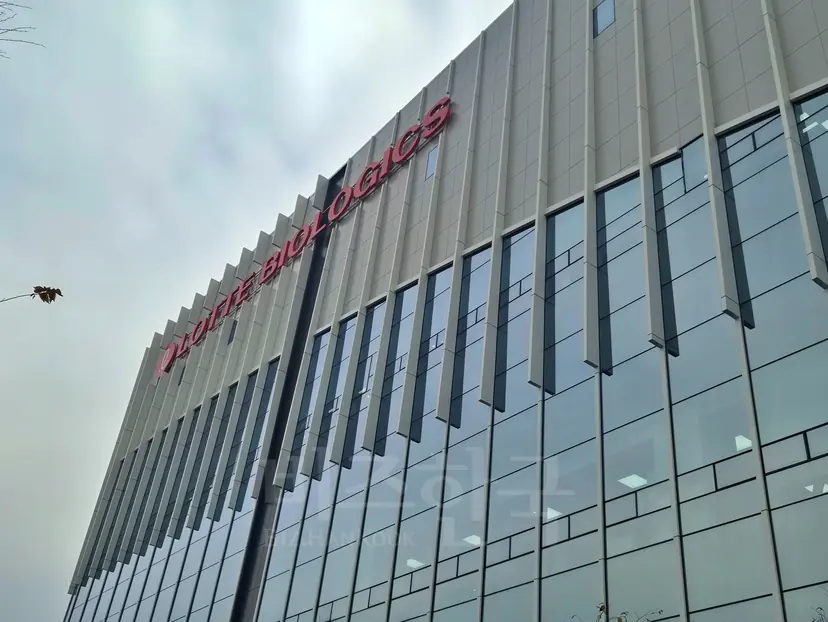
[BizHanKook] Lotte Biologics has completed a 120,000-liter biopharmaceutical production facility in Songdo, Incheon, and has begun full-scale efforts to capture the global CDMO (Contract Development and Manufacturing Organization) market. The company has highlighted the integration with its Syracuse plant in the U.S., a customer-tailored production system, and a global sales network as its key differentiators. It also considers a stable labor-management relationship as a strength that will support its competitiveness. However, challenges remain, such as converting newly secured production capacity and initial large-scale orders into tangible revenue and improved profitability.
Differentiation Through Labor Stability and Flexible Production Systems
Lotte Biologics held the completion ceremony for its first plant at the Songdo Bio Campus on the 18th. This day also marked the announcement that the Samsung Biologics labor union had joined the Federation of Korean Trade Unions (FKTU). Amidst ongoing labor-management conflicts at Samsung Biologics, Lotte Biologics expressed confidence in its relatively stable labor-management culture.
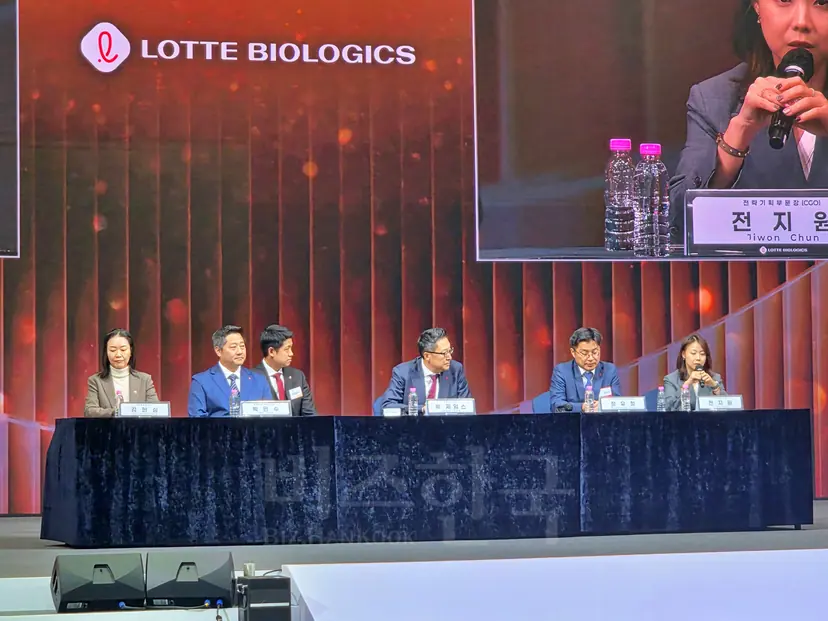
During a press conference following the completion ceremony, when asked about the Samsung Biologics union's move to join the FKTU, a Lotte Biologics official stated, "It is a natural trend of the times that as the bio-industry grows, movements for protecting workers' rights or establishing unions appear," while adding, "Lotte Group has established a stable labor-management culture based on mutual cooperation over its long history."
The official added, "For now, the company's rapid early stabilization and growth are the top priorities," and "We will continue to build a trusted labor-management relationship based on a healthy and transparent corporate culture."
However, the entire Lotte Group is not immune to labor disputes. In July of this year, labor unions from subsidiaries including Lotte Department Store, Lotte Duty Free, and Lotte Mart held a joint press conference to protest the introduction of a job-based pay system and the procedures for changing employment rules.
The Songdo Plant 1, which will serve as the backbone of Lotte Biologics' CDMO business, spans approximately 99,558 square meters of floor space and features eight 15,000-liter bioreactors, securing a total production capacity of 120,000 liters of biopharmaceuticals. The company explained that through equipment qualification and validation, it achieved Good Manufacturing Practice (GMP) readiness six months ahead of its original plan.
The production competitiveness highlighted by Lotte Biologics is its flexible production system tailored to the development stage and product characteristics of client companies. In addition to the 15,000-liter bioreactors used for large-scale commercial production, the Songdo Plant 1 is designed to utilize 3,000-liter bioreactors as independent production facilities. This setup is intended to meet production demands for both high-titer antibody drugs and general antibody drugs.
The production facility adopts a "top-down" approach, where processes are arranged vertically by floor, allowing materials to move via gravity. Autonomous Mobile Robots (AMRs) have been introduced for material transport, and an automated warehouse with a capacity of approximately 6,000 cells has also been constructed. These measures are designed to enhance production efficiency and reduce potential contamination risks during the manufacturing process.
Jeon Ji-won, Executive Director of Strategic Planning at Lotte Biologics, pointed to customized customer response as a strength for a latecomer. She explained that while large CDMO firms have secured economies of scale, they may face relative constraints in meeting the specific requirements of individual clients.
"We proactively identify and resolve the 'pain points' of our customers, deliberate in the same language as the customer, and provide customized support for the journey of their pipelines," she said, emphasizing that this partnership and agility are helping to secure clients.
Targeting the Global Market by Linking U.S.-Korea Production Hubs… Profitability Remains a Task
The link with the Syracuse plant in the U.S. is another pillar of the company's differentiation strategy. Lotte Biologics acquired the Syracuse plant from BMS (Bristol Myers Squibb) in 2023, securing a U.S. production base. The plant is equipped with a 40,000-liter production capacity and Antibody-Drug Conjugate (ADC) conjugation facilities.
The roles of the two plants are distinct. Syracuse handles relatively smaller volumes for initial clinical trials and ADC conjugation processes, while Songdo handles large-scale production of antibody drug substances. The plan is to link technology transfers and production scale-ups as client companies transition from the development stage to commercial production.
In particular, there are expectations that Lotte Group can leverage its business network established in Japan to capture demand from Japanese pharmaceutical companies looking to enter the U.S. market and diversify their production bases. The Syracuse plant could serve as a bridge if Japanese pharmaceutical companies wish to utilize local U.S. production facilities.
Executive Director Jeon explained that since Japanese pharmaceutical companies value the trust and partnerships built over a long period, Lotte Group's experience in the Japanese market and the commercial production track record of the Syracuse plant are beneficial in securing clients.
However, as Japanese firms like Fujifilm and AGC have also secured local production facilities in the U.S., Lotte Biologics needs to prove its unique competitiveness. A company official also explained that while they are optimistic about additional business opportunities with Japanese pharmaceutical companies, more time is needed before these translate into concrete large-scale contracts.
The company also noted that CEO Shin Yoo-yeol, who was recently promoted to President, is focusing on global business expansion. A Lotte Biologics official explained that rather than daily factory operations, CEO Shin is concentrating on global external cooperation, participating in major overseas conferences, and utilizing his global network to support large-scale contracts and sales. He also regularly participates in key strategic decision-making, the company added.
On the 17th, Lotte Biologics announced that it had signed its first large-scale commercial production contract with a global pharmaceutical company.
The company expects that once the Songdo Plant 1 is operating at 100% capacity, it could generate approximately 700 billion won in annual revenue. Combined with the potential annual revenue of approximately 300 billion won from the Syracuse plant, the calculation is that the two production hubs could generate 1 trillion won in annual revenue.
Furthermore, considering existing Syracuse plant contracts, new Songdo orders, and additional volume under negotiation, the cumulative order volume is projected to reach up to $1.9 billion (2.5276 trillion won) by the end of this year. However, this is a maximum estimate including potential future contracts and should be distinguished from confirmed order performance.
The task ahead is to convert secured production capacity and orders into stable revenue and profitability. Kang Hyun-shim, Executive Director of Finance at Lotte Biologics, said, "Revenue does not only occur when commercial production begins," adding, "We start generating revenue from 2027 as we receive payments from client companies during the stages of technology transfer, test production, and production for regulatory approval." Full-scale commercial production is expected to begin after the client's technology transfer and regulatory approval processes are completed.
The schedule for subsequent investments may also change depending on order status. Lotte Biologics originally set a goal to complete Songdo Plant 2 by 2028 and Plant 3 by 2030. However, the company is currently not finalizing specific groundbreaking dates and is reviewing investment schedules by considering the trend of increasing orders.
Executive Director Kang explained, "We plan to make flexible decisions by comprehensively reviewing construction and validation periods, as well as the expansion trend of the order pipeline currently in progress."
Regarding an IPO (Initial Public Offering), Executive Director Kang stated, "Market justification is extremely important for an IPO," and that the timing for listing would be determined by comprehensively considering the visibility of order performance, market environment, and pipeline maturity.
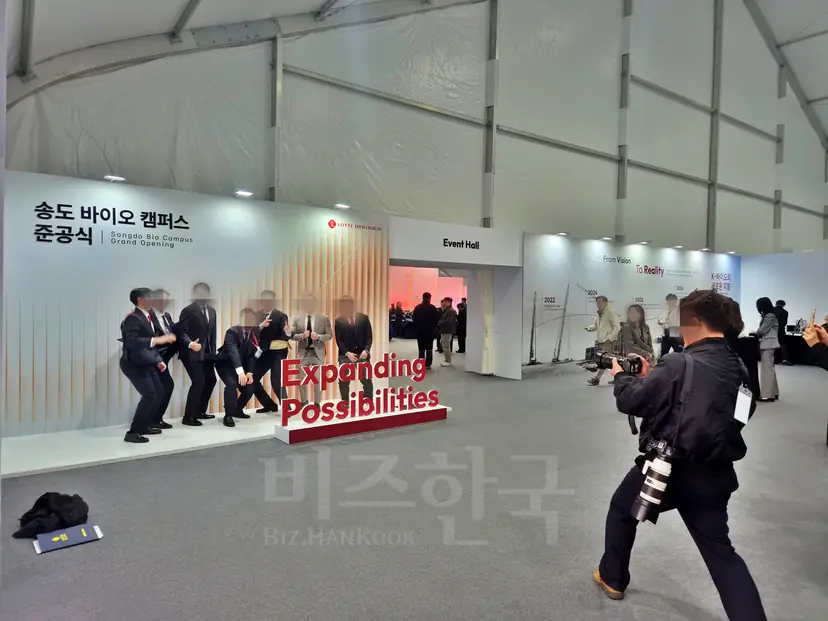
Having secured a production base with the completion of the Songdo Plant 1, it has become crucial for Lotte Biologics to secure additional clients and achieve stable utilization rates to solidify its position in the global CDMO market. Whether the company can continue its momentum from the facility completion and its first large-scale order to actual commercial production and improved profitability will be the benchmark for assessing its future competitiveness.