

[BizHanKook] The scope of the authority to determine what constitutes a "core game" has re-emerged as a point of contention in the appellate trial regarding a 223.5 billion won lawsuit between Line Yahoo Group and a private equity fund that invested 125 billion won in Line Games. Because the determination of whether a new game released by a group affiliate is a "core game" acts as the starting point for deciding whether an investor's put option (stock purchase claim) is valid, both sides are clashing over whether Line Yahoo infringed upon this right.

Limited to 'Core Games' or a right to judge all new games?
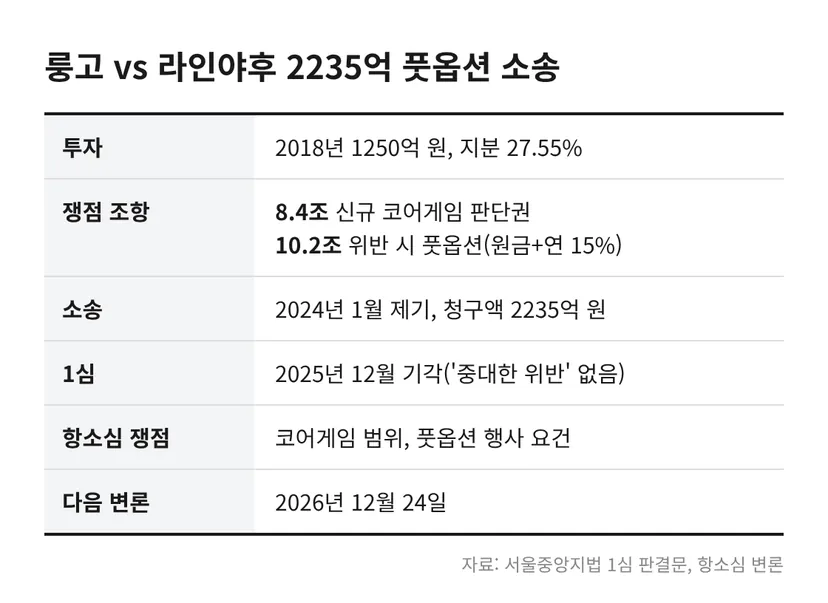
On the 12th, the 14-3 Civil Division of the Seoul High Court held the second hearing for the appellate trial of the stock purchase price claim lawsuit filed by Lungo Entertainment against Z Intermediate Global (ZIG, formerly Line Corporation). Lungo, a special purpose company (SPC) established by Hong Kong-based private equity firm (PEF) Anchor Equity Partners to invest in Line Games, acquired a 27.55% stake in 2018 with an investment of approximately 125 billion won, becoming the second-largest shareholder. ZIG is a subsidiary of Line Yahoo, the operator of the Japanese messenger "Line," and was the largest shareholder of Line Games.
At the time, the shareholders' agreement included a put option clause allowing Lungo to sell back its shares at the original investment amount plus 15% annual compound interest if Line Yahoo violated its non-compete obligations. Lungo exercised the put option in September 2023, claiming Line Yahoo violated these duties, and filed a lawsuit in January 2024 when payment was not made.
The core of the dispute lies in Article 8.4 of the shareholders' agreement. This clause grants Line Games the authority to determine whether a new game, in terms of development and publishing, is a "core game" and guarantees exclusive publishing rights if it is so determined. Lungo argued, "Line Games was granted the authority to decide if a new game is a core game," and claimed that Line Yahoo failed to guarantee this power. They further stated that if Line Yahoo’s interpretation were correct, "there is no way to explain why this clause was included in the first place."
Line Yahoo countered that "to those in the gaming industry, this case might sound like a comedy," adding that core games and casual games differ in their very development capabilities. They added that core games refer to multi-billion to hundreds-of-billions-won projects developed by firms like NCSoft, while casual games are light games enjoyed in conjunction with messengers. They argued that the 124 games flagged by Lungo are either apps integrated with Line or clearly casual games. They also pointed out that Lungo did not raise issues for five years, only filing the lawsuit after Line Games' initial public offering (IPO) attempt failed.
Lungo emphasized that during contract negotiations, the "casual game exclusion" clause that Line Yahoo sought to include was not reflected in the final contract. Their interpretation is that the definition of a core game in the contract includes all types and genres of games, excluding only those integrated into the Line app. Lungo argued, "Almost all games contain both casual and core elements, and most games fall somewhere in between," asserting that they cannot be excluded from protection based solely on genre.
According to the first-instance court ruling, during negotiations, Lungo proposed changing "new core games" in Article 8.4, Clause 3 to "new games," but failed to reach an agreement due to Line Yahoo's opposition. Based on this, the first-instance court judged that it was difficult to conclude that the guarantee of rights applies to all new games. The court also used as evidence a response sent by Line Games in November 2018, immediately after the contract, suggesting that obviously casual games like puzzle games were not considered "core games."
First Instance Ruling: "Breach of notification duty is ancillary"... Actual guarantee of rights is the issue
In December last year, the 31st Civil Division of the Seoul Central District Court dismissed Lungo's claim. It concluded that it was not sufficiently proven that Line Yahoo and its controlled affiliates were engaged in business competing with Line Games' core game business. The court acknowledged that there might be room for a duty to notify regarding games where it is unclear if they are "core games," but judged that even if this were violated, it would only constitute an ancillary breach of contract.
The requirements for exercising the put option were also an issue. The court held that since the defendant would have to pay the original investment of approximately 124.9 billion won plus 15% annual compound interest upon exercising the put option, there must be a significant violation severe enough to hinder the achievement of the contract's purpose. It judged that the performance of the games in question, the resulting loss in sales and profits for Line Games, and the specific profits attributed to Line Yahoo were not proven.
In the appellate trial, Lungo argues that not only the text of the contract but also the actual implementation process must be examined. They contend that it is necessary to reveal what guidelines Line Yahoo provided to its affiliates regarding new game development and publishing, and whether there were internal procedures to guarantee Line Games' decision-making authority. Lungo also cited an email from before the contract was signed, in which the CEO of Line Games suggested they would follow the procedures set by Line Yahoo headquarters, and demanded an explanation regarding the context and meaning of that communication.
The positions of Lungo, who requested four people involved in finalizing the contract language as witnesses, and Line Yahoo, who opposed it, also diverged. Lungo argued that statements from those involved in the contract are necessary to confirm the intent and scope of the clause. Conversely, Line Yahoo opposed it, stating, "It is doubtful what impact having witnesses testify about events from eight years ago would have."
The court decided to determine whether to accept the witnesses after confirming the results of the fact-finding inquiries. The next hearing will be held on December 24.