

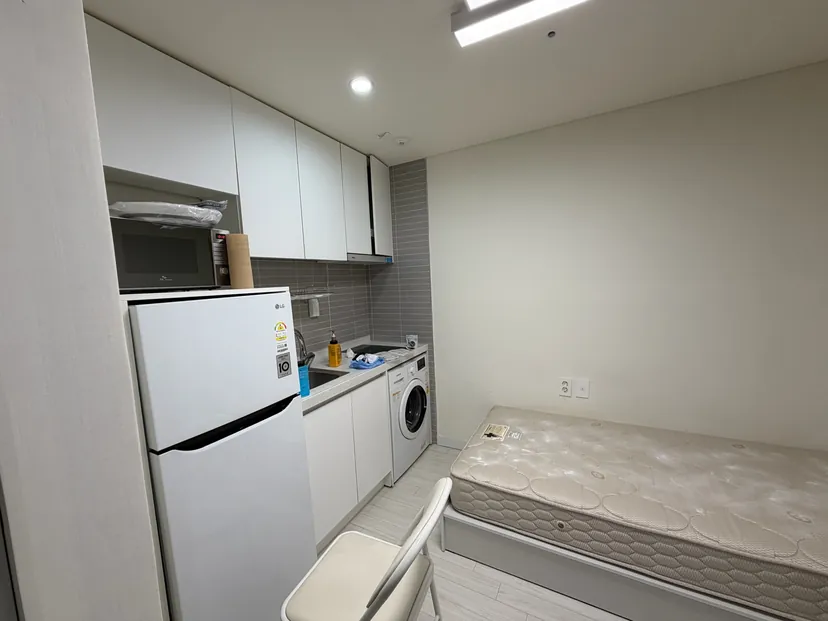
[비즈한국] A worker in their 30s, identified as A, who had been living at their family home in Ansan, Gyeonggi Province, began looking for public rental housing last year while preparing to transfer to a job in Seoul. Initially, they looked for relatively spacious homes, but after applying to dozens of places and being rejected each time, they eventually reduced their desired floor area to increase their chances of winning. In February, one month before starting their new job, they moved into a Korea Land and Housing Corporation (LH) youth purchase rental unit in Geumcheon-gu with a dedicated area of 17㎡.
Although housing costs were low, space was tight. With a security deposit of 8.4 million won and a monthly rent of 240,000 won, the total monthly housing cost—even including management fees and utilities—was half that of nearby private studio apartments. However, the space was nearly full with just basic furniture, and unfolding a drying rack made other activities difficult. Out-of-season clothes had to be sent back to their family home, and the indoor exercise and video recording they had dreamed of doing were impossible. "You end up doing nothing at home," A said.
More than Half of Youth Rental Homes Built or Purchased by LH Are ‘25㎡ or Less’
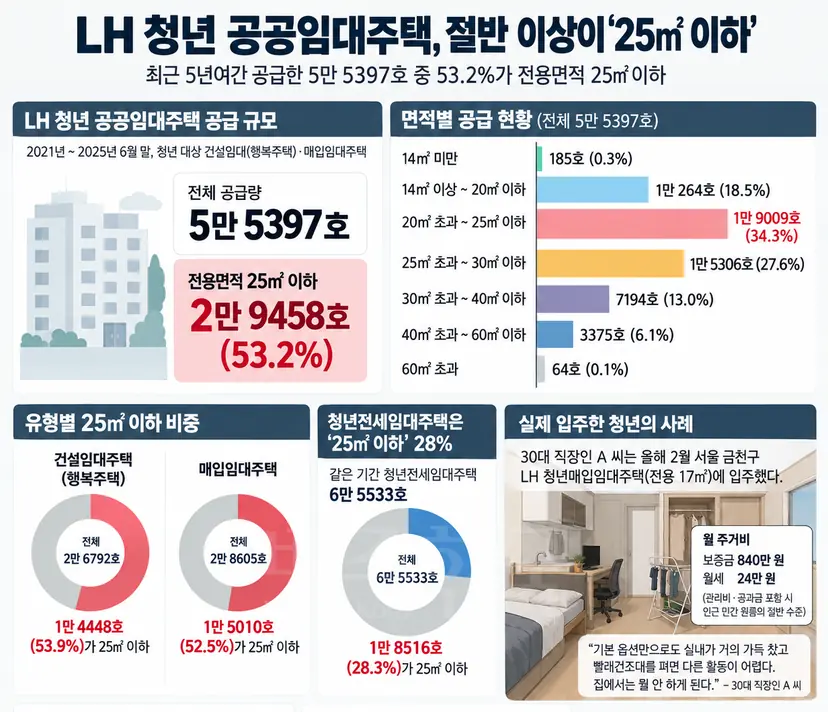
According to data submitted by LH to the office of Representative Yoon Jong-oh of the National Assembly's Land, Infrastructure and Transport Committee, which was obtained by Bizhankook, a total of 55,397 units of construction rental housing (Happy Housing) and purchase rental housing were supplied to youth (aged 19–39) from 2021 through the end of June this year. Of these, 29,458 units were 25㎡ or less in dedicated area, accounting for 53.2% of the total. In other words, more than half of the public rental housing built or purchased by LH for youth is 25㎡ or less.
By size, units exceeding 20㎡ to 25㎡ accounted for the largest share at 19,009 units (34.3%), followed by 15,306 units (27.6%) for those exceeding 25㎡ to 30㎡, 10,264 units (18.5%) for 14㎡ to 20㎡, 7,194 units (13.0%) for exceeding 30㎡ to 40㎡, and 3,375 units (6.1%) for exceeding 40㎡ to 60㎡. Units under 14㎡ accounted for 185 cases (0.3%), while those exceeding 60㎡ accounted for 64 cases (0.1%). By type, 14,448 out of 26,792 Happy Housing units (53.9%) and 15,010 out of 28,605 purchase rental units (52.5%) were 25㎡ or less.
Some areas fell short of legal standards. The current minimum housing standard sets the minimum living area for a one-person household at 14㎡. However, 185 cases of units under 14㎡ were found in LH youth purchase rental housing during the aforementioned period. LH explained that these included shared-type housing. The current minimum housing standard is the minimum residential level necessary for citizens to lead a pleasant and good life, and it has been maintained since being revised in May 2011.
Only 28% of Youth ‘Jeonse’ Rental Homes, Selected by the Youth Themselves, Are ‘25㎡ or Less’
The distribution of housing area changed when the youth looked for homes themselves. Among the 65,533 units of LH youth Jeonse rental housing supplied during the same period, only 18,516 units (28.3%) were 25㎡ or less. This is a larger proportion of spacious homes compared to the Happy Housing and purchase rental housing directly built or bought by the public sector, where units under 25㎡ accounted for 53.9% and 52.5% respectively.
In the youth Jeonse rental program, young people search for homes in the private rental market themselves. Once a selected individual finds a house that meets the eligibility criteria, LH verifies the legal rights and enters into a Jeonse contract with the landlord, then re-leases the property to the youth. This differs from public construction rental housing (Happy Housing), where LH directly builds and supplies homes, or public purchase rental housing, where existing homes are bought and supplied.
Government Aims to Expand to ‘30㎡ or More’… Experts Divided Over Small Homes
The government recently proposed a plan to increase the size of public rental housing for youth. In its "Housing Stability Plan" announced on the 21st of last month, the Ministry of Land, Infrastructure and Transport stated that while it plans to supply 190,000 universal public rental units by 2030, it will, in principle, provide at least 30㎡ of space to one-person youth households. However, it allowed for units under 30㎡ to be supplied in core urban areas where rents are high, considering the burden on housing costs.
Kim Jin-yoo, a professor of Urban Transport Engineering at Kyonggi University, pointed out, "While students or job seekers might be able to manage with about 25㎡, lifestyles change as people get older. Considering daily activities like cooking, housekeeping, and studying, it is not desirable to have so many public rental units under 25㎡. Rather than chopping up houses to increase supply, we should provide homes with adequate living standards."
On the other hand, Choi Eun-young, director of the Korea Center for City and Environment Research, explained, "It is difficult to view the supply of small housing as a problem simply because there are many units under 25㎡. In places like Seoul, where housing costs are high and demand for public rental is significant, it may be more necessary to provide many affordable units, even if they are 20㎡. It is necessary to consider area standards differently depending on regional housing costs, demand, and market conditions."
In reality, the youth living in small public rental homes placed more weight on the quality of housing than the quantity of supply. A, mentioned earlier, added, "Arguments that we need to supply more, even if they are small homes, have some merit, but as someone who is actually a young person and has lived in a rental home, I think that prioritizing the quality of housing over the quantity is more important so that young people can lead a life with dignity."