

[비즈한국] LG Group has overtaken Hyundai Motor Group to reclaim its spot as the third-largest business group by market capitalization in Korea after 325 days. This comes about 11 months after it ceded the third position to Hyundai Motor Group last November.
This reversal is not a sudden overnight outcome but rather the result of divergent stock price trends among the flagship subsidiaries of both groups. Hyundai Motor’s stock, which once soared to the 700,000 won range earlier this year, has fallen to less than half of its peak. Conversely, within LG Group, LG Electronics' stock has recently recovered to the 200,000 won range, and LG Energy Solution, the group's largest company by market cap, has also rebounded on expectations of a performance recovery.
In particular, LG Energy Solution recorded its highest-ever quarterly revenue in the third quarter. Even excluding the U.S. government's advanced manufacturing production tax credits, the company turned a profit, showing a recovery in performance that had previously been shaken by the EV "chasm" (temporary demand slowdown). However, since one-off gains such as compensation from certain clients are believed to have been reflected, it is difficult to conclude that the profitability improvement is solely due to a full recovery of its core business.
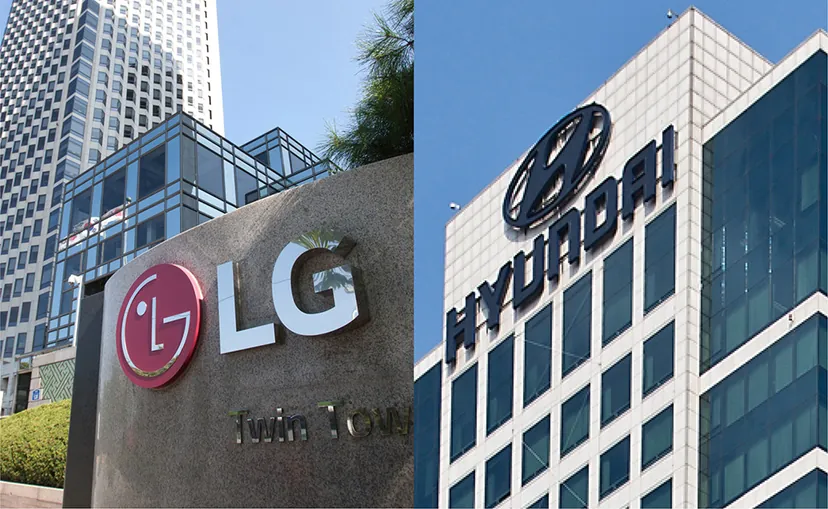
Hyundai Motor Was Ahead by 2 Trillion Won Until Yesterday, Then Reversed
According to the Korea Exchange and FnGuide, as of the closing price on the 8th, the market capitalization of LG Group's 12 listed companies stood at 198.321 trillion won, while Hyundai Motor Group's 12 listed companies stood at 193.5632 trillion won. With LG Group ahead of Hyundai Motor Group by 4.7578 trillion won, it climbed to third place in group market cap, following Samsung Group and SK Group. It is the first time in 325 days since November 17 of last year that LG Group's market cap has exceeded that of Hyundai Motor Group.
The order was the opposite just a day earlier. As of the closing price on the 7th, the market cap of Hyundai Motor Group's 12 listed companies was 199.7683 trillion won, while LG Group's 12 listed companies were at 197.6877 trillion won, with Hyundai Motor Group ahead by 2.0806 trillion won. However, by the closing price on the 8th, LG Group's market cap had increased by 633.3 billion won from the previous day, while Hyundai Motor Group's fell by 6.2051 trillion won. As a result, the rankings flipped in a single day, with LG Group pulling ahead of Hyundai Motor Group by 4.7578 trillion won.
The biggest change lies with Hyundai Motor. Hyundai Motor's stock price surged from 271,500 won on November 17 last year to an intraday high of 783,000 won on June 1 this year. The closing price on June 1 was also 750,000 won. However, the stock has declined rapidly since then. On the 8th, Hyundai Motor closed at 324,500 won, down 3.42% from the previous trading day. This is about 58.6% lower than its intraday peak in June.
The securities industry believes that concerns over production disruptions due to recent labor union strikes and the burden on profitability caused by a strong won have acted as headwinds for Hyundai Motor's stock. The weakening of expectations related to the robotics business, which drove the stock's rise in the first half of the year, is also cited as a factor in the stock price correction. Since Hyundai Motor accounts for a large portion of the group's total market cap, the stock adjustment had a direct impact on the entire group's market cap ranking.
LG Energy Solution Records Highest Revenue; Returns to Profit Even Without Subsidies
A completely opposite trend is appearing within LG Group. The most notable company is LG Energy Solution. On the 8th, LG Energy Solution announced preliminary results for the third quarter of this year, with revenue of 9.6434 trillion won and an operating profit of 756 billion won. Revenue increased by 59.0% from the third quarter of last year and by 27.6% from the previous quarter, marking the highest figure on a quarterly basis. Operating profit also grew by 25.7% from the third quarter of last year and by 567.3% from the previous quarter.
The amount of North American production tax credits, including the Advanced Manufacturing Production Credit (AMPC) under the U.S. Inflation Reduction Act (IRA), is 416.9 billion won. Excluding this, revenue was 9.2265 trillion won and operating profit was 339.1 billion won, resulting in an operating profit margin of 3.7%.
In the second quarter, the company posted an operating loss of 127.7 billion won excluding North American tax credits, but it turned to a profit of 339.1 billion won in the third quarter. However, as the third-quarter results are analyzed to include one-off gains such as compensation from some clients, it is difficult to view all 339.1 billion won as profit generated from its core business.
The expansion of North American Energy Storage System (ESS) shipments and a recovery in battery sales are also analyzed to have influenced the performance improvement. The market views the expansion of North American ESS production capacity and additional orders as key factors that will support future performance.
The stock price has also rebounded. LG Energy Solution closed at 401,000 won on the 8th, up 2.56% from the previous trading day. Its market cap has exceeded 90 trillion won, making it the largest among LG Group's listed companies.
LG Electronics also underwent a correction for a while after a sharp rise in the first half of this year, but it has recently recovered to the 200,000 won range. LG Electronics' stock fell to 148,000 won on July 30 but closed at 200,500 won on the 8th. Compared to its July low, it has risen by about 35%.
The performance trend also supports this. LG Electronics' preliminary third-quarter results announced on the 7th show revenue of 23.827 trillion won and an operating profit of 781.8 billion won. Revenue increased by 8.9% and operating profit by 13.5% compared to the third quarter of last year. Cumulative revenue for the first three quarters of this year was 71.3807 trillion won, and operating profit was 4.0343 trillion won, an increase of 9.2% and 55.9%, respectively, compared to the same period last year. Appliances and the vehicle component business sustained profitability, while B2B business growth helped boost performance.
Not So Much an LG Surge, But a Narrowing Gap with Hyundai Motor
However, it is difficult to interpret LG Group's reclamation of the third-largest market cap solely as a result of a sharp rise in all LG subsidiary stocks. Looking at the 8th alone, the stock prices of some major subsidiaries such as LG Electronics and LG Corp actually fell. While LG Energy Solution rose, not all subsidiaries in the group moved in the same direction.
Nevertheless, the change in group market cap rankings occurred because LG Electronics and LG Energy Solution have recovered over the past few months, while Hyundai Motor has faced a significant correction from its June peak, rapidly narrowing the gap between the two groups.
The situation was different in the first half of this year. As Hyundai Motor's stock price exceeded 700,000 won, its market cap surpassed 150 trillion won, and the value of Hyundai Motor as a single company far outpaced LG Energy Solution. However, while Hyundai Motor's stock fell to less than half of its peak, LG Energy Solution was buoyed by expectations of a recovery in battery and ESS performance, and the fact that LG Electronics has expanded its business structure from being appliance-focused to include vehicle components, B2B, and subscription models was also reflected in its stock price.
Ultimately, the ranking reversal after 325 days is a result created simultaneously by the recovery of LG Group’s corporate value and the stock price adjustment of Hyundai Motor Group.
It is difficult to view the future rankings as fixed. As of 2:00 PM on the 8th, the difference in market cap between the two groups is only about 4.5 trillion won. Since both hold large-cap stocks like LG Energy Solution and Hyundai Motor, where the market cap can fluctuate by trillions of won in a single day, the rankings could flip again with just a few stock price movements.
The key will be how well the expectations that drove both groups' stock prices actually translate into real performance. For LG, it will be the recovery of battery/ESS performance from LG Energy Solution and LG Electronics' business restructuring, while for Hyundai Motor, it will be the normalization of production after strikes, the easing of exchange rate burdens, and the recovery of new car sales and robotics business expectations that will determine the future group market cap rankings.