

[비즈한국] We introduce three new books that explore humanity, history, and psychology.
What History Teaches Us
‘What History Teaches Us’ (written by Will Durant and Ariel Durant, translated by Ahn In-hee, Dolbegae) is a historical survey that summarizes 5,000 years of human civilization, written by the renowned historian Will Durant—author of the Pulitzer Prize-winning 11-volume masterpiece ‘The Story of Civilization’—and his wife, Ariel Durant. It has been retranslated and published 12 years after it went out of print under the title ‘The Lessons of History by Will Durant.’
Author Will Durant, one of the greatest historians of the 20th century, spent his entire life tracing the flow of world civilization alongside his wife, Ariel Durant. Through various lenses—geography, biology, race, character, morality, religion, economics, politics, and war—the two authors survey the recurring laws of the rise and fall of human civilization. The book systematically describes the patterns that human society has repeated between repression and reform, and between balance and division. Concluding human history with a single definitive verdict is dangerous. The authors are well aware of this. Nevertheless, they approach the subject with caution, stating, "Only a fool would try to force 10,000 years into 100 pages of dangerous generalizations, but we move forward anyway."
Elon Musk praised this book as "a book that penetrates the ups and downs of civilization and the patterns of history repeated over thousands of years." Its compressed structure, which offers insight into vast world history in a single volume, and its refined prose are cited as its key features. It is regarded as a masterpiece that summarizes the moral and intellectual flow of human history from a macroscopic perspective.
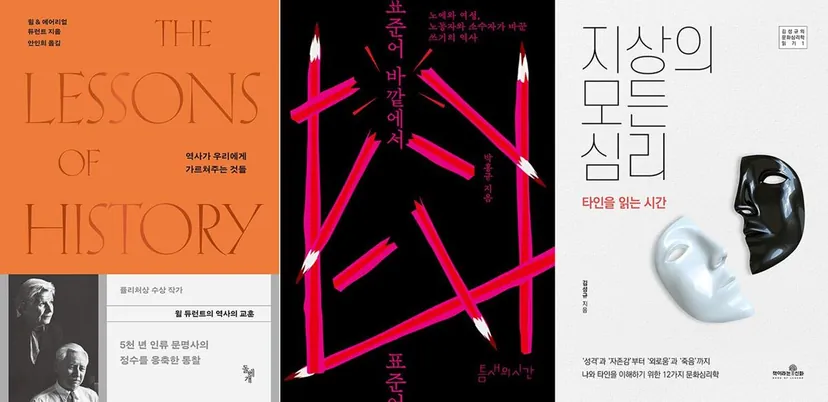
Outside the Standard Language: Written by Park Hong-kyu, Teumsae-ui-sigan
All the Psychologies on Earth: Written by Kim Seong-gyu, Chaek-iraneun-sinhwa
Outside the Standard Language
‘Outside the Standard Language’ (written by Park Hong-kyu, Teumsae-ui-sigan) deals with the literary struggles of marginalized subjects who were pushed outside the boundaries of the "standard language" and discourse during times when writing ability was synonymous with class and power. The "standard language" referred to in this book points to the language established and managed by the ruling class in each era. In other words, it is the standard that determines who has the right to speak and write.
In the past, reading and writing were not a matter of talent, but a matter of qualification. Slaves, women, and laborers were not given the time or the right to learn. Nevertheless, Aesop wrote as he was sold from place to place as a slave; Sappho wrote in an era where women's desires could not become language; and Dickens wrote from the perspective of a twelve-year-old shoe-black factory worker.
Author Park Hong-kyu is a professor emeritus at Yeungnam University Law School and a leading critical intellectual who has taught labor law and legal philosophy. The author, who has published numerous works spanning the fields of art, philosophy, labor, and human rights, highlights the lives and works of 17 writers—including slaves, women, laborers, and colonial subjects—who fought against the linguistic power monopolized by a small ruling class in this book. It covers figures who found their own voices through writing despite disadvantageous social status, such as Charles Dickens, Hans Christian Andersen, Pablo Neruda, and José Saramago.
The book is noted for being a painstaking work that restores the literary dynamism that grew outside the boundaries during an era when linguistic control defined the world.
All the Psychologies on Earth
‘All the Psychologies on Earth: A Time to Read Others’ (written by Kim Seong-gyu, Chaek-iraneun-sinhwa) is a general psychology book that analyzes the inner lives and behaviors of humans, who are social animals living in relationships with others, from various angles.
Author Kim Seong-gyu is a cultural psychologist who studies how individual psychology is formed within historical and cultural contexts. This book is the first in the ambitious 10-volume project ‘Kim Seong-gyu’s Reading Cultural Psychology,’ and it compiles the content of the author’s liberal arts psychology lectures at Dongguk University, for which he received an award for excellence in teaching.
The author explains 12 psychological themes that individuals face in daily life—such as personality, self-esteem, anxiety, loneliness, and death—by connecting them with films. He discusses self-esteem through the movies ‘Good Will Hunting’ and ‘Dead Poets Society,’ explains the "good girl/boy complex" through ‘Black Swan,’ and reaches the possibility of love with artificial intelligence through ‘Zoe’ and ‘Transcendence.’
He addresses the mechanisms of representative abnormal psychology and mental illnesses, such as trauma, panic disorder, and complexes, within a cultural-psychological framework. By diagnosing inner agony not just as an individual problem but within the context of culture and social networks, it provides a deeper understanding of both others and oneself.