

[BizHanKook] Since its inauguration, the Lee Jae-myung administration has introduced a series of balanced development policies, vowing to disperse industrial and R&D bases that have been concentrated in the capital region. Following last year’s development strategy of '5 Mega-Regions and 3 Special Autonomous Provinces (5+3 Strategy)' for the nation’s sustainable growth, the government announced its 3 Mega-Projects this year.
However, it has been found that more than half of the R&D budget for national strategic technologies—the core technologies determining the success of these plans—is concentrated in the capital area. Even outside the capital region, budgets have skewed heavily toward Daejeon, where research institutions such as the Korea Advanced Institute of Science and Technology (KAIST) have been clustered since the Daedeok research complex was designated during the Park Chung-hee administration. Experts point out that to ensure the success of the government's 5+3 strategy and the 3 Mega-Projects, it is essential to disperse the national strategic technology budget currently concentrated in the capital region and Daejeon.
In his budget speech for 2027 at the National Assembly on November 2, President Lee Jae-myung emphasized, “We must make a great transformation toward ‘growth for all,’ where every region and every citizen enjoys the opportunities and fruits of growth, rather than ‘growth for the few,’ where such benefits are concentrated in specific regions, social classes, and a small number of corporations.” To achieve this, President Lee announced plans to “establish a special subsidy for growth engines and create growth hubs for each of the 5+3 regions.” He also outlined investment plans for the 3 Mega-Projects, stating, “We will boldly invest in artificial intelligence (AI) and future growth engines.”
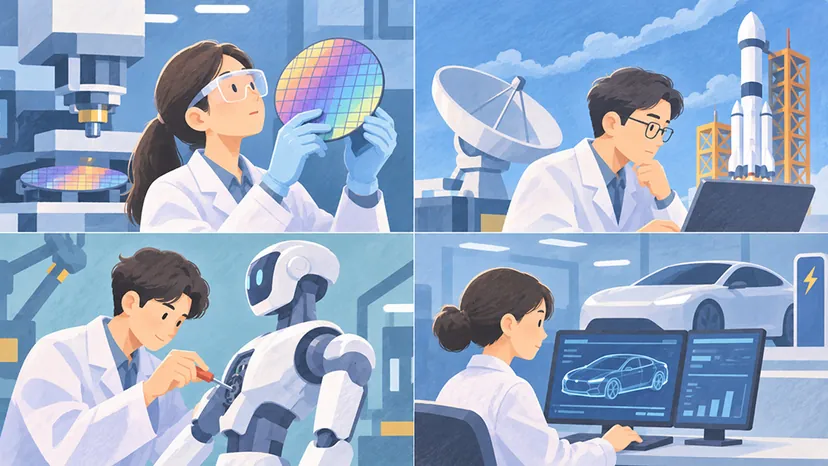
President Lee is focusing heavily on the 5+3 Strategy and the 3 Mega-Projects to promote balanced regional development. The 5+3 Strategy divides the country into five mega-regions (Capital, Southeast, Chungcheong, Daegu-Gyeongbuk, and Southwest) and three special autonomous provinces (Gangwon, Jeonbuk, and Jeju). The strategy aims to foster regional industries by leveraging semiconductors and displays in the Chungcheong region, robots and automotive parts in the Daegu-Gyeongbuk region, AI and future mobility in the Southwest region, and shipbuilding and aerospace in the Southeast region.
The 3 Mega-Projects involve building a semiconductor cluster in the Southwest, an AI data center and infrastructure in the Chungcheong-Gangwon regions, and a physical AI industrial base in the Yeongnam region, aiming to expand the high-tech industrial growth base currently concentrated in the capital area to other parts of the country.
However, regarding the national strategic technology sector, where the government is expanding fiscal investment amid the recent technology hegemony competition and supply chain restructuring between the U.S. and China, a significant portion of the budget is concentrated in the capital region and Daejeon. In 2024, the government first designated 50 priority technologies in 12 fields, including AI, advanced robotics, advanced mobility, and semiconductors, as national strategic technologies and released a cultivation plan. This September, the government reorganized the framework into 55 priority technologies across 10 fields, including AI, semiconductors/displays, advanced bio, and quantum.
The government has invested a total of 25.822 trillion KRW in R&D for these national strategic technologies from 2024 to this year. According to the National Assembly Budget Office, 5.9525 trillion KRW (23.1%) was allocated to advanced bio, 4.6754 trillion KRW (18.1%) to semiconductors and displays, 4.3479 trillion KRW (16.8%) to AI, and 2.2143 trillion KRW (8.6%) to advanced mobility.
Notably, out of the 20.4038 trillion KRW invested in the 'technology development' type of R&D for these strategic sectors, 14.5692 trillion KRW (71.4%) was allocated to the capital region and Daejeon. For the 1.8256 trillion KRW allocated to workforce development, 1.2774 trillion KRW (70.0%) went to the capital region and Daejeon.
In the case of support for startups and commercialization, 2.91 trillion KRW (74.3%) of the 391.6 billion KRW budget was assigned to the capital region and Daejeon, as was 1.807 trillion KRW (66.9%) of the 270.2 billion KRW budget for patents, standardization, systems, and policy. Infrastructure construction saw a relatively lower concentration, with 1.1284 trillion KRW (59.4%) of its 1.8994 trillion KRW budget allocated to the capital region and Daejeon.
The greater problem is that the budget for training personnel in key fields such as AI, semiconductors, aerospace, advanced robotics, and advanced mobility—the very sectors meant to lead the 5+3 or 3 Mega-Projects—is concentrated in the capital region and Daejeon. Despite plans to build a large-scale semiconductor cluster in the Honam region, 70.3% of research funding for AI workforce training and 79.4% of funding for semiconductor and display training were funneled to the capital region and Daejeon. Similarly, in the Gyeongnam region, which aims to foster physical AI, future mobility, aerospace, and shipbuilding, 68.5% of funding for advanced robotics/manufacturing, 69.5% for advanced mobility, and 87.1% for aerospace/marine workforce training are concentrated in the capital region and Daejeon.
Lee Seung-hyun, Journalist