

[BizHanKook] The domestic stock market has been severely shaken by uncertainty surrounding artificial intelligence (AI) investments originating from the U.S. As the possibility of stricter data center regulations gained traction following the U.S. midterm elections, a sell-off spread, primarily targeting semiconductor-related stocks. In South Korea, the combination of high reliance on Samsung Electronics and SK Hynix, along with an exodus of foreign capital, caused the KOSPI to drop more than 11% in just one week. However, some analysts suggest that the market is preemptively reflecting these concerns, as there has been no confirmation that actual AI investments have been reduced.
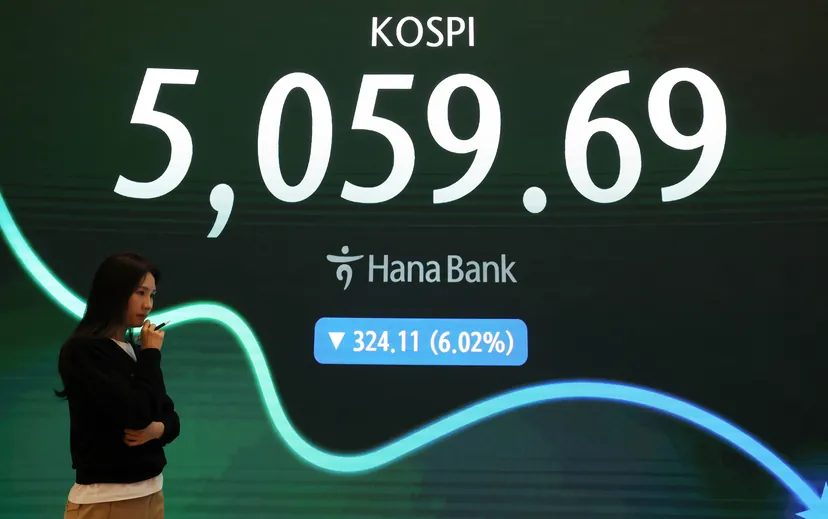
KOSPI Drops 11.7% in a Week… Semiconductor and Supply Chain Stocks Plunge
According to the Korea Exchange on the 7th, the KOSPI closed at 5,059.69 on the 6th. This is a decline of 671.05 points (11.71%) from the previous week's closing price (5,730.74). During the same period, the KOSDAQ also fell by 11.06%. The previous day, the KOSPI plunged more than 8% in early trading, breaking the 5,000-point mark and triggering a circuit breaker that halted trading for 20 minutes.
The decline in semiconductor-related companies was particularly notable. Over the week, Samsung Electronics and SK Hynix plummeted 16.13% and 20.17%, respectively. Samsung C&T and SK Square, which hold stakes in both companies, also fell by 12.34% and 19.29%. As the selling pressure spread to the semiconductor materials, parts, and equipment (semiconductor supply chain) sector, the stock prices of related companies such as Daeduck Electronics (-40.37%) and Samsung Electro-Mechanics (-27.26%) saw sharp declines.
Foreign selling also dragged down the index. Following a net sell-off of approximately 3.4 trillion won in the KOSPI market on the 5th, foreign investors sold off another 2.7 trillion won on the 6th. While retail and institutional investors stepped in with net purchases, they could not prevent the index's decline.
Stocks in the U.S. also plunged, particularly those related to AI. On the 5th (local time), the tech-heavy Nasdaq Composite Index in New York fell 5.52% from the previous trading day, and the S&P 500 index also fell 4.36%. The Philadelphia Semiconductor Index plummeted 12.25%. Major semiconductor firms such as Nvidia (-9.3%) and AMD (-17.3%) led the downward trend.
U.S. Democratic Landslide Fuels Data Center Regulation Fears… AI Investment Outlook Reassessed
In the U.S. midterm elections held on the 3rd (local time), a so-called "Blue Wave" emerged, with the Democratic Party securing a majority in both the House and the Senate. The Democratic Party has previously taken the position that corporate cost burdens should be increased to prevent the electricity consumption of AI data centers from leading to higher electricity bills for residents. With the Democrats securing control of Congress through this election and gubernatorial candidates who campaigned on limiting data center construction winning their seats, the possibility of serious discussions regarding related regulations has increased.
If brakes are applied to data center construction, the impact could reach semiconductor demand. If permitting is delayed or the cost of securing electricity increases, the schedule for building new facilities could be pushed back, potentially slowing the growth in demand for the AI accelerators and memory semiconductors supplied to data centers. This is why the sell-off has been concentrated on semiconductor firms that have grown on the back of expanded AI infrastructure investment.
However, the market's skepticism regarding AI investment has existed since before the election. While big tech companies are pouring massive amounts of capital into securing data centers and semiconductors, it remains unclear whether the revenue generated from AI services will increase to a level commensurate with the scale of investment. Added to this is the concern that data center construction could be delayed, leading to a reassessment of growth expectations for AI-related companies.
According to J.P. Morgan Private Bank, the 24-month forward price-to-earnings ratio (PER) of the MVIS Semiconductor Index, which tracks major U.S.-listed semiconductor companies, dropped from 22.5x in June to 11.4x as of the 5th of this month. This indicates that investors are evaluating the future earnings growth of semiconductor companies and the sustainability of increased AI capital expenditure more cautiously than before.
Concentration in Semiconductors Exacerbates Losses… Securities Industry Says "Too Early to Conclude AI Investment Reduction"
In the domestic stock market, the high proportion of semiconductor heavyweights increased the scale of the decline. As of the 6th, the combined market capitalization of Samsung Electronics and SK Hynix accounted for approximately 46% of the entire KOSPI during trading hours. As the stock prices of both companies plummeted due to the U.S.-driven AI investment anxiety, the shock was concentrated on the entire KOSPI index.
Some in the securities industry analyze that the possibility of tighter U.S. data center regulations does not immediately equate to a reduction in AI investment. The reasoning is that demand for data centers already under construction and semiconductor demand secured through long-term supply contracts has not disappeared.
Lee Jae-won, a researcher at Yuanta Securities, analyzed, "Not all new expansion plans exposed to regulations are being canceled, and there is insufficient evidence to suggest that demand based on already started projects and long-term supply contracts has been damaged." He added, "This is a period where we can expect a normalization of oversold conditions if the intensity of foreign dumping eases in the short term," emphasizing, "Now is not the time to join the panic and sell off by assuming the end of the AI investment cycle."
However, as the selling pressure has been concentrated over a short period, market volatility is expected to continue for the time being. Kang Jin-hyuk, a researcher at Shinhan Securities, also explained, "Fundamentally, what the market is pricing is more likely a slowdown in speed rather than a structural crisis," but noted, "Due to the aftermath of the rapid sell-off, market volatility could continue until early next week."