

[비즈한국] The South Korean steel industry is facing significant difficulties both at home and abroad. Major export markets like the U.S. and Japan are imposing high tariffs on Korean steel products under the guise of protecting their own domestic industries. Meanwhile, the domestic market is struggling to maintain price stability as China, suffering from an economic downturn, dumps a massive surplus of cheap steel. Recently, growing concerns have emerged that South Korean steelmakers could see their market position shrink in the mid-to-long term, as the U.S. government has officially announced plans to build massive, state-of-the-art steel mills domestically, backed by high tariff barriers.
Half of Global Trade Regulations Target ‘Steel’... Import Barriers Everywhere
According to the report ‘H1 2026 Trends and Outlook for Import Regulations Against Korea’ published by the Korea Trade-Investment Promotion Agency (KOTRA), there were a total of 241 import regulations in force or under investigation against Korean products across 26 countries as of the end of June 2026. This is an increase of 11 cases compared to the second half of the previous year. Among these, 113 cases—or 46.9% of the total—applied to steel and metal products, making it the category with the highest concentration of regulations. Compared to other major export items like chemicals (37 cases) and plastics/rubber (35 cases), regulations are heavily skewed toward steel materials.
The number of new investigations is also steadily increasing. New probes targeting Korean products rose from 10 cases in the first half of 2025 to 23 in the second half, and to 25 in the first half of 2026. Regulatory measures are spreading across both developed and emerging economies. Australia has launched anti-dumping investigations into specific steel products, and the European Union (EU) has revamped its existing steel safeguards by introducing country-specific duty-free quotas. The U.K. is also operating a system of quota reductions and tariffs on excess amounts, while Canada has extended steel-related regulations; protectionist measures are becoming the norm among major trading partners.
Defending Against Chinese Dumping at Home: Government Raises Barriers for H-Beams and Steel Bars
As overseas market access shrinks, the domestic market is under constant price pressure due to the influx of Chinese steel. Surplus supply, stemming from China’s slowing property market and decreased domestic consumption, has directly impacted the domestic raw construction materials and special steel markets. Although steelmakers have attempted to adjust facility operations and transition shift systems, these efforts have had limited success in resolving domestic supply-demand imbalances in the face of a stagnant construction sector.
In response, the Trade Committee of the Ministry of Trade, Industry and Energy held a meeting on September 17 and officially decided to recommend the imposition of anti-dumping duties and the extension of price undertakings on Chinese H-beams, as requested by Hyundai Steel and Dongkuk Steel. H-beams are essential structural steel used for building columns, factory supports, and civil engineering projects.
The Trade Committee concluded that if the import regulations on Chinese H-beams were to end, domestic industry damage would likely recur, and it decided to pursue a five-year extension of the price undertakings along with anti-dumping duties ranging from 28.23% to 32.72%. Furthermore, the committee recommended the imposition of provisional tariffs of 25.08% to 27.96% on Chinese alloy steel bars, as requested by SeAH Besteel and SeAH Changwon Integrated Special Steel.
Amid U.S. and Japanese Tariff Pressure, Trump Announces ‘$15 Billion Iowa Steel Mill’
Trade pressure is also intensifying in key export markets like the U.S. and Japan. In its final determination for the annual review of Oil Country Tubular Goods (OCTG), the U.S. Department of Commerce recently confirmed anti-dumping duty rates of 29.94% for Nexteel and 9.80% for SeAH Steel. These rates have risen significantly compared to the 0% received during the preliminary determination in March. If the 50% steel tariff imposed by the U.S. government under Section 232 of the Trade Expansion Act is simply added on top, the maximum tariff rate importers must pay for Korean OCTG could reach nearly 80%.
Japan also began imposing provisional anti-dumping duties of up to 38% on Korean hot-dip galvanized steel sheet (GI) starting in August. With talk of these investigations expanding to major flat steel products like hot-rolled and cold-rolled steel sheets, export volumes are being adjusted.
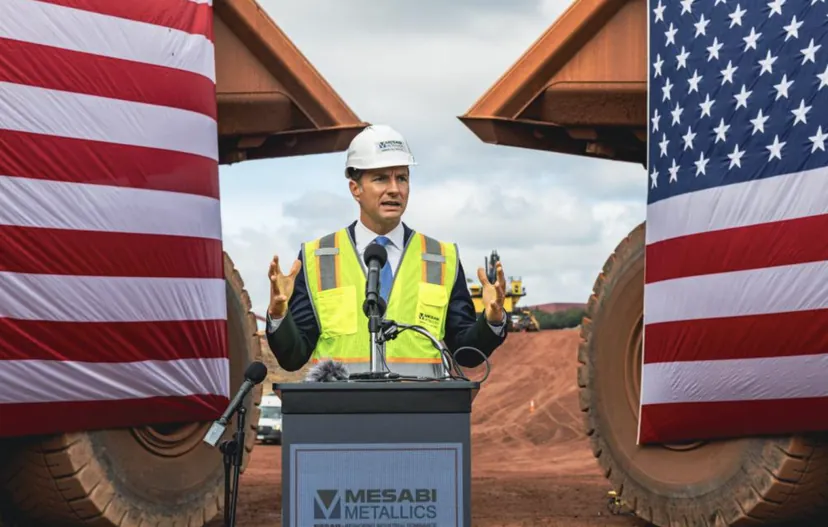
The most structural change in the export environment is the U.S. push for “manufacturing internalization.” On September 28, U.S. President Donald Trump officially announced a project at the White House to invest $15 billion (approx. 20 trillion KRW) in Iowa to build a massive Mesabi Metallics steel mill. Targeting an annual production capacity of up to 10 million tons of steel, the plant aims for a fully integrated production system that utilizes domestic U.S. raw materials to complete every stage of processing within the country. If U.S. domestic production capacity expands alongside high tariff barriers on imports, the market share and footprint of Korean steel in the local supply chain are highly likely to diminish further in the long term.
The South Korean steel industry is busy blocking cheap Chinese steel in the domestic market while facing the dual walls of high tariffs and new local steel mill construction in its primary U.S. export market. It is a critical time for the domestic steel industry to find a breakthrough amid these internal and external trade variables.