

[비즈한국] The Korean shipbuilding industry, despite possessing world-class vessel construction capabilities, has long faced an unresolved challenge. As the industry relies on foreign companies for core technologies like LNG cargo containment systems and ship control systems, the structure is such that building more ships leads to an increase in massive royalty payments and equipment/maintenance costs. Previous articles have highlighted the reality that the domestic shipbuilding industry pays significant costs to overseas entities every year.
Recently, the atmosphere has been shifting. With domestic shipbuilders deploying self-developed LNG cargo containment systems into actual commercial service and applying autonomous navigation software to large vessels to complete transoceanic demonstrations, the localization of core technologies is moving beyond the research and development phase into the commercialization stage. The move is aimed not just at building excellent ships, but at securing the technology fees and service revenues that were previously claimed by foreign companies.
Although there remains a significant gap compared to foreign companies that dominate the global market, the fact that domestic technology has begun to build a track record of successful operations is highly significant. Attention is now focused on whether the Korean shipbuilding industry can evolve beyond a competitiveness model centered on "assembling finished products" into an industry that possesses its own core technologies.
Expanding LNG Cargo Containment Systems from Small Vessels to Large Ships
The most prominent battlefield is undoubtedly the LNG cargo containment system. Over the past 30 years, Korea's three major shipbuilders have paid approximately 7.29 trillion won in royalties to GTT, averaging 13 billion won per vessel. The "KC-2/KC-2C," a Korean-style cargo containment system developed to break this structure, has recently achieved a symbolic breakthrough. On October 27 last year, Samsung Heavy Industries delivered a 7,500㎥ LNG carrier equipped with the KC-2C to Korea Line LNG and completed its first voyage from Tongyeong to the Aewol LNG terminal in Jeju. This marks the first instance where a domestic cargo containment system has moved beyond the testing phase into actual commercial operation.
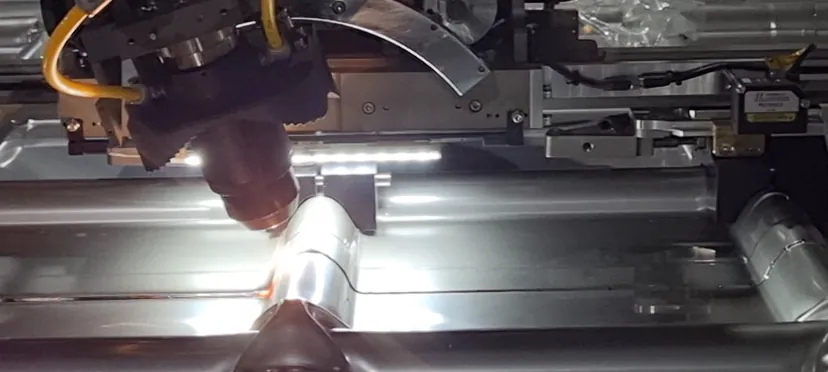
The government is also picking up the pace. On December 22 last year, the Ministry of Trade, Industry and Energy held a kickoff meeting for the "LNG Cargo Containment System Localization Working Group," launching a public-private consultative body involving the Ministry of Economy and Finance, the Ministry of Oceans and Fisheries, Korea Gas Corporation, HD Hyundai Heavy Industries, Samsung Heavy Industries, and Hanwha Ocean. The goal is to expand the application of the KC-2 series containment systems—which have so far only been verified in small vessels—to the 174,000㎥-class large LNG carriers that dominate the market. The government has presented a roadmap to complete large-vessel demonstrations by 2028 and achieve orders for LNG carriers equipped with Korean-style cargo containment systems by 2030.
Competition for the ‘Brain’ of the Ship: Autonomous Navigation Software
A field that the domestic shipbuilding industry has aggressively entered recently is autonomous navigation software, which serves as the "brain" of a ship. HD Hyundai and Samsung Heavy Industries are challenging the territory of European marine companies, such as Kongsberg, which has long dominated the Integrated Automation System (IAS) market.
In June 2022, Avikus, an HD Hyundai subsidiary specializing in autonomous navigation, succeeded in the world's first transoceanic voyage of a large ship using its self-developed second-stage autonomous navigation solution, "HiNAS 2.0." The 180,000㎥ ultra-large LNG carrier "Prism Courage," operated by SK Shipping, sailed approximately 20,000km over 33 days from the Gulf of Mexico, through the Panama Canal, and across the Pacific to Boryeong, South Chungcheong Province. For half of this journey—10,000km—HiNAS 2.0 directly controlled steering commands without human intervention. During this process, it autonomously avoided collision risks with other vessels over 100 times, while improving fuel efficiency by about 7% and reducing greenhouse gas emissions by about 5%. Avikus has since received type approval from the American Bureau of Shipping (ABS) for HiNAS Control (formerly HiNAS 2.0), moving into the commercialization phase.
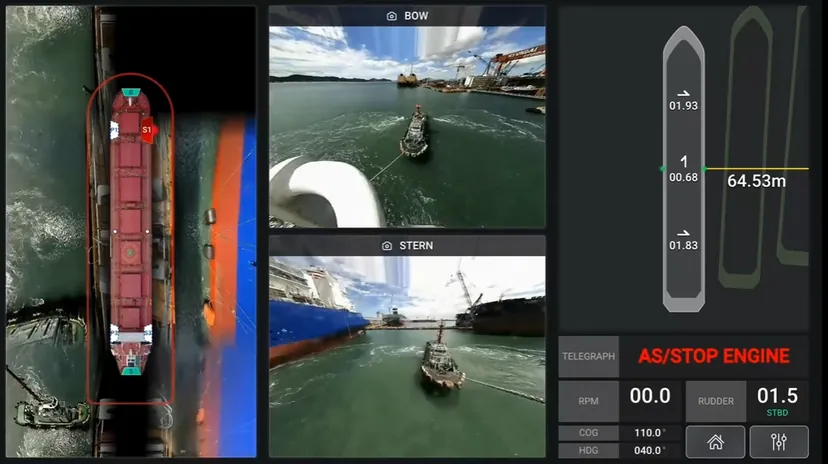
Samsung Heavy Industries is also walking its own independent path. Its autonomous navigation system, "SAS (Samsung Autonomous Ship)," developed in 2019, is a system that perceives situations by fusing data from radar, GPS, AIS, and camera footage, and automatically controls the engine and rudder to avoid collisions. On September 25 last year, it mounted SAS on a 15,000 TEU container ship from Taiwan's Evergreen and successfully demonstrated it over a 10,000km Pacific route from Oakland, USA, to Kaohsiung, Taiwan. During this voyage, SAS analyzed weather conditions every three hours, providing 104 optimal navigation guides and executing 224 automatic control maneuvers, ensuring on-time arrival without crew intervention.
While these companies' demonstration records are not yet at a level to replace Kongsberg's market dominance, given the industry's mantra that "operational track record equals market entry rights," the data from these two trans-Pacific voyages serves as a minimum foundation of trust that domestic integrated control systems can present to foreign shipowners in the future.
Moving Beyond Assembly Bases Toward 'Technological Sovereignty'
These localization attempts, occurring simultaneously in gas tanks and autonomous navigation software, can be read as a strategy to change the very profit structure of the Korean shipbuilding industry, rather than just competing on individual technologies. Royalty payments to GTT for cargo containment systems are in the 10-billion-won range per ship, and for Kongsberg-series control systems, equipment purchase costs are followed by continuous software upgrades and maintenance contracts. Eliminating these costs creates immediate room for improving the actual operating profit margins of shipbuilders.
At the same time, this battle is also a competition for dominance in the next market: eco-friendly and digital vessels. It is the industry's common diagnosis that as environmental regulations from the IMO tighten, ship fuels shift to methanol and ammonia, and autonomous navigation becomes the standard, it will be difficult to protect margins with hardware construction capabilities alone. This is because whoever holds the underlying technology—whether for cargo containment or control software—is the one who captures the after-market and subscription-based service revenues.
There is, of course, a long road ahead. The KC-2C is only now entering the full-scale commercialization stage, and for both HiNAS and SAS, the dynamic positioning (DP) systems physically implemented under the hull still require localization. Nevertheless, the Korean shipbuilding industry's movement toward securing source technologies, moving beyond mere assembly, is accelerating.