

[비즈한국] The selection process for pharmaceutical and biotech companies accompanying the President on overseas visits is becoming increasingly sophisticated. While in the past, a wide range of companies representing the industry participated, recent trends show a shift toward selecting firms that can yield concrete business results—such as local licensing, market entry, and joint R&D—in the host countries. Observers note that economic delegations are evolving beyond simple shows of force into a ‘precision accompaniment’ model that provides substantive support for corporate overseas ventures.
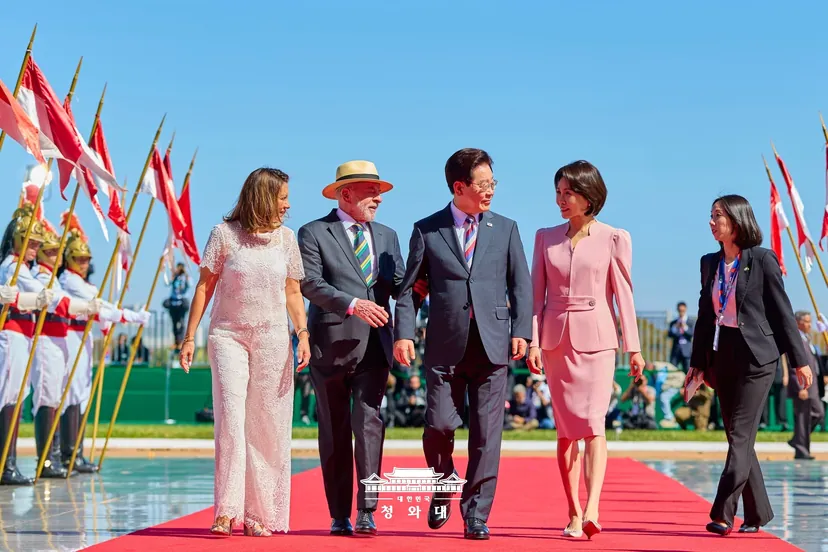
In the economic delegation that accompanied President Lee Jae-myung on his Latin American tour from the 24th of last month to the 3rd of this month, SK Biopharmaceuticals was the only pharma-biotech firm included. This contrasts with previous presidential tours, where numerous companies from the sector were typically part of the delegation.
SK Biopharmaceuticals is preparing for the launch of its epilepsy treatment ‘Cenobamate’ in Brazil. The company received marketing authorization from the Brazilian Health Regulatory Agency (ANVISA) in March and is working with Brazilian pharmaceutical firm Eurofarma to push into the Latin American market, including Brazil. During the visit, at the Korea-Brazil Business Roundtable, the company also signed a comprehensive Memorandum of Understanding (MOU) for joint research and development (R&D) of rare epilepsy treatments and cooperation in AI-based digital healthcare.
Celltrion for the U.S., SK Biopharmaceuticals for Brazil… Custom Selection by Region
A look at the pharmaceutical and biotech companies that have joined economic delegations since President Lee Jae-myung took office reveals a clear trend of selecting firms based on regional market characteristics and specific business objectives.
Seo Jung-jin, Chairman of Celltrion Group, accompanied President Lee on his first overseas visit after taking office, which was to the United States in August 2025. At the time, Celltrion was seeking to secure a production base in the U.S., and later finalized the acquisition of local production facilities, thereby securing a local manufacturing foothold.
For President Lee’s Southeast Asian (Vietnam) tour last April, Bae Byung-jun, CEO of Hyundai Bioscience, and Kim Kyung-nam, CEO of Waycen, joined the delegation. Hyundai Bioscience was pursuing the local distribution of a broad-spectrum antiviral drug and entry into local Phase 2 clinical trials for a new anticancer drug, while Waycen was preparing to launch its AI endoscopic medical solution.
On the state visit to China in January of this year, Seo Ki-sung, Chairman of SY Group—which owns the ‘Kanghanbang’ brand—joined the economic delegation. SY Group signed MOUs with two large local Chinese distribution networks and healthcare companies to exclusively supply K-healthcare products and build a traditional Korean medicine platform in China, signaling a push to expand its local business.
These cases share the commonality that they involve companies pushing for projects requiring inter-governmental cooperation—such as local licensing, network building, joint R&D, and investment collaboration—rather than simple corporate promotion. The industry views this as a shift in how economic delegations operate, moving toward leveraging diplomatic schedules to support corporate overseas business.
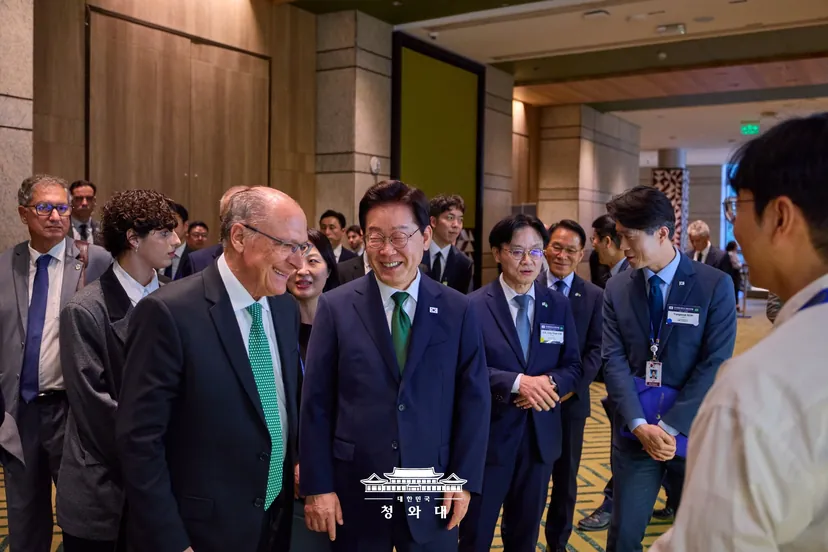
“Choosing Companies Capable of Delivering Results Over Large Delegations”
The operation of presidential overseas economic delegations varies by administration.
During the Lee Myung-bak administration, pharma and biotech companies participated based on the policy of fostering new growth engines. At that time, the domestic biotech industry was in a stage before global drug development and overseas licensing had taken off, so discussions centered mainly on raw material exports or technical cooperation.
The Park Geun-hye administration significantly expanded the size of economic delegations. During a visit to China in 2015, over 40 companies and organizations in the health and medical sectors participated. However, it was noted that many of these MOUs remained at the level of non-binding cooperation, leading to limited tangible business results.
The Moon Jae-in administration expanded the participation of small and medium-sized enterprises (SMEs) and startups, emphasizing practical support for overseas expansion. The Yoon Suk-yeol administration also broadened the participation of bio-healthcare companies by placing high-tech industrial cooperation at the forefront. However, the industry consistently raised concerns that as the size of these delegations grew, the capacity for tailored support for individual companies became limited.
Recently, the atmosphere has shifted: the criteria for composing these delegations focus less on ‘how many companies are participating’ and more on ‘which companies are pushing concrete business projects locally.’ As more delegations are composed of companies that genuinely need inter-governmental cooperation for overseas licensing, regulatory resolution, local network building, and joint R&D, the analysis is that sales diplomacy is also shifting from a focus on size to a focus on results.
Jung Yoon-taek, President of the Pharmaceutical Industry Research Institute, said, “The government did not arbitrarily exclude pharma-biotech firms or just meet a quota; rather, it was a result of prioritizing companies that could expect visible outcomes, such as pre-coordinated MOUs.”
He added, “While economic delegations have a strong character of setting the direction for future cooperation, there is a clear recent tendency to center them around companies that can produce substantive business results during the tour.”
President Jung forecasted, “If the global expansion of domestic pharma and biotech companies continues and the number of business projects aligning with presidential tour schedules grows, the number of companies participating in economic delegations will naturally increase.”