

[비즈한국] On August 21, the Defense Acquisition Program Administration (DAPA) issued a request for proposals (RFP) for the "South Korean Next-Generation Fighter Concept Study." This is a service project to define the operational concepts, shape design, and technology roadmap for a 6th-generation Korean fighter. The budget is 900 million KRW (approximately $650,000) with a project duration of 14 months. What stands out is the density of the requirements. It explicitly specifies two competing stealth fighter configurations, a tailless design with alternative control surfaces, broadband stealth covering L, S, and X bands, two adaptive cycle engines capable of supersonic cruise, a single-seat cockpit, and an internal weapons bay.
The 'tailless' aircraft brought forth by ADD
Meanwhile, the Agency for Defense Development (ADD) unveiled a 6th-generation fighter design currently under internal research at the 'Aerospace Conference 2026' hosted by the Air Force in Daejeon on July 7. The ADD stated that this design was created during the process of developing design methodologies to rapidly implement aircraft shapes and analyze flight performance and radar cross-section (RCS) more quickly than in the past. Although this design is not directly related to DAPA’s 6th-generation fighter concept study announced on August 21, it is highly likely that the current ADD design will be significantly reflected in the actual research process.
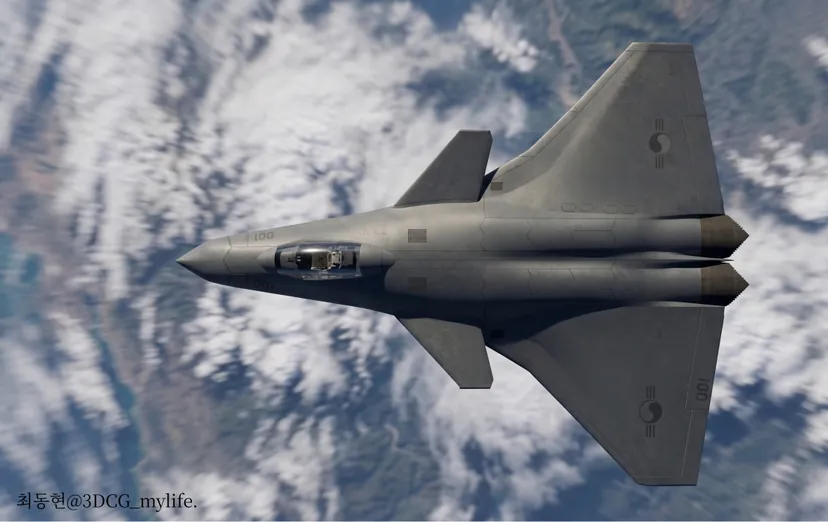
The shape is a twin-engine stealth aircraft featuring a completely tailless design with no vertical or horizontal stabilizers, combining double delta wings and canards. The fuselage and wings are smoothly integrated. Based on an analysis of the released images by Bizhankook, the length-to-wingspan ratio is approximately 1.35:1, the sweep angle of the main wing leading edge is about 65 degrees at the inner section and 52 degrees at the outer section, the trailing edge has about 17 degrees of forward sweep, and the aspect ratio (AR) is calculated at approximately 2.7.
The airframe has three internal weapons bays: one under the fuselage and two on the sides. The lower bay carries four MBDA Meteor missiles, while the left and right side bays each carry one Diehl Defence IRIS-T missile. Back-calculating from the missile size, the total length is approximately 16m and the wingspan is about 11m. The engine size is similar to the General Electric (GE) F414 currently in the KF-21, or the KTF16000 engine, which will soon begin domestic development. S-shaped air intakes are installed in front of the engines, and thrust-vectoring nozzles (TVC) are mounted at the rear.
Not quite up to the US F-47, but comparable to the GCAP
If the South Korean 6th-generation fighter is realized according to the ADD design, it is estimated to have a cruise speed similar to the Global Combat Air Programme (GCAP) being jointly developed by the UK, Japan, and Italy, with a shorter range but similar or slightly improved stealth performance. Synthesizing the aforementioned ADD design elements and the ongoing "stealth bridge technology" trends, the rough blueprint for the South Korean 6th-generation fighter can be sketched as follows.
First, in the radar sector—a core piece of equipment for modern fighters—a broadband AESA radar using a wider frequency band than existing ones could be applied. A broader frequency range makes it difficult for enemies to detect when our radar is in use and enables more precise tracking. It could also make it possible to neutralize enemy radar via electronic warfare while operating our own radar unilaterally.
The stealth design configuration is also very challenging. China’s J-36 and J-50 adopt diamond or lambda-shaped delta wings with no tail, while the US F-47 features ear-shaped canards in front of a delta wing. The GCAP features an oversized delta wing with two vertical tail fins. The ADD design is at a level similar to the F-47, and because it lacks vertical tail fins, it likely has superior stealth performance compared to the GCAP.
The most unique aspect of the ADD's 6th-generation fighter design is its size. While the GCAP, F-47, J-36, and J-50 are all massive fighters reaching 20 meters in length, South Korea's 6th-generation design is quite small, falling between the size of the KF-21 and the F-22. Consequently, while it may have a shorter range and lower weapons payload than 6th-generation fighters from other countries, it may secure competitiveness in terms of economic efficiency.
The engine is the 'Achilles' heel'
The problem is the propulsion system. The RFP specifies two adaptive cycle engines capable of supersonic cruise. Adaptive cycle engine technology allows for switching bypass ratios and combustion methods during flight to toggle between fuel-efficient cruising and high-thrust supersonic flight. Simply put, it is like a car that switches between "eco mode" and "sports mode" in real-time on the road.
However, adaptive cycle engines require highly advanced technology, and it is currently difficult for South Korea to implement this with its current technical prowess. Having only just developed a domestic jet engine for a fighter, this is a "burdening goal." Since the US F/A-XX, GCAP, and China's J-36 and J-50 have either abandoned or are considering abandoning the installation of adaptive cycle engines, the decision to apply this engine to the 6th-generation fighter must be made cautiously.
Equipping the engine currently under development is also problematic. The domestic KTF16000 jet engine, being developed as a national project for the KF-21, aims for Initial Flight Release (IFR) by 2041 but provides only 16,000 lbs of dry thrust and 24,000 lbs of afterburner thrust. Installing this engine on a 16m-class tailless stealth aircraft would make it difficult to achieve the supersonic cruise capability requested by DAPA. Thrust-vectoring nozzle technology is also still in its infancy, having been applied to rockets but never to a jet engine.
Assuming the author's personal opinion, I believe we should prioritize using the KTF16000 engine as a base, but instead of setting excessive, high-risk goals, we should develop an improved engine—perhaps incorporating integrated generators like the HAF4500 engine to provide hundreds of kilowatts of high-output electrical power—and focus on developing thrust-vectoring nozzles. Rather than obsessing over increasing afterburner output for maximum thrust, I believe it is correct to focus on securing practical capabilities first, and then collaborate with international partners in the future to develop a KTF16000-based variable cycle engine.
Prioritizing the KF-21EX-T and the 6th-generation fighter
Another concern in 6th-generation fighter development is the priority allocation relative to the KF-21EX-T. Currently, Korea Aerospace Industries (KAI) is conducting internal research on a plan to upgrade the KF-21 into a 5.5-generation fighter; this is expected to materialize as the KF-21 Block 3 once the Air Force’s final requirements are finalized. The problem is that stakeholders have differing opinions on what should ultimately be applied to the KF-21 Block 3 specifications.
The core issue is the stealth performance of the KF-21EX-T. The current plan involves applying an internal weapons bay and stealth paint/materials, but there are arguments that the cost and time required for developing the internal weapons bay are substantial, and that long-range missiles or the use of Collaborative Combat Aircraft (CCA) for long-range strike capabilities are sufficient. There are even opinions that the KF-21 upgrade should be concluded early to focus on developing a full-fledged 6th-generation fighter.
Both are valid arguments, but if the "early development of 6th-generation fighter" theory and the "maximum KF-21 upgrade" theory repeat the past "F-50 vs. KF-X" debate, it could have a very negative impact on the Korean aerospace industry, so extreme caution is required. Given that exhaustive debates were repeated unnecessarily from 2002 to 2014, a development strategy for both platforms must be established based on "efficient decision-making" and "multiple investments." In other words, developing the KF-21EX's lower internal weapons bay in the same manner as the 6th-generation fighter could reduce costs and time, while applying the 6th-generation fighter's tailless, canard design to the CCA could maximize the reusability of new technologies.
A fighter that must prepare for the future 20 years from now
The entities likely to participate in DAPA's current 6th-generation fighter concept study are ADD, KAI, and Korean Air. DAPA has also permitted joint bidding by multiple companies and research institutes. Both KAI and Korean Air have been attempting to participate in the ADD’s full-scale stealth fighter demo program that began last November. South Korea has accumulated experience in tailless, low-observable design through the development of the KF-21, the KUS-LW combat drone, and the KAORI-X stealth technology demonstrator, while LIG Nex1 (079540) is researching internal weapons bay production and testing/evaluation technologies. The ADD is also leading the 63.6 billion KRW "Stealth Bridge Technology Development" (48 months) project, which integrates everything from RCS base technology to multifunctional composite materials and low-observable sensors.
Although South Korea has just completed the development of the KF-21, it feels late to start preparations for a 6th-generation fighter now. China's J-36 and J-50 are already undergoing flight tests, and the US F-47 aims for its first flight in 2028. Even if South Korea's 6th-generation fighter development proceeds smoothly, practical use is unlikely to be possible until the mid-to-late 2040s.
The 900 million KRW concept study designated by DAPA is ultimately a starting point that is less than 0.01% of a multi-trillion KRW project. The variables that will determine success or failure are narrowed down to three: Will the stealth bridge technology be completed by 2030? Is the engine roadmap realistic? Is the Manned-Unmanned Teaming (MUM-T) system maturing in stages? Only when these three factors are aligned can the "South Korean 6th-generation fighter" gain competitiveness beyond the skies of the Korean Peninsula and into the global K-defense export market.