

[BizHanKook] “While the Korean market is smaller in scale compared to the U.S., it is sophisticated and advanced, and we felt a sense of urgency regarding security.”
South Korea, reeling from a series of hacking incidents, has emerged as a new target for global security firms. As domestic companies also step up their responses by advancing AI-based security technologies, attention is focused on whether competition between domestic and foreign firms over the growing demand for security investment will intensify.
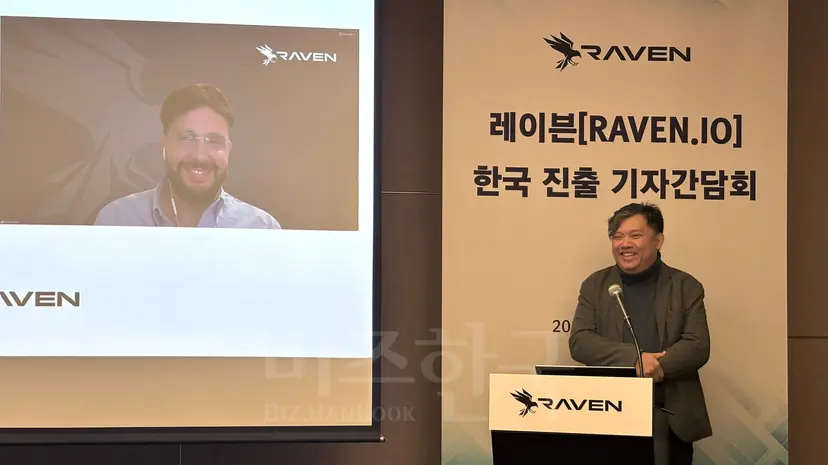
Raven: “Security risks are high in banking and insurance”
On the 12th, the U.S. cybersecurity firm Raven.io held a press conference at the JW Marriott Hotel in Seocho-gu, Seoul, to announce its plans for expanding its domestic business. The event was led by Managing Director Adrian Ong, while Raven Co-founder and CEO Roy Avitbul joined via video call to introduce the background and business strategy for the company's entry into the Korean market.
Raven is a company that develops runtime security technology capable of detecting and blocking abnormal code behavior in the actual environment where applications run. It secured $20 million (approximately 28 billion KRW) in seed funding last March.
CEO Avitbul stated, “Seeing the various breach incidents that recently occurred in Korea made us prioritize the country,” adding, “We view the security risks in the financial sector, such as banking and insurance, as significant, and have selected these industries as our primary targets.”
He continued, “A significant portion of the code used by most banks and financial service institutions is based on open source. Attackers can also access this code, and the speed at which they use AI to discover and exploit vulnerabilities is accelerating,” he explained.
Raven is collaborating with the Singapore-based business consulting firm The Executive Action to conduct its operations in Korea. Based on a subscription business model, the company plans to utilize three simultaneous methods: direct sales to clients, resellers, and sales through Managed Security Service Providers (MSSPs).
Managing Director Ong explained that he is reaching out to companies with demand for relevant technology based on the network he built while working at IBM Korea in the past. Currently, the company is conducting Proof of Concept (PoC) and Proof of Value (PoV) projects with several domestic financial firms.
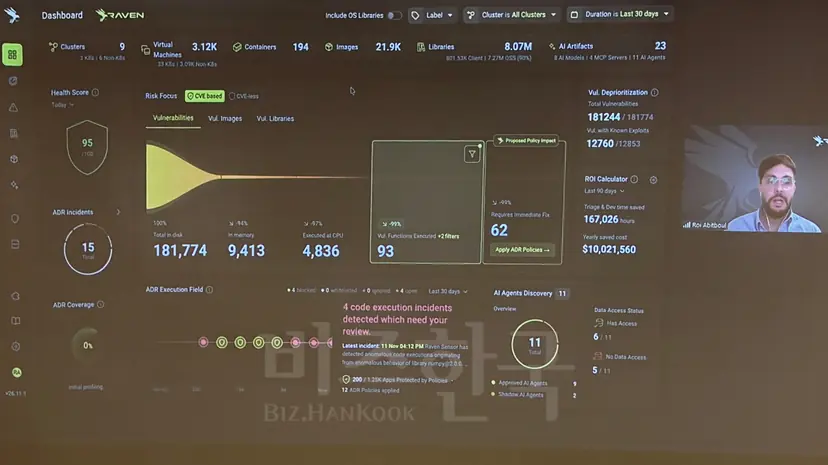
“Blocking abnormal behavior as if monitoring with CCTV”
Software used by companies is often developed by combining various open-source libraries. If a vulnerability exists in a published library, attackers can analyze the code to find an entry point. In particular, “zero-day attacks,” which exploit unknown vulnerabilities, are difficult to counter because they occur before a vulnerability is officially disclosed or a security patch is provided.
Raven observes the behavior of code running inside an application directly. While existing Endpoint Detection and Response (EDR) solutions primarily monitor abnormal behavior of files and processes occurring in the operating system, Raven analyzes even the execution processes of the individual libraries that make up an application.
The company explained that this allows them to block only the problematic behavior without shutting down the entire application when abnormal activity is detected. For example, if a library that does not need to access an external network suddenly attempts to communicate or executes unauthorized code, the action is blocked.
CEO Avitbul explained, “It is like installing CCTV on every library. While the code is actually running, we can observe what each library is doing and distinguish between what it should normally do and what it should not.”
Information security market grows to 7 trillion KRW… Corporate and government investments increase
According to the Ministry of Science and ICT, the revenue of 876 domestic information security companies reached approximately 7.1244 trillion KRW two years ago, a 15.9% increase from the previous year. During the same period, total revenue for the information protection industry, including physical security, increased by 10.5% to 18.5945 trillion KRW. Additionally, total investment by 773 companies that disclosed their information protection status last year reached 2.423 trillion KRW, an increase of 14.3% compared to the previous year.
The government is also increasing investments in the development of AI-based security technology. In its 2027 budget proposal, the Ministry of Science and ICT allocated 55 billion KRW for the development of “AI Cyber Shield Dome” technology, 70 billion KRW for AI-based threat response service support for SMEs, and 50 billion KRW for building AI learning infrastructure for cybersecurity.
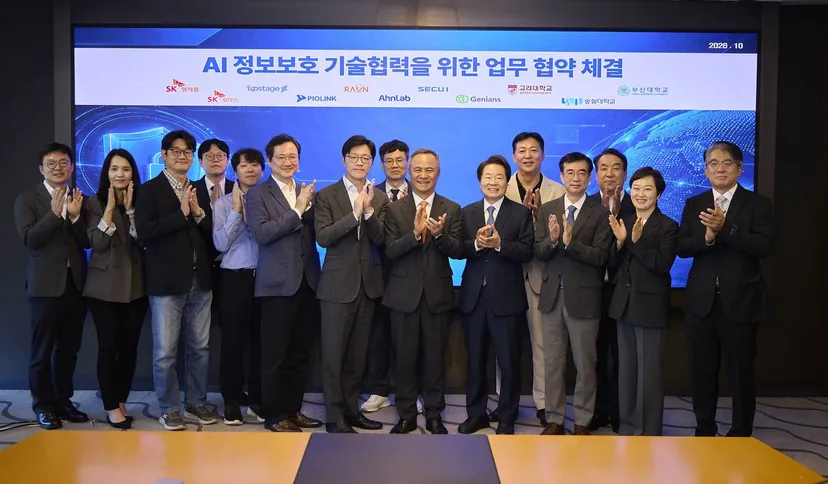
In line with this, domestic companies are accelerating the development of AI-based security technologies. In October, SK Telecom and Upstage launched the “Independent AI Cybersecurity Alliance,” which includes 6 domestic security firms such as AhnLab, SK Shieldus, Genians, and Secui, as well as 3 universities.
As the domestic security industry grows, overseas companies are also expanding their reach to capture new demand. Seven Israeli security companies participated in the “Korea-Israel Cybersecurity Forum 2026,” held in Pangyo, Seongnam-si, Gyeonggi-do on the 3rd, to discuss cooperation plans with domestic firms.
Managing Director Ong emphasized, “Korean companies have excellent human resources and technical capabilities and can invest heavily in AI, but the time to respond to cyberattacks is limited. Raven’s role is to buy time to protect client systems even before security patches are released.”