

[비즈한국] Discussions have moved into full swing regarding the need for the role of finance in responding to the climate crisis to transition beyond simple declarations toward actual investment execution—specifically through concrete capital allocation and portfolio restructuring.
Policy authorities, private financial institutions, and academic experts from Korea and abroad gathered at the '1st Seoul Climate Finance Conference 2026' to seek comprehensive solutions for connecting climate data and industry-specific reduction pathways to tangible investment actions in the capital markets. In particular, the introduction feasibility and structural challenges of 'Korean-style Climate Benchmarks (K-PAB and K-CTB)' were highlighted as key infrastructure to drive the low-carbon transition of the stock market.

The '1st Seoul Climate Finance Conference 2026,' co-hosted by the global climate non-profit Arc and the Korea ESG Community (KEC), was held on October 22 at the Glad Hotel in Yeouido, Seoul. Approximately 200 attendees from government, the National Assembly, the Bank of Korea, domestic and international asset management firms, and academia participated to evaluate implementation strategies for the climate finance system from various perspectives.
Removing High-Carbon Stocks Does Not Lower Investment Returns
In the opening special session, the introduction of Korean-style climate benchmarks was discussed in depth as infrastructure to extend the domestic climate finance structure—currently heavily skewed toward lending—into the stock market. Climate benchmarks serve as standards, such as indices or ratings, used to compare and evaluate climate-related investment performance. Many existing eco-friendly funds or ESG indices launched in domestic and international markets have faced frequent 'greenwashing' controversies, as their vague quantitative reduction criteria and pathway settings often resulted in the inclusion of numerous companies with high carbon emissions.
In response, the European Union (EU) established strict standards that grant official designations only to indices aligned with the Paris Agreement goal of limiting global average temperature rise to 1.5 degrees Celsius. Representative examples include the Paris-Aligned Benchmark (PAB), which requires starting with a 50% lower carbon footprint than the market average and implementing an additional 7% annual reduction, and the Climate Transition Benchmark (CTB), which starts with a 30% reduction and requires a 7% annual cut.
Min Jun-ki, a team leader at the Bank of Korea's Sustainable Growth Office and one of the presenters, explained the results of a study conducted by BOK researchers last year on the feasibility of introducing Korean-style climate benchmarks to the market. The researchers analyzed 807 KOSPI-listed companies that disclosed data on direct emissions (Scope 1) and indirect emissions from power usage (Scope 2). They then applied conditions to reduce carbon emissions while still tracking the overall stock price movement of the KOSPI market. As a result, 450 companies that met the Paris Agreement standards were included in the K-PAB index, while 515 companies meeting the gradual transition criteria were included in the K-CTB index.
The simulation results confirmed a clear environmental improvement effect. Comparing the 'Weighted Average Carbon Intensity (WACI)'—an indicator representing a company's carbon emissions relative to its revenue—the K-PAB index was 92.4 tons/billion KRW as of 2024, a whopping 57.4% lower than the general KOSPI market average (217.0 tons/billion KRW). The K-CTB index, aimed at gradual reduction, also showed a high reduction rate of 40.3% at 129.4 tons/billion KRW.

The proportion of high-emitting companies—those releasing over 500 tons of greenhouse gases annually—fell significantly from 8.6% to 2.3% in the K-PAB index. By reducing the weight of polluting companies and increasing the weight of firms leading the carbon transition, investment capital was steered toward low-carbon companies.
In terms of returns, the results shattered long-standing market prejudices. There had been widespread concern that lowering the weight of high-carbon, large-cap stocks to meet eco-friendly criteria would reduce investment returns. However, after simulating both indices using actual stock price data from the past 10 years (October 2015 to May 2025), the cumulative return of the K-PAB was 5.6 percentage points higher than the KOSPI market average, and the K-CTB outperformed it by 4.6 percentage points. The standard deviation of the tracking error, which represents the variance in weekly returns against the KOSPI index, remained at 0.17 for K-PAB and 0.14 for K-CTB. This proved with numbers that one does not need to sacrifice investment returns to cut more than half of carbon emissions for the environment, all while stably tracking the overall market trend.
Team Leader Min Jun-ki explained, "If these indices are utilized for investment, we can expect the effect of capital being redistributed from high-carbon to low-carbon sectors." However, he suggested, "Korea has a high proportion of manufacturing and its industrial structure is highly dependent on fossil fuels. Therefore, rather than uniformly excluding high-carbon manufacturers when constructing indices, we should develop them in a direction that quantitatively evaluates and encourages corporate technological innovation and transition efforts."
Sharing Asian Perspectives Beyond 'Loan-Centered' Green Finance
Discussions continued on the need to address the structural limitations of domestic green finance to increase the effectiveness of these indices. Choi Yong-hwan, head of the ESG team at NH-Amundi Asset Management and moderator of the session, diagnosed that domestic green finance is currently overly tilted toward lending. While the domestic green and climate finance market size is approximately 1,081 trillion KRW, he pointed out that about 61% consists of bank loans, meaning capital supply to private capital markets like stocks remains insufficient.
Choi stated, "The K-PAB and K-CTB research has provided an important milestone in introducing climate capital into the stock market, moving beyond the existing loan-centered structure. We must enhance corporate value by linking corporate value-up programs, climate risk management, and institutional investors' stewardship codes (voluntary guidelines encouraging shareholders to actively participate in corporate decision-making and fulfill their responsibilities)."
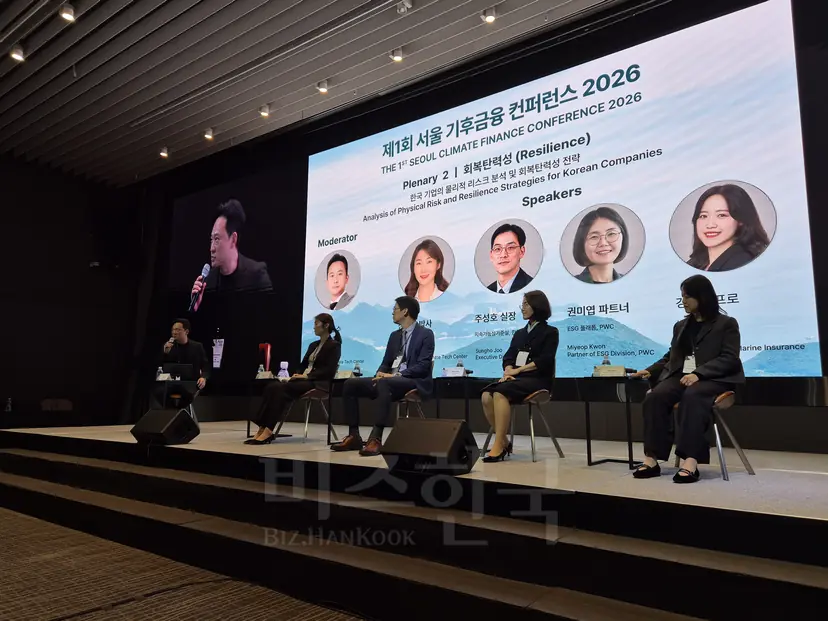
International institutional investors emphasized that domestic companies must move beyond mere goal declarations and present investable business plans. Trista Chen, Co-Head of Global Investment Stewardship at L&G Investment Management, referred to the case of the Sustainable Finance Institute Asia (SFIA) under the Monetary Authority of Singapore (MAS) to explain the importance of building a common language (taxonomy) among authorities, financial firms, and companies. Chen pointed out, "While it is said that trillions of dollars of capital are needed for Asia's transition, from an investor's perspective, what is lacking is not capital, but trust in execution." She added, "Korean companies' reduction declarations and risk assessments are just the beginning; the core is how those assessments are materialized into actual business strategies and capital expenditure plans. Global capital will move when trust in implementation is formed."
Climate finance initiatives from major Asian countries with high proportions of high-carbon manufacturing were also discussed. Ma Jun, President of the Beijing Institute of Finance and Sustainability (IFS) in China, introduced China's transition finance system, as China accounts for about 31% of global carbon emissions. Based on his experience in creating the world's largest green loan and bond market, totaling approximately 7 trillion USD over the 10 years since the 2016 green finance guidelines were announced, Ma explained that they recently established a central bank-level 'Transition Finance Taxonomy' covering 11 high-carbon sectors including steel, cement, and petrochemicals, and are promoting commercial transition projects with over 20 local governments.
Following this, Yasuhito Iwanaga, Chief Climate Risk Officer (CRIO) at the Amundi Japan branch, shared Japan's 'GX (Green Transformation) Strategy,' which involves injecting 150 trillion JPY (approx. 1 trillion USD) through public-private cooperation over the next 10 years to achieve 2050 carbon neutrality. CRIO Iwanaga reported that following guidelines co-developed by the Ministry of Economy, Trade and Industry (METI) and the Financial Services Agency (FSA), the Japanese government issued the world's first national 'Climate Transition Bonds (GX Bonds)' worth 4.2 trillion JPY (approx. 28 trillion KRW) in early 2024, and is allocating a significant portion of the proceeds to support decarbonization R&D and innovative technologies for private companies. This provided useful policy implications for Korea as it contemplates the transition of high-carbon industries and the expansion of stock and bond infrastructure.
On this day, the importance of policy and disclosure infrastructure was emphasized to build market trust. In his congratulatory remarks, Kwak Byung-jin, President of the Korea Accounting Institute, said, "With the publication of the Korea Sustainability Disclosure Standards (KSSB) in February this year and the Financial Services Commission's disclosure roadmap announcement in July, Korea has entered its inaugural year of sustainability disclosure." He added, "The starting point for capital needed to achieve the Nationally Determined Contributions (NDC) to flow into transition investments in a timely manner is reliable disclosure information." He further noted, "As it is difficult for all figures to be perfect in the early stages of institutional introduction, we should focus now not on the perfection of the numbers themselves, but on how transparently companies disclose the limitations of their assumptions and data, and how they work to improve quality."