

[BizHanKook] Good news has reached South Korean game and entertainment companies aiming to enter the Chinese market. In the follow-up negotiations for the South Korea-China Free Trade Agreement (FTA) on services and investment, which reached a substantial conclusion on the 18th, China agreed to apply Most-Favored-Nation (MFN) treatment to South Korean films and games. This means Korean content will not be treated less favorably than content from third countries, and the principle of non-discrimination will be applied to pre-screening processes. The domestic content industry is now focused on how this commitment will change the issuance of publishing licenses (ISBNs) and film censorship practices.
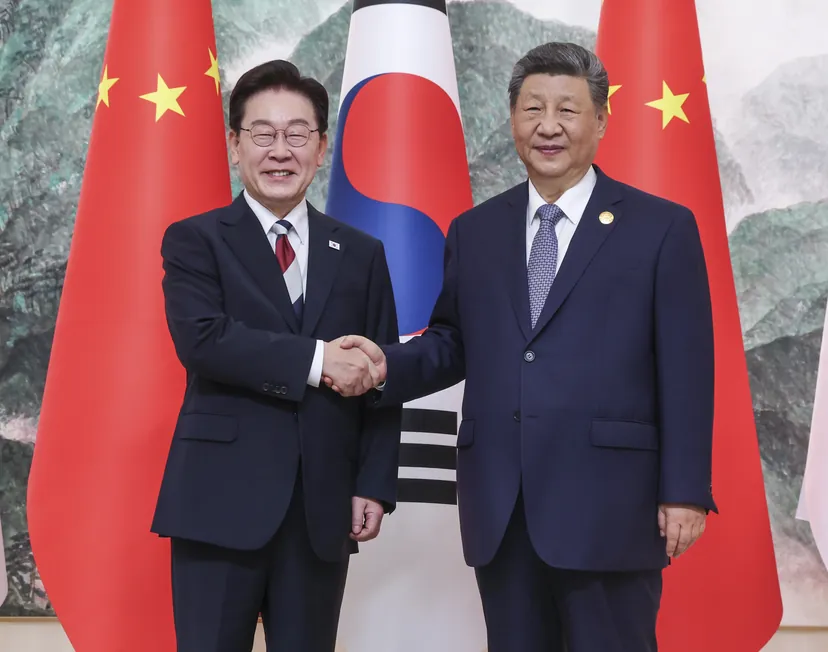
President Lee Jae-myung and Chinese President Xi Jinping met on the same day in Shenzhen, China, on the sidelines of the Asia-Pacific Economic Cooperation (APEC) summit, and declared the substantial conclusion of the follow-up negotiations. It has been 8 years and 8 months since negotiations began in March 2018, based on the South Korea-China FTA that took effect in December 2015. Although official negotiations had been stalled for over four years due to differences between the two countries, discussions gained momentum following the summit in January of this year. The two countries held five rounds of official negotiations this year. China's state-run Xinhua News Agency also reported that President Xi confirmed the substantial completion of the second phase of FTA negotiations.
The negotiations covered services, investment, and finance. According to the Ministry of Trade, Industry and Energy, South Korea's commodity trade with China in 2024 amounted to $272.9 billion, accounting for 20.7% of its total commodity trade. In the same year, service trade with China was $38.8 billion, representing 12.4% of total service trade. The agreement includes conditions for South Korean companies to start and operate businesses in China, ranging from content screening and the sale of travel products to the opening of retail stores and the protection of local investments.
Non-discrimination principle in film/game screening… Path opened for joint production of dramas and variety shows
In the context of MFN treatment, the comparison is not against Chinese domestic content, but against content from third countries. Chinese authorities' screening processes must still be passed. The Ministry of Trade, Industry and Energy explained that this is the first time China has included MFN treatment and the principle of non-discrimination in pre-screening for films and games in a trade agreement. The change that South Korean game companies will feel depends on how screening procedures and processing times will differ compared to foreign games under similar conditions.
For video production companies, the expansion of joint production targets is another opportunity. The two countries decided to expand the scope of joint production from the previous agreement, which was limited to films, to include dramas, animation, variety shows, and documentaries. According to the Ministry of Culture, Sports and Tourism, as cited by Yonhap News, content recognized as a joint production is excluded from China's import quota system. Selling the rights to a completed Korean drama to China is a different revenue structure than partnering with a Chinese production company from the planning stage. The business viability of individual projects will depend on which works are recognized as joint productions and how production costs and rights are shared.
To gauge the direction of the "Hallyu Ban" (ban on Korean culture), one must look at it sector by sector. The released agreement does not contain provisions to collectively lift the ban on Chinese performances by Korean singers. According to the Blue House, both leaders agreed to expand cultural and content exchanges in stages, considering regional conditions within China and the sensitivity of each sector. While screening principles for films and games are included in the agreement, the speed at which K-pop performances will resume depends on individual permits from Chinese authorities.
Direct recruitment of tourists in China… Retail companies can expand stores without joint ventures
In the tourism sector, a path is being opened for Korean travel agencies to recruit customers directly within China. Korean travel agencies established in 23 designated areas in China, including Beijing and Shanghai, will be able to arrange overseas travel for both Chinese and foreign residents. This means that Korean travel agencies can plan and sell Korea-bound tourism packages—combining local tours or K-pop and beauty experiences—directly to Chinese consumers. According to the Ministry of Trade, Industry and Energy, the number of Chinese visitors to Korea last year was 5.48 million, accounting for 28.9% of all foreign visitors.
In the retail sector, Korean companies looking to operate 30 or more stores in China are now allowed to operate independently without forming joint ventures with Chinese companies. This could reduce the burden on Korean fashion and beauty companies to coordinate store opening plans or operating methods with local partners. The regions where Korean law firms can engage in joint recruitment or business partnerships with Chinese law firms have also expanded from the existing Shanghai Free Trade Zone to include the Tianjin and Qianhai Free Trade Zones and the Hainan Free Trade Port.
In the construction sector, it was decided to remove restrictions on the types of projects in which Korean companies can participate. Regarding finance, if China promises further openness in future trade agreements with third countries, the same benefits will apply to Korean companies. South Korea has also expanded its opening commitments in legal, retail, and audiovisual services within the scope of domestic law and current regulations. This includes allowing business partnerships between Korean and Chinese law firms and reflecting current regulations on construction equipment rental and film screening services in the agreement.
Strengthened investment protection… The 'reservation list' that will determine the actual extent of opening
Both countries adopted a "negative list approach," where markets are opened in principle, with exceptions noted on a reservation list. The agreement also introduces a "ratchet clause," which restricts the re-strengthening of regulations that have been voluntarily relaxed. It prohibits forcing technology transfers as a condition for investment and expands the scope of protection under the Investor-State Dispute Settlement (ISDS) mechanism to include the pre-establishment phase of investments. As the scope of investor protection widens, mechanisms to prevent abuse, such as the early dismissal of baseless claims and restrictions on duplicate litigation, have also been put in place.
The two countries plan to proceed with formal signing and ratification after reviewing some technical clauses and legal details. The extent of opening by sector will only be clear once the final agreement and the reservation list are released. Once the agreement takes effect, the time it takes for Korean games to receive publishing licenses, the conditions under which co-produced dramas are broadcast in China, and cases of Korean travel agencies receiving local business permits will be the indicators that demonstrate the effectiveness of this agreement.