

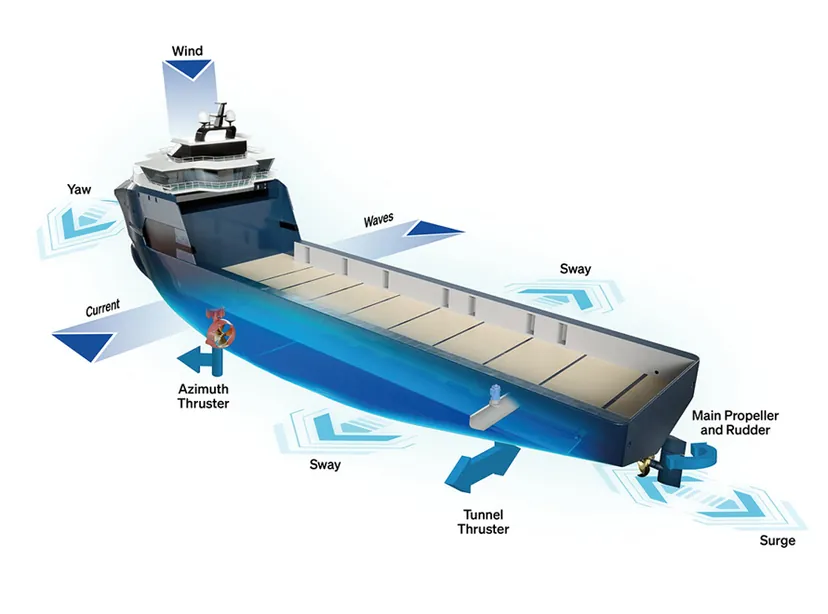
[BizHankook] The ability to weld a massive hull and float it on the sea is one thing, but the control technology required to hold that vessel in place in the middle of a rough ocean with absolute precision is an entirely different level of capability. A prime example of such control technology is the "Dynamic Positioning System (DP)," which maintains a ship's position and heading against wind, waves, and currents in deep seas or near offshore structures where anchors cannot be used.
Kongsberg Maritime, a Norwegian company, is the powerhouse of this technology, which uses position reference sensors, motion measurement units, control algorithms, and thrusters in real-time to keep positioning errors within a 1–2 meter range. Kongsberg currently leads the market for high-specification specialty vessels such as offshore crane ships, drillships, and wind turbine installation vessels (WTIV).
A "Full Package" Completed by the Rolls-Royce Acquisition
Kongsberg's dominance was solidified on April 1, 2019, through the acquisition of Rolls-Royce's commercial marine division, "Rolls-Royce Commercial Marine (RRCM)." The deal, valued at 500 million pounds (approximately 950 billion KRW) and initiated in July 2018, was finalized the following year after approval from European Union competition authorities. With the acquisition, Kongsberg instantly expanded into a company with 11,000 employees in 40 countries and annual revenue of 22 billion Norwegian Krone (approximately 3.28 trillion KRW). By bringing together Rolls-Royce, which manufactured hardware like thrusters and propulsion systems, and Kongsberg, which developed DP software, the company completed a vertical integration that allows it to provide a "design-control-propulsion" package as a single supplier.
The result of this integration is the Integrated Automation System (IAS), which has become the standard for modern large merchant and specialty vessels. Recently, the ultra-large subsea cable-laying vessel currently being built by Korea's LS Marine Solution at the Tersan Shipyard in Turkey is also being equipped with a bundled package of Kongsberg’s K-Pos Dynamic Positioning System, battery hybrid power system, and main propulsion units.
This is not the first time the domestic shipbuilding industry has crossed paths with Kongsberg. In the past, Daewoo Shipbuilding & Marine Engineering signed a joint technology development agreement with Kongsberg to co-develop control systems for LNG Floating Storage and Regasification Units (FSRU) built at the Okpo Shipyard.
Even If the Hull is Built by a Korean Company, the Control Technology Must Be Purchased
No matter how precisely a domestic shipyard completes a hull, they must go through Kongsberg’s licensing to operate the integrated control software that actually drives the ship. While it is not a structure where a certain percentage of the ship price is taken as royalties—like with GTT’s LNG cargo containment systems—revenue is generated through equipment purchases followed by software upgrades and maintenance contracts. The shift of Kongsberg’s digital platform, "Kognifai," to a subscription-based service follows the same trend.
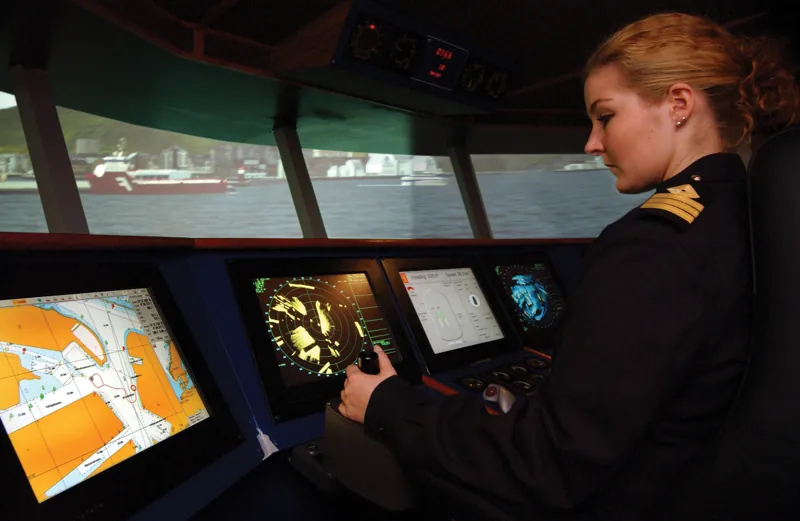
Kongsberg’s reach now extends beyond "moving ships." In March of this year, Kongsberg partnered with US offshore drilling company Seadrill and Hanwha Drilling to develop "Remote DP" technology, which allows for the remote control of a deep-sea drillship's DP system from an onshore control center. The concept aims to control positioning—previously operated by personnel directly on board—via standardized procedures from land, essentially setting the operational standards for the era of autonomous navigation.
Competition is also fierce. Wärtsilä (Finland) and ABB (Switzerland) each supply their own DP and automation systems. However, they are still trailing Kongsberg in brand awareness and service network. Market research data sometimes puts Kongsberg’s market share in the overall DP market at around 20%, but this is because the figure includes general-purpose small vessels. Industry consensus is that Kongsberg’s dominance in the top-tier (DP3) specialty vessel market, such as drillships and crane ships, is overwhelming.
Pioneering Autonomous Navigation Standard Technology
Kongsberg also holds a solid position in the regulatory sphere. As the digitalization of ships accelerates, the International Association of Classification Societies (IACS) has mandated cybersecurity certification for ship control systems through Unified Requirement (UR E27) since July of last year. Partnering with the Norwegian classification society DNV, Kongsberg was the first to complete cybersecurity certification based on International Electrotechnical Commission (IEC) standards for its entire range of automation, navigation, and DP products, including the K-Pos DP system, K-Chief, and K-IMS.
Kongsberg had already received the first cybersecurity type approval from DNV GL for its K-IMS in 2017. By preemptively securing certifications whenever new regulations emerge, the company is solidifying its status as a "standard-defining company."
Given this trend, the domestic shipbuilding industry has few alternatives. While Korea leads the world in hull construction competition, it appears that the current structure—relying on Norwegian technology for the systems that control those hulls—will continue for the time being.